
Electoral 'Tsunami' in France: Is Paris Changing Its Stance Towards the Western Balkans and Kosovo?
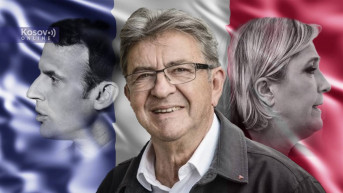
For mathematicians, it's an equation with three unknowns, but for political experts, the recently concluded parliamentary elections are more akin to a weather forecast: France is facing a "politically hot summer." Interviewees from Kosovo Online assess that the new government's composition will determine whether and to what extent France will change its stance towards the Western Balkans, Serbia, and the negotiations between Belgrade and Pristina.
Written by: Arsenije Vuckovic
After the second round of extraordinary parliamentary elections, the French parliament has three dominant parties.
The left-wing coalition around the “New Popular Front” has the most deputies, followed by the coalition around President Emmanuel Macron's party.
Despite receiving the most votes ever, the National Rally led by Marine Le Pen, which was predicted to win the most votes, can be considered the loser of the elections.
Although no party can form a government alone and post-election negotiations will follow, Prime Minister Gabriel Attal announced his resignation immediately after the elections.
"I know that in light of this evening's results, many French people feel a sense of uncertainty about the future, as no absolute majority has emerged. Our country is experiencing an unprecedented political situation and is preparing to welcome the world in a few weeks. Therefore, I will obviously take on my duties as long as necessary," Attal said.
Axioms and Combinatorics
Expert in the history of international relations, historian Stanislav Sretenovic, says that the election results in France are not surprising and that despite no party having a majority, there is a possibility that President Emmanuel Macron's party could form a left-right coalition that would have a majority in parliament.
"In this situation, I see that the Macronist group, which won around 160 seats, could still form a coalition that includes both moderate left and moderate right. These elections have shown that the classic 'Gaullist party' - the Republicans, who won 65 seats, have great coalition potential. If the leftist coalition, which includes extreme leftists like Mélenchon's followers and Communists, were to break up, and if the Socialists and Ecologists separated, they could, along with the Macronist center and this Republican party, form a centrist, moderately left-right coalition that might achieve an absolute majority of 289 out of 577 seats," Sretenovic told Kosovo Online.
He says it is no surprise to him that Marine Le Pen's National Front did not win, explaining this with a French axiom.
"This was one of two possibilities after the first round of the French elections when the National Front came first. It has been shown that the axiom of French internal politics always works in both presidential and parliamentary elections, which is - when the National Front is in first place, the second or third party or a group of parties or all of France comes together to prevent them from winning. This worked again this time," Sretenovic points out.
Similar Situation in the Belgrade-Pristina Dialogue
Sretenovic also highlights a similar situation regarding the dialogue between Belgrade and Pristina.
"France certainly contributes to the dialogue and to finding a solution that will be acceptable to all parties. It is somewhat more lenient in its approach than Germany, which we saw when Kosovo was blocked in the Council of Europe. However, the essential issue of pressuring Serbia to recognize the self-proclaimed independence of its southern province will not change. The French will remain committed to that demand, but they may primarily insist on concrete solutions on the ground, for the benefit of all citizens, both Serbs and Albanians. This very unpleasant demand, which goes against Serbian interests and which Serbia cannot accept, might be pushed to the background," Sretenovic emphasizes.
Forecasts and Misses
On the other hand, French historian and geopolitics professor at the University of Versailles, Alexis Troude, in an interview with Kosovo Online, evaluates the election results as an "extremely important historical moment for France," which will reflect on the previously firm stance towards Serbia and Kosovo.
"Until a few years ago, all major parties, the Socialist Party and especially the right-wing Conservative Party, were strictly pro-Albanian. They had deputies like Olivier Dujon, who previously worked for Kouchner. These people were strictly oriented towards Albanians. We also remember Kouchner, Lévy, leftists... These parties that ruled France for more than 30 years are now very small parties. On the right, the National Rally of Marine Le Pen, and on the left, the New Popular Front of Jean-Luc Mélenchon, are much more oriented towards Serbs. Marine Le Pen has talked with Vucic and Dodik in Paris. Mélenchon's party is strictly pro-Russian, anti-NATO, and very well acquainted with Balkan issues and is very supportive of the Serbs," emphasizes Troude.
Therefore, he does not exclude the possibility of France derecognizing Kosovo.
"I think that for the first time in 25 years, since the NATO bombing, some new leaders will be very strict against recognizing Kosovo," says Troude.
Simultaneously, changes in both domestic and foreign policy in France are to be expected.
"On one hand, the elections prove that there will be some kind of blockage of reforms in France in education, immigration policy, and socio-social or pension policy. On the other hand, I think the election results will unblock and open a new era on the international scene. Whether the government is formed by the National Rally or the New Popular Front, which differ on internal issues, they have the same view towards Russia, China, and the new world order. We can expect a new policy that will give France a better role on the international scene, and I hope it will give Serbia more opportunities to get closer to France," evaluates Troude.
The outcome of these elections, he emphasizes, also signifies the fact that for the first time, the majority parties have lost that status in parliament, which has not happened since the time of Charles de Gaulle.
"No party has reached a majority, which has not happened in France before. Since De Gaulle, in 1958, the majority parties have always won. For the first time, they do not have a majority, and any government the president chooses will have great difficulty governing France," says Troude.
He emphasizes that the election results were a complete surprise and that the institutions responsible for forecasts made errors in their analyses for the first time in the country's history.
"All the polls indicated, especially between the first and second rounds of the elections, that the National Rally, Marine Le Pen's party, would have 200-220 deputies. The actual result is much lower, as they won about 150, which is still very good for them since they doubled their number of deputies. This has never happened before in public opinion research in France, where there was such a significant error in projections," Troude emphasizes.
Five Scenarios
The president of the association "All Serbs in Paris," Sasa Pesic, states that the election results in France have shown the extent of societal division and that there are five scenarios for the formation of the new government, but that France is unlikely to change its policy towards Serbia.
"These parliamentary elections have shown another division in French society. After social and ethnic divisions, we see that France is divided into three blocs. One bloc is led by President Emmanuel Macron, the second is a leftist bloc and coalition of left-wing forces, and the third is the National Rally. The results are somewhat unexpected, knowing that all projections and research indicated that the National Rally would garner the most votes. This is the result of a tacit support between Emmanuel Macron and the Left Center," Pesic told Kosovo Online.
He emphasizes that there are five scenarios for how the new French government could be formed.
"The first scenario is that the Popular Front, which won the most votes despite not having an absolute majority, forms the government. The second scenario is that Emmanuel Macron and his party form a minority government with the support of the Republicans. The third scenario is that Macron, similar to Germany, forms a government with the Republicans and Socialists who are part of the Popular Front but also brought him up as a politician since he was the Minister of Economy in Hollande's government. The fourth scenario is that we have a technical government that would continue the mandate, and the final scenario is that France enters an institutional crisis, potentially leading to new elections in the foreseeable future," Pesic explains.
If Emmanuel Macron's party remains in power, Pesic does not expect a change in policy towards Serbia.
"France will not radically change its policy regarding Serbia. If the National Rally had at least a relative majority, some things might have changed, perhaps not radically and not in the foreseeable future. We know that the National Rally already has a few prominent politicians of Serbian origin, such as Aleksandar Nikolic, Stefan Milosevic, and Andrej Kotarac. Unfortunately, they did not manage to win parliamentary seats in the second round. However, on the left side, we have Mélenchon, who in recent years, particularly in 2018, stated that Kosovo is not a closed issue and that Kosovo is an integral part of Serbia," Pesic points out.



0 comments