
Ethnically motivated incidents against Serbs in Kosovo: Silent persecution before the eyes of the international community
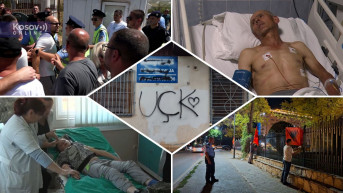
The recent beating of Nenad Raskovic, a Serb from the village of Dren, by Kosovo Police officers is only one case in an excessively long series of ethnically motivated incidents targeting Serbs in Kosovo—nearly 800 have been recorded over the past five and a half years, including as many as 78 since the beginning of this year alone. The targets of individuals, as well as Kosovo institutions, have included the elderly, children, Orthodox churches, and Serbian property. Yet punishments, condemnations by the Pristina authorities and the opposition, as well as concrete reactions from the international community, have largely been absent. Kosovo Online's interlocutors therefore warn that such incidents will not be resolved, as they have not been in the past, given what they describe as Pristina's intention to conceal their true motive in order to portray an alleged rule of law in Kosovo.
Written by: Katarina Saicic
Photographs showing severely beaten Serb Nenad Raskovic lying in a hospital bed circulated throughout the region. He is only one of hundreds of Serbs who have faced various forms of ethnically motivated attacks.
According to records kept by the Office for Kosovo and Metohija, these include attacks on private property and Orthodox religious sites, shootings and physical assaults, detentions, checks and entry bans, inspection orders prohibiting Serbian institutions from operating, the removal and replacement of signs in Serbian with new signs in Albanian, "KLA" graffiti on Serbian community institutions, and the removal of Serbian symbols.
In the case of Nenad Raskovic, two Kosovo Police officers were suspended following a recommendation by the Kosovo Police Inspectorate, while caretaker Minister of Internal Affairs Xhelal Svecla said that the public would be informed of the findings and any measures taken once the investigation was completed. Serb List representatives said that suspension was not enough and that those responsible must be held accountable before the courts.
A day before the attack on Raskovic, KLA and Albanian flags were hung on the fence surrounding Orthodox churches in Lipljan. A little over a month ago, in the presence of the Kosovo Police, workers from the Ibar-Lepenac company demolished the Jezero motel and beach bar at Gazivode, having previously demolished several holiday homes owned by Serbs.
During the Vidovdan commemoration, the Kosovo Police detained 37 people. Following their detention, some worshippers were subjected to physical mistreatment, humiliation, and ethnic insults by Kosovo Police officers.
The list is excessively long. Today, another case should be added to it—the detention of a man suspected of damaging the doors and exterior lighting of the Church of the Holy Savior in Prizren on the night between August 18 and 19 while under the influence of alcohol. The case was referred for regular court proceedings under the criminal classification of "destruction or damage to property."
Albin Kurti's anti-Serbian agenda
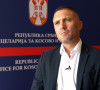
Deputy Director of the Office for Kosovo and Metohija Milos Terzic warned that ethnically motivated attacks against Serbs in Kosovo were part of a broader anti-Serbian agenda pursued by Albin Kurti, with what he described as the tacit support of part of the international community.
Terzic noted that it must always be borne in mind that more than 800 ethnically motivated attacks directed exclusively against Serbs had been recorded since Albin Kurti came to power in Pristina, including attacks against children.
"We always talk about what is currently happening, but we also recall attacks on Serbian children, including the shooting of Serbian children in Gotovusa on Christmas Eve. Everything Serbian has been attacked. What is required for an act to be classified as an ethnically motivated attack is motive, and Albin Kurti's motive is to attack everything Serbian. He has clearly defined objectives in his plans and programs, and those objectives include unifying the two parts of Mitrovica, something that cannot happen on the basis of everything agreed in 2013 and 2015 under the Brussels Agreement and the part concerning the establishment of the Community of Serb-Majority Municipalities," Terzic told Kosovo Online.
He added that another of Albin Kurti's objectives was pan-Albanianism, or the creation of a "Greater Albania."
"The objective is the ethnic cleansing of Kosovo and Metohija, the expulsion of all remaining Serbs living in the southern Serbian province, and the abolition of Serbian as an official language. Accordingly, all these ethnically motivated attacks on the Serbian people and Serbian children are directly connected with Albin Kurti's objectives. The motive is to attack everything Serbian, and that is why we view these acts in this way. Ethnically motivated attacks are, in fact, part of Albin Kurti's broader anti-Serbian agenda, apparently with the tacit support of part of the international community, which we can say is complicit in these processes. This also includes everything that has happened over the past month," Terzic said.
In his view, the intention to open the Ibar Bridge also constituted a major incident and a departure from the Dialogue.
"There is also the beating of Nenad Raskovic. In that case, we can see that certain disciplinary proceedings have been initiated, demonstrating that members of the so-called Kosovo Police terrorized this innocent man. We have seen what they did at Gazivode as well, and the sole objective is an anti-Serbian campaign. It reflects Albin Kurti's anti-Serbian policy of pressuring Serbs into leaving. That is something the Serbian state will never allow. We will also point out to that part of the international community what kind of regime this is, because this regime is creating intolerable living conditions for the Serbian people. In addition to what Kurti is doing, the attitude of international actors—the EU, KFOR, and EULEX—is also important, because if they do not stop what Kurti is doing, we can say nothing other than that they are complicit in this process," Terzic said.
He also noted that representatives of the international community had responded to attacks against Serbs, but only with what he described as sterile and anemic statements.
"The Serbian people in Kosovo and Metohija gain nothing from that. Concrete measures must be taken toward the Provisional Institutions of Self-Government in Pristina and Albin Kurti in order to stop this terror against the Serbian people. Under the leadership of President Aleksandar Vucic, we will, of course, do everything within our power and fight to improve the position of the Serbian people in Kosovo and Metohija. We have been doing so institutionally and materially, and we will continue to do so," Terzic stressed.
Repeated incidents require a serious investigation
Serbia's Protector of Citizens Zoran Pasalic said that repeated incidents in which members of the Serbian community were victims required a serious investigation by all institutions, including an examination of whether there was a pattern of violations of their rights and whether the possible ethnic dimension of such incidents was being adequately recognized and recorded.
In a written response to Kosovo Online, the Protector of Citizens stated that it was important to draw attention to the seriousness of the position of Serbs in Kosovo and the need for every allegation concerning violations of their human rights to be carefully and impartially investigated.
"The Protector of Citizens would not prejudge the nature of each individual incident or confirm a specific number without examining the methodology used to determine it, but neither would the institution downplay the problem. On the contrary, repeated incidents in which members of the Serbian community are victims require a serious investigation by all institutions, including an examination of whether there is a pattern of violations of their rights and whether the possible ethnic dimension of such events is adequately recognized and recorded," the response stated.
It added that the fact that an incident had not been recorded as ethnically motivated did not in itself mean that such a motive could be ruled out.
"It is therefore necessary for the competent authorities, when recording and handling incidents, to consider the possible ethnic dimension of each case and to collect data in an appropriate manner that enables a reliable assessment of the actual situation. More specifically, when an incident is first recorded, it does not have to have already been proven that the motive was ethnic. Objective facts and circumstances that may indicate bias should be recorded—for example, ethnic insults or messages, symbols and graffiti, the selection of the victim, the circumstances and location of the incident, statements made by the perpetrator, as well as the perception of the victim or witnesses. An important element is tracking the case through the system: what the police did, whether the case was forwarded to the prosecution, how it was subsequently classified, and what the outcome was. Particular attention should be paid to how many recorded incidents reach the prosecution and how many are ultimately classified as racist or ethnically motivated offenses," the Protector of Citizens stated.
For that reason, the response added, every individual case must be recorded and documented, while reliable data must enable patterns and the frequency of violations targeting members of a particular ethnic community to be identified.
"The Protector of Citizens has previously drawn the attention of international institutions to the position and protection of the rights of Serbs in Kosovo and Metohija, addressing 106 institutions. This year, the Protector of Citizens informed international institutions and human rights organizations about the events at Gazimestan and allegations of inappropriate treatment of participants in the Vidovdan commemoration. The institution had previously alerted international mechanisms to the position and protection of the rights of Serbs in Kosovo and Metohija. Such action forms part of the Protector of Citizens' continuing priorities, within its mandate, to draw attention to human rights violations and seek an appropriate response from international mechanisms," the response concluded.
Effective investigations needed
The Kosovo Ombudsperson Institution said it was concerned about every form of violence, including ethnically motivated violence, discrimination, intimidation, or other conduct that threatened the rights of members of any community.
In a response to Kosovo Online concerning ethnically motivated incidents against Serbs in Kosovo, the Institution said that all such cases required effective investigations, the determination of responsibility, and appropriate protection for victims regardless of their ethnicity.
"The Ombudsperson Institution does not have a mandate to replace law-enforcement authorities in identifying and classifying criminal offenses. The data available to the Institution relate primarily to complaints and cases submitted to it or initiated within its mandate to protect and promote human rights. The Institution's Annual Report, for example, presents data on complaints received, the ethnicity of complainants, and categories of rights allegedly violated," the Ombudsperson Institution in Pristina stated.
Concealing the motive
Political scientist from Gracanica Ivan Tomic explained that the most important issue in ethnically motivated incidents was how investigations were conducted and how the motive behind attacks was established, given that, in his view, it did not suit the Kosovo Police to portray problems, crimes, or conflicts as interethnic incidents. Instead, he said, they preferred to classify them as ordinary criminal offenses in order to present an idealized picture of conditions on the ground to the international community.
Tomic explained that international frameworks were fairly clear regarding ethnically motivated attacks.
"As far as the OSCE is concerned, for any attack to be characterized as ethnically motivated or as a hate crime, it must meet two criteria. The first is that a criminal offense has been committed, and the second is that the motive for that criminal offense was bias or membership of a particular group. That membership can be defined on linguistic, ethnic, or national grounds. Therefore, we cannot say that the mere occurrence of an incident between a Serb and an Albanian is sufficient for it to be classified as ethnically motivated," Tomic told Kosovo Online.
He added that the problem arose once a criminal offense had occurred and the police took charge of the case, noting that the crucial issue was how the investigation was conducted and how the motive was established.
"Practice shows that the Kosovo Police does not demonstrate sufficient commitment to classifying crimes occurring between Albanians and Serbs in this way. This is probably politically instructed as well, because it does not suit Kosovo for incidents to be presented as interethnic. Instead, they want to present to the international community that everything on the ground is ideal and that such crimes do not exist, so that Albanians can achieve everything they aspire to and everything they want to implement at some point," Tomic said.
On the other hand, he noted, there was also a problem when a crime was reported and a person was questioned in that context.
"That person certainly will not admit that an ethnic motive was the true motive for the attack. Instead, if there is a robbery or any other attack, they seek to classify it merely as an ordinary criminal offense rather than something that may have an ethnic motive," Tomic explained.
He also stressed the importance of considering the problem of intervention by the international community, which, he said, generally acted on the basis of official data and what it could see on paper while remaining "deaf and blind" to events on the ground.
Abuse of institutions
Journalist Milos Garic does not expect cases of ethnically motivated attacks against Serbs in Kosovo to be resolved because they have not been resolved for years, adding that the fact that such incidents do not appear in the official records of the authorities in Pristina is a clear indication of institutional abuse.
In Kosovo today, he said, everything was "lies, falsification, and manipulation."
"This, too, is a clear sign of institutional abuse. The police, the judiciary, and all government bodies that should be doing their jobs are in Albin Kurti's hands and serve his extremist, Greater Albanian, chauvinist policy. So why are we surprised? Of course not a single case of ethnically motivated attacks will be resolved, just as they have not been resolved for years. They wrap all of this in the packaging of democracy and the rule of law, supposedly the best and most advanced in Europe. And they have the support of the German and British embassies in Pristina for this. They support the positions of the Albanians currently in power in Pristina," Garic told Kosovo Online.
He said that Kosovo was characterized by an environment of distorted reality and attempts to portray it, through manipulation and falsehoods, as a highly successful democratic achievement.
"Such an attitude is to be expected from Kurti, but it must not be present among those who bear responsibility and sit in Western centers of power. That is what is dangerous. From the side from which a reaction should come, we are seeing precisely the opposite.
Support is being given to Albin Kurti's policy, which is based entirely on falsehoods and distortion of reality, institutional abuse, and everything else we are witnessing in Kosovo and Metohija," Garic said.
Asked what would be required for the international community to respond more concretely to ethnically motivated incidents, Garic said that, apparently, they were waiting for a major tragedy.
"They are waiting for dramatic events like those of 2004 to happen, and only then for someone to wake up and realize what this has led to. Representatives of influential Western countries intervened in similar ways in Afghanistan, Libya, Iraq, and Egypt. Tragic consequences remained after they left those places. Will something similar happen in Kosovo when they leave, when they decide that it is no longer worthwhile to invest in something that is a completely dysfunctional state? And what will happen then? That is something Albin Kurti and the Albanians should be thinking about," Garic concluded.


0 comments