
Five months after import ban lifted: Serbian goods increasingly in demand in Kosovo
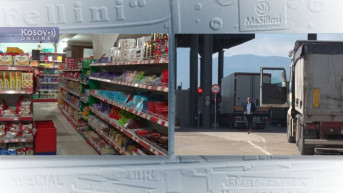
Serbian goods have become more present in the Kosovo market following the partial lifting of the import ban in October last year. In January alone, Serbian companies doubled their exports, surpassing Albania in terms of the total value of goods sold. Economists from Tirana, Pristina, and Belgrade interpret the reasons differently, but they all agree on one thing—economics paves the way for political agreements.
Written by: Arsenije Vuckovic
The latest import statistics from CEFTA member states for 2025, published by Kosovo Customs, show that Serbia has significantly increased its exports to Kosovo, leaving Albania behind.
In January this year, imports from Serbia reached €10.3 million, while imports from Albania stood at only €7.1 million.
According to the Kosovo Statistical Office, total imports from CEFTA countries reached €83.6 million in January, accounting for 17.6% of total imports, marking a 45.1% increase.
The countries with the largest share of imports were North Macedonia (7.7%), Albania (6.2%), and Serbia (3.0%).
The most imported goods included mineral products, processed food, beverages and tobacco, machinery and electrical equipment, and base metals for production.
The import ban was imposed in July 2023 for "security reasons," as stated by Pristina.
It was lifted in October last year, but imports are only allowed through the Merdare crossing.
Trade Flows and Economic Impact
Economic analyst Sasa Djogovic points out that five months after the lifting of Pristina's import measures, Serbian goods are gradually returning to the Kosovo market.
“It is certainly positive that this measure has been removed. This has helped to partially normalize trade flows between Serbia and Kosovo. Kosovo's population has always been accustomed to products from central Serbia, dating back to the Yugoslav era, especially when it comes to confectionery and essential food products. In addition, Serbian products such as mineral fertilizers, agricultural tools, semi-finished goods, and machinery have always been in demand,” Djogovic told Kosovo Online.
He added that the growing demand for Serbian goods in Kosovo highlights the need to open additional border crossings to facilitate smoother trade.
Moreover, he sees potential for further growth in economic relations, which could also ease political tensions between Pristina and Belgrade.
“There are significant opportunities for expanding trade and economic ties between Pristina and Belgrade. Strengthening these ties could help ease political tensions, not only between political elites but also among the general population,” Djogovic emphasized.
He believes that future joint investments, particularly in the energy sector, could further enhance economic cooperation.
“This could create a new business and social environment that improves the quality of life for people in Kosovo and central Serbia, while also generating positive economic effects,” he added.
Djogovic was not surprised that Serbian goods are now more sought after than Albanian ones, attributing this to long-standing business ties between Serbian and Albanian entrepreneurs.
“It is no surprise that Serbia overtook Albania in exports in the first month of this year. Business connections between Kosovo and central Serbia have always existed. These ties were never completely severed, even if they were temporarily halted or slowed, which led to financial losses on both sides. In many cases, Kosovo businesses were forced to buy goods at higher prices than they would have from Serbia,” he explained.
He also noted that better relations between Belgrade and Pristina have a positive ripple effect on the entire region.
“Any improvement in economic relations between Belgrade and Pristina has a positive domino effect on the region. Conversely, any escalation in tensions inevitably spills over into other parts of the Balkans,” he concluded.
Economic "Invasion" from Europe
Agim Shahini, president of the Kosovo Business Alliance, believes that political disputes are the main obstacle to economic progress, not the people themselves.
He warned that the region must unite as soon as possible to counter an impending “economic invasion” from Europe.
“The relationship between Kosovo and Serbia, at the level of the people, is normal. The political relations, however, are another matter. There are still challenges, but gradually, changes will come both in Kosovo and Serbia. It is up to politicians to realize that we need to find a way to move forward together towards the European Union. Small Balkan countries must build economic strength to compete against the increasingly dominant European market,” Shahini told Kosovo Online.
Commenting on the growing presence of Serbian goods in Kosovo, Shahini said that consumers prioritize price and quality over the origin of products.
“Kosovar consumers do not necessarily choose products based on their origin, but rather based on quality and price. Serbian goods, which have already started arriving in Kosovo this year, are reclaiming their place in the market,” he said.
He also cautioned Serbian manufacturers to pay closer attention to consumer demands in Kosovo to restore pre-ban export levels.
“Serbian producers must be more attentive to Kosovar consumers if they want to return to pre-sanction export levels, which once accounted for nearly €500 million in trade between Kosovo and Serbia,” Shahini emphasized.
The Albanian Perspective
Former Albanian Deputy Minister of Agriculture, Alban Zusi, attributed the rise in Serbian exports and the decline in Albanian products to the depreciation of the Albanian lek against the euro, as well as trade tariffs that disadvantage small and medium-sized enterprises.
“The decline in Albanian exports to Kosovo and the weakening position of Albanian products is a direct result of the depreciation of the euro, a trend that has been ongoing for the past two years. Albanian goods, especially food and agricultural products, have become less competitive because their prices have increased by 20-30%. In Albania, production costs are paid in leks, while Kosovo uses the euro, which automatically makes our products less competitive both in Kosovo and in other European markets,” Zusi told Kosovo Online.
The result, he specifies, is the expansion of Serbian goods.
"This has not happened only in Kosovo, as Serbian products have also taken over in Albania in recent years, for the same reason—they have been 20 to 30 percent cheaper than two years ago. I must emphasize that Serbia has a highly stabilized currency in relation to the euro, which makes its products competitive. This is a kind of expansion of Serbian production in two countries where Albanian is predominantly spoken, Albania and Kosovo, and it happened due to the loss of competitiveness of our products, not because Serbian products had any other advantage. We are the ones who are no longer competitive in the market," Zusi explains.
As another major issue, he highlights customs duties, which do not favor small and medium-sized enterprises (SMEs).
"In general, Serbia trades in large volumes and is interested in that. When the volume of goods exceeds tens of thousands of euros, customs costs are relatively low. However, due to the economic structure of business in Albania and Kosovo, where SMEs dominate, trade exchanges are lower in monetary value, making customs transaction costs high," says Zusi.
He explains that a €300–400 customs fee is not a burden when exporting goods worth €50,000, but it becomes noticeable when the export value is around €5,000.
"This still represents a major obstacle for 70 to 80 percent of businesses in both Kosovo and Albania, as the majority of enterprises in these two countries are SMEs. Even if you look at statistical data, there is a significant distortion in the graph showing companies that trade between Albania and Kosovo. There is very intensive trade between large companies, but trade between small and medium enterprises is declining," Zusi emphasizes.
He is convinced that economic ties contribute to easing political relations between countries and expects this to happen.
However, he warns that Kosovo and Serbia have a ‘specific relationship’ with ethnonational weight on both sides.
"There is a possibility that economic exchange may not have the impact it should on political relations. There is another risk—that this intensification of mostly unipolar economic relations, where Serbia exports the most to Kosovo, could affect the national pride of Kosovars and increase a certain form of ‘national aggression’ among Serbs. Increased economic exchange should be a bridge for greater political communication. I truly hope that the latter will happen," Zusi concludes.


comments