
Friendships and calculated alliances lead to new OSCE leadership
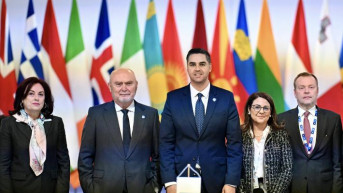
Helga Schmid of Germany has been succeeded as OSCE Secretary-General by Feridun Sinirlioğlu of Turkey after months of negotiations among the organization's member states. The election of a close associate of President Recep Tayyip Erdoğan is largely seen as the result of agreements on two fronts: between the West and Russia, facilitated by the good relations between Erdoğan and Putin, and between Ankara and Athens, with Greece securing the leadership of ODIHR. In this arrangement, Tirana was left empty-handed.
By Dusica Radeka Djordjevic
The regional rivals Turkey and Greece jointly lobbied intensively, both across Europe and in Washington. The appointment of Sinirlioğlu in the 57-member organization, where decisions are made by consensus, was not opposed even by Armenia and Cyprus. Some international media highlighted this with headlines claiming that the Turkish diplomat gained support even from "enemies."
When it became clear that the Turkish-Greek duo would assume the OSCE leadership, Albania withdrew the candidacy of its Foreign Minister, Igli Hasani.
The outcome is as follows: At the OSCE Ministerial Council meeting in Valletta last week, it was decided that Feridun Sinirlioğlu would be appointed Secretary-General, Maria Telalian from Greece would lead the OSCE Office for Democratic Institutions and Human Rights (ODIHR), Dutch diplomat Kristof Kamp would become High Commissioner on National Minorities, and OSCE Representative on Freedom of the Media would be Jan Braathu.
Former Serbian Ambassador to the OSCE Branka Latinovic told Kosovo Online that the election of Sinirlioğlu and Telalian represents an agreement between the Western bloc and Russia, as there had been long-standing disputes over the Secretary-General's position, requiring Russia's approval.
“Although Turkey is a NATO member, I believe that in this case, the good personal relations between Russian President Putin and Turkish President Erdoğan played a decisive role. There may have been some persuasion between them—we don’t know—but this was certainly an important factor that helped secure the election of the Turkish candidate as Secretary-General, who faces significant challenges. Likely, this election also serves as part of an agreement on the OSCE budget, which has been under temporary funding for years, with resources 30-40% below necessary levels,” Latinovic noted.
The election of a Greek representative to head ODIHR, she added, should also be viewed through the lens of Russia’s stance on that role and Greece’s generally good relations with Russia. However, Latinovic pointed out that while Sinirlioğlu and Telalian are experienced diplomats, their backgrounds do not show that they are from the "OSCE family," meaning they have not previously served in the organization during their diplomatic careers.
Regarding comments that the new OSCE leadership signals closer Turkish-Greek relations, Latinovic said this was likely part of the agreement between Turkey and Greece, stemming from their mutual rivalry. Greece probably did not want Turkey to secure such a significant role without also securing a prominent position for itself.
“This is understandable at this critical moment for the OSCE, as it works to overcome its paralysis. However, it is not standard practice to let bilateral rivalries influence appointments within the organization, as this sets a poor precedent,” Latinovic emphasized.
Impact on the Western Balkans
On how the new OSCE appointments will affect the Western Balkans, Latinovic said that the Secretary-General and ODIHR Director do not hold political authority to direct OSCE work in the region. That responsibility lies with the OSCE Permanent Council and its Chairmanship, which will be held by Finland starting January 1.
“The Secretary-General oversees the operations of numerous missions in the region—in Albania, Montenegro, Bosnia and Herzegovina, Serbia, Kosovo, North Macedonia, and beyond—and ensures these missions are well-staffed, adequately funded, and fulfilling their mandates. The ODIHR Director focuses on monitoring electoral processes, ensuring they are conducted effectively, providing timely reports to the Permanent Council, and implementing any recommendations,” Latinovic explained.
Andreja Stojkovski, Executive Director of the “Prespa Institute,” told Kosovo Online that the OSCE’s relevance is greater for the Caucasus and Central Asia than for the Western Balkans.
“We must not forget that the first OSCE field mission, still operational, was established in North Macedonia. In Sarajevo, there is a functional mission with substantial tasks. However, while the OSCE previously focused on issues or principles problematic in the East, these may now become areas of focus in the West,” Stojkovski noted.
Stojkovski also remarked that the appointment of the new leadership ensures the organization’s continued existence and that there should be satisfaction with the new leaders, given the professionalism of Turkish and Greek diplomacy. He emphasized the success of achieving consensus among the member states on key officials.
On what Turkey and Greece can contribute to the Western Balkans through their OSCE roles, Tirana-based analyst Frok Çupi said the outlook is not entirely positive, as neither country has a strong track record in respecting human rights. Greece, he noted, faces significant issues with minorities within its borders.
Political analyst Nexhmedin Spahiu argued that it is understandable why diplomats from Turkey and Greece were chosen for key OSCE positions, as both countries maintain good relations with Russia. The OSCE, he said, remains the only organization connecting Russia and the West.
“Russia is still an OSCE member, and Turkey is a Western power with good relations with Russia. This may explain why a Turkish diplomat was elected as Secretary-General: to sustain the organization and keep it functioning, as it is the only body linking Russia and the West after the complete boycott of Russia by Western countries in other organizations,” Spahiu explained.
Regarding the appointment of Telalian to lead ODIHR, he highlighted that although Greece is part of the West, it maintains close Orthodox ties with Russia.
Why was Hasani rejected?
Igli Hasani, according to Latinovic, has ties to the “OSCE family,” but other criteria prevailed in selecting the Secretary-General. When appointing officials to such high positions in an international organization, considerations include the overall capacity of the candidate's country and its contribution to the organization.
“Albania chaired the OSCE, but it faced the misfortune of doing so during the pandemic, limiting its activities. Circumstances prevented it from achieving more, despite Prime Minister Rama’s ambitious opening speech. Additionally, Albania only joined the OSCE in 1991 and was not among the original signatories of the Helsinki Final Act,” Latinovic said.
Çupi believes that Albania’s Foreign Minister was not elected as OSCE Secretary-General because Greece has, in recent years, consistently sought to block Albania from holding high positions in such international organizations.
“This didn’t happen because Albania’s Foreign Minister is an unknown figure—on the contrary, he has a background in human rights and the OSCE. The problem here is Greece,” Çupi told Kosovo Online.
He states that it currently seems the issues between Albania and Greece are not very significant and that the situation is not very tense, with both governments being careful not to escalate sharp disputes.
“However, Greece is determined to obstruct Albania on its path to European integration. This is a threat to the Western Balkans originating from outside the region. Greece behaves this way because, in recent years, it has lost its leading role in the Balkans, which has created a sense of inferiority compared to other Balkan countries that are not EU members, such as Albania, Serbia, or Montenegro, but are getting closer to joining the Union. This has influenced the elections within the OSCE,” Çupi believes.
Commenting on Albania’s failure to secure the OSCE leadership, Stojkovski pointed out that not everyone can become the OSCE Secretary-General, and when discussing the selection process, it is important to recognize that this organization has 57 participating countries.
Due to this outcome, Spahiu believes that Tirana is not disappointed, as he assesses that Albania was not particularly interested in the position.
“They put themselves forward, but when they saw the agreement surrounding the selected team, they withdrew,” Spahiu said.



0 comments