
"Fruits of progress" for Serbs in Kosovo - number of ethnically motivated attacks on the rise
"Belgrade is lying that Kosovo is carrying out ethnic cleansing or pogroms against the Serbian population; the danger comes from Serbia," said Kosovo's Prime Minister Albin Kurti recently. However, his statement is contradicted by the fact that there have been 68 ethnically motivated attacks on Serbs since the beginning of the year. Interviewees from Kosovo Online believe that the rhetoric of the authorities in Pristina about the "prosperity" of Serbs is not surprising, but the reality is different – the lives of Serbs have become complicated in recent years, and they are very dissatisfied with the conditions in which they live.
Written by: Milena Miladinovic
During the meeting of the Committee for Europe within the Socialist International in Bucharest, Kurti said that "the Government of Kosovo has ensured that all citizens, including the Serbian community, enjoy the fruits of progress."
"This progress is precisely what angers Belgrade so much," Kurti stated.
The "fruits of progress" regarding the Serbian community in Kosovo are best seen in the increasing number of ethnically motivated attacks on them. On average, one attack has occurred every three days since the beginning of this year.
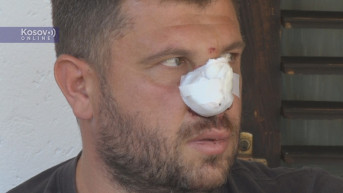
The most recent attack was on July 5th when, in the village of Donja Brnjica near Pristina, an Albanian neighbor attacked Serb Mladen Djosic in a market in the presence of a minor child. Although Djosic sustained visible injuries to his head and called the Kosovo Police hoping for protection, both he and his father were the ones detained.
In addition to physical and direct attacks, private property of Serbs is often targeted by Albanians, with land seizures, break-ins, and thefts of homes becoming "normal occurrences," and even the property of the Serbian Orthodox Church (SPC) is not protected from extremist attacks.
In the returnee village of Ljubozda in the Istok municipality, family homes of Zarko Zaric and Radovan Ristic, as well as the households of Marinko Blagojevic and Tomislav Radivojevic, were broken into and robbed. The home of Miodrag Kostic from Plemetina, as well as the homes of Bozidar Vanic and Ranko and SrDjan Milicevic in Donja Brnjica, were also targeted. A group of Albanians beat and robbed twenty-year-old Petar Kostic in a parking lot in Kosovska Mitrovica. In the ETC market in Gracanica, Damnjan Sabic from Novo Badovce was attacked while at work.
An Albanian from Suva Reka fired several shots from a firearm in the village of Donja Bitinja in the Strpce municipality, placing a funeral wreath on the wall of Svetislav Stojkovic's house. In the village of Zupce, in the Zubin Potok municipality, the Church of the Holy Fathers, which has been targeted multiple times, was broken into and robbed. The foundations of the Serbian monastery of the Mother of God in Hvostane in Studenica were fenced off, with a sign in Albanian labeling it as a basilica. A group of Albanian youths stoned the "November 21" elementary school in Gojbulja, and hand grenades were thrown into the yards of several Serbian families... These are some of the 68 recorded examples of ethnically motivated attacks since the beginning of this year.
Our interviewees believe that the number would be even higher, but some Serbs, out of fear or aware that law enforcement will not help them, choose not to report the incidents.
Significant Increase in Attacks on Serbs
The Office for Kosovo and Metohija stated that the increased number of ethnically motivated attacks is a clear indicator that the regime led by Kurti is spreading hatred towards Serbs in the public.
Igor Popovic, Assistant Director of the Office for Kosovo and Metohija in the sector for legal protection, support to local self-government, and property-legal affairs, told Kosovo Online that such attacks are not treated as ethnically motivated by the Kosovo judicial authorities but rather as incidents.
"Last year, there were 179 attacks, and in 2022, there were 150, which is a clear indicator that the regime led by Kurti is spreading hatred towards Serbs in the public. Serbs are blamed for all their difficulties, their unemployment, lack of investment, and massive emigration to the West... Serbs are blamed for all of this. It is expected that the Albanian population, thanks to this media campaign, blames Serbs for everything, and that attacks on Serbian and non-Albanian populations are increasing. Compared to previous decades, in recent years, this is a significant number of attacks. These include physical altercations, attacks, assaults, thefts, provocations, attacks on churches, thefts, property damage, and destruction of houses," Popovic added.
According to him, the Serbian population in Kosovo is facing security threats, and the attacks on them send a clear message.
"That in Kosovo and Metohija, there is room only for Albanians, for an ethnically clean space, and that any presence of Serbs, whether cemeteries, their property, or simply hearing their language in public, will be subjected to attack. This is entirely clear," said Popovic.
Despite the fact that Serbs report the attacks, Popovic emphasizes that they are not treated as ethnically motivated but as ordinary incidents, and thus they are not prioritized for prosecution.
"We do not have data that any of the attackers have been punished, sentenced to prison, fined, or convicted in any way. Simply, these records do not exist, they do not disclose them, according to their interpretation, Serbs and non-Albanians are protected in Kosovo, and that framework is excellent for non-Albanian communities, which is evidently untrue," Popovic emphasized.
It is not surprising, claims Popovic, that the number of attacks is increasing because the judicial institutions do not treat cases of attacks on Serbs.
"They do not treat Serbian and non-Albanian victims or the attacks on them. There are also other cases where people are subjected to physical attacks, for example, in Pomoravlje, in those mixed areas, Mogila, Klokot, where people are simply attacked, and the attackers file criminal charges against them, claiming they were threatened. So, with such a judicial framework of the provisional self-government institutions, it is not surprising that the attacks are increasing, because there is no punishment," concluded Popovic.
A Different Truth
Ivan Nikolic, Director of the NGO "Communication for Social Development" (CSD) from Gracanica, says that the statements by Kosovo’s Prime Minister Albin Kurti about the "comfortable life" of Serbs in Kosovo are not surprising, as this was his rhetoric during the election campaign, and it has continued since he came to power.
However, Nikolic adds, the truth is different – Serbs are not satisfied with the conditions in which they live.
"It is not surprising to receive such messages from Prime Minister Kurti; this is his pattern, the way he conducts politics, the rhetoric he used in the election campaign, and continues to use now," Nikolic told Kosovo Online.
He adds that the figure of 68 ethnically motivated attacks since the beginning of this year should not be ignored and that, in light of such statistics, it is irresponsible for Kurti to speak of the well-being of the Serbian community in Kosovo.
Furthermore, the number of Serbs who have left Kosovo since Kurti came to power supports the notion that they are dissatisfied with the conditions created in recent years.
"What needs to be said is that this is not true. According to some data, there have been more than 60 ethnically motivated attacks; this information should not be ignored; it is a very serious number. It is irresponsible for someone in such a position to comment in such a way, claiming that the Serbian community lives in prosperity. The Serbian community is confused in this whole process, they feel insecure, and the trend of migration, that is, the increasing and more frequent departure of Serbs from Kosovo, supports the notion that they are not satisfied with the quality of their life in Kosovo," emphasized Nikolic.
He stated that the distorted public perception of the life of Serbs in Kosovo is also due to Albanian media, which do not give any significance or space to the problems of Serbs and the attacks on them.
"We also have Albanian media that do not devote even a fraction of space to such ethnically motivated attacks, and this creates a completely distorted picture of the real situation in Kosovo," said Nikolic.
"We also have Albanian media that do not devote even a fraction of space to such ethnically motivated attacks, and this creates a completely distorted picture of the real situation in Kosovo," said Nikolic.
Serbs do not believe that anyone will solve their problems in Kosovo, which is why many of them give up on resolving these issues through the authorities, Nikolic believes.
"There are many such examples where people do not report attacks because they do not believe that their problem will be solved, and if such a situation becomes known, they could be even more endangered. So, it is not uncommon for Serbs to remain silent about less dangerous but still ethnically motivated situations," concluded Nikolic.
Destroyed Systems of Protection for Serbs
Aleksandar Rapajic, Program Director of the NGO Center for Advocacy of Democratic Culture from North Mitrovica, stated that the life of Serbs in Kosovo has become very complicated in the past few years and that all systems of protection for Serbs have been destroyed.
Rapajic told Kosovo Online that while Kosovo’s Prime Minister Albin Kurti claims that Serbs in Kosovo "enjoy the benefits of the work of the Government of Kosovo," the authorities in Pristina are doing everything to destroy every protection system for Serbs.
He added that Pristina’s goal is to sever all forms of communication between Serbs and Belgrade.
"In addition to Prime Minister Kurti's statements that Serbs in Kosovo enjoy the benefits of the government’s work, we can see that the life of Serbs has become so complicated in recent years. All those benefits that existed and protection systems have been practically destroyed. Everything is being done to prevent any connections between Kosovo Serbs and central Serbia, with Belgrade," said Rapajic.
He added that there are numerous examples of how mechanisms for improving the lives of Serbs are being destroyed, such as their inability to withdraw payments from Serbia and the lack of protection within the Kosovo Police.
"The protective mechanisms that existed for a better life for Serbs in Kosovo have been destroyed. Serbs have an obligatory minister in the government who is supposed to represent the Serbian community, but he is now actually chosen by the government. We used to have protection within the police, now we don't have that. We cannot pay in dinars, it is impossible to receive dinars from central Serbia... So, there are many examples where the life of Serbs has become more complicated, not easier," concluded Rapajic.
Theory and Practice
Aleksandar Gudzic, an analyst from Gracanica, emphasized that the increasingly frequent ethnically motivated attacks on Serbs in Kosovo are the result of the inflammatory rhetoric conducted by the Kosovo government in recent years, as well as the narrative over the past 25 years that "Serbs are to blame for everything."
As he pointed out, life and politics in Kosovo can be divided into two parts.
"We can divide the political scene and life in Kosovo into two parts. One is theory, the other is practice. In theory, Kosovo has excellent democratic laws, but they are not applied in practice," said Gudzic.
He emphasized that the Serbian Orthodox Church (SPC) and Serbian property are often targeted by Albanian extremists.
"Attacks on Serbs have mostly not been resolved to this day. Kosovo is perhaps the only area in the world where private property is not sacred. Only in Kosovo is it possible for someone to usurp someone else's property and not face consequences. There are countless examples where Kosovo Albanians have falsified documents and appropriated Serbian property. Even today, there are many Serbs who are fighting in Kosovo and international institutions to prove ownership of their property," Gudzic added.
He noted that the figure of 68 ethnically motivated attacks on Serbs since the beginning of the year is not surprising, given the inflammatory rhetoric from Pristina and the Kosovo government’s Prime Minister Albin Kurti. However, he added, such a narrative could be heard in Kosovo even before Kurti came to power, in the past 25 years.
The history textbook for elementary school children, Gudzic pointed out, is a true example of the prevailing sentiment among Kosovo Albanians regarding Serbs.
"As for the attacks on Serbs, they are a byproduct and result of the extreme rhetoric led by Albin Kurti in recent years, as well as a narrative that has been built in Kosovo over the past 25 years, blaming Serbs exclusively for everything that happened in the 1990s. The best example of this narrative and how it leads to ruin is the fact that their history textbook begins with a picture of Adem Jashari, and the first lesson is the Racak massacre and everything that happened in the 1990s. Everything is portrayed in black and white, with Serbs being blamed for everything. Of course, this does not correspond to the truth, because, as with love, it takes two or more parties for war, and in this case, it is a triangle of the international community, Kosovo Serbs, and Kosovo Albanians. This is why ethnically motivated attacks on Serbs continue," said Gudzic.
He emphasized that there are cases where Serbs do not want to report ethnic attacks for two reasons. The first is fear, and the second is because they are aware that the case will not be resolved.
"Some Serbs decide to report, and I know of some cases where they did not decide to report violence. Probably out of fear, or because they do not want to further deepen these misunderstandings, they probably think that if they withdraw, all of this will stop," concluded Gudzic.


0 comments