
Gambling becoming an increasingly serious problem across the region, addicts growing younger
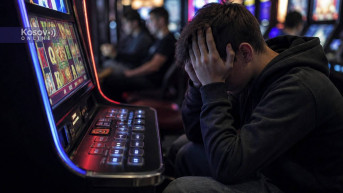
Gambling is becoming an increasingly prominent social problem, while gambling addicts are getting younger. Whereas betting shops were predominantly frequented by middle-aged men some twenty years ago, today’s gamblers are increasingly teenagers who circumvent legal restrictions through the use of a growing number of online betting platforms that are heavily promoted in the media, experts from Belgrade, Tirana, and Skopje told Kosovo Online. On Kosovo, gambling was banned in 2019 following the murders of two young men in gambling establishments in Lipljan and Suva Reka and amid public pressure over rising crime.
Written by: Darko Savanovic
According to Kosovo Online’s interlocutors, an even greater problem than the large number of casinos and betting shops is the proliferation of illegal betting operations and the growing misuse of online gambling, which is virtually impossible to control effectively.
Betting activity increases significantly during World Cups and other major sporting events, attracting even those who do not normally gamble.
Serbia and North Macedonia have laws regulating gambling that, at least on paper, are intended to prevent minors from gambling. However, neither country has a comprehensive national strategy encompassing prevention, youth education, public awareness campaigns, early identification of risky behavior, and accessible psychological support.
Young People Already Burdened by Serious Loan-Shark Debts
Psychotherapist Jelena Manojlovic from the Belgrade-based SOS Center for Gambling Addiction Prevention and Treatment stated that the center’s clients are becoming increasingly younger and assessed that the greatest challenge lies in the large number of illegal betting outlets and the growing abuse of online gambling.
“As a therapist who has been working in gambling addiction treatment for 18 years, we have certainly noticed that, regardless of whether there is a World Cup taking place or not, our clients are becoming younger every year. At present, our treatment program includes young people aged 18 to 21 who are already deeply in debt to loan sharks and facing serious gambling-related problems,” Manojlovic told Kosovo Online.
Speaking about gambling regulations, she noted that Serbia has an Association of Gambling Operators that oversees betting shops but emphasized that the problem lies in the existence of numerous illegal betting operations and the increasing abuse of online gambling.
“That is the biggest problem and the area where control is most difficult, because anyone who is underage can take an ID card from a parent, grandparent, or relative and create an account with virtually any betting operator. So even when authorities try to address the consequences or improve regulation, they cannot fully resolve the issue because young people are resourceful. Moreover, the illegal market is large and highly popular,” Manojlovic explained.
According to her, Serbian law prohibits persons under the age of 18 from entering betting shops and requires such establishments to be located at least 200 meters away from schools.
“They generally comply with these rules to some extent, but if children know an employee at the betting shop, they find ways to get in. Alternatively, they wait outside for an adult customer and ask them to place a bet on their behalf. However, this is a smaller issue compared to online betting. Today it is available everywhere; people no longer need to be physically present in betting shops—they can simply log in from the comfort of their homes,” Manojlovic pointed out.
She added that, unlike in the past, gambling is now increasingly recognized as an addiction disorder, and parents are becoming aware that treatment is necessary, bringing their children to rehabilitation programs and offering support.
“Awareness of gambling as a serious problem is growing. When I first started, betting and gambling were not treated as addiction disorders but rather as a form of recklessness, arrogance, or irresponsible behavior. Today, people recognize that there is a real problem requiring professional treatment, and families increasingly understand this and bring their children for rehabilitation,” said psychologist and psychotherapist Jelena Manojlovic.
Gambling Addiction Is More Than a Bad Habit
Psychologist and psychotherapist Nataša Ivanovska from Skopje warned that gambling is becoming an increasingly serious social issue in North Macedonia and expressed concern over the growing number of young people engaging in gambling.
According to Ivanovska, gambling advertising is widespread, access is easy, and online platforms are much more difficult to regulate, creating the impression that the state demonstrates a degree of tolerance toward the gambling industry at the expense of public health.
She stressed that this increases the risk of addiction, financial instability for individuals and entire families, problematic interpersonal relationships, and psychological consequences such as anxiety and depressive behavior.
“I would particularly highlight the impact on young and vulnerable groups, who are especially susceptible to easy access and aggressive marketing campaigns that encourage participation in gambling. From that perspective, gambling addiction is not merely a bad habit, as many people tend to perceive it, but a serious condition affecting emotions, impulse control, and overall functioning. That is why a comprehensive and systematic approach is urgently needed,” Ivanovska told Kosovo Online.
She also noted that betting shops become crowded during major sporting events, including the ongoing world football championship, due to a combination of factors. In such an atmosphere, betting is often perceived as part of a shared social experience and a way of becoming more involved in the event itself.
According to Ivanovska, gambling in North Macedonia is regulated by the Law on Games of Chance and Entertainment Games, which includes licensing requirements, age restrictions, responsible gambling measures, and taxation. Nevertheless, she emphasized that the country lacks a comprehensive national strategy encompassing prevention, youth education, public awareness, early detection of risky behavior, and accessible psychological support.
Blagorodna Koceva Simjanov, Executive Director of the Skopje-based association HOPS – Healthy Life Options, agreed that the World Cup acts as a catalyst that intensifies gambling addiction. She noted that betting shops serve as social gathering places where watching matches is inseparably linked to a “betting culture.”
According to her, the problem in North Macedonia is exacerbated by the fact that, unlike many European countries, there are still no restrictions on gambling advertisements during sports broadcasts, allowing operators to remain present around the clock “in the pocket of every young person.”
She also pointed out that North Macedonia lacks a comprehensive national strategy for addressing gambling addiction, despite initial legislative measures such as the 2024 amendments to the Law on Games of Chance, which introduced a mandatory distance of 500 meters between gambling venues and schools.
Gambling Has Destroyed Many Families in Albania
Former Director of the Albanian State Police, Lieutenant Colonel Fation Softa, stated that many Albanian families have been destroyed by gambling and that this was one of the reasons why the government sought to ban betting. He also noted that increasing numbers of young people in Albania are gambling.
“In Albania, many families have been ruined by gambling and by people trying to recover money they had lost. These financial losses have led to drama and tragedy, as individuals accumulated debt and destroyed their families. That was one of the reasons Albania attempted to ban betting. We are talking about sports betting, which was state-regulated, and by prohibiting it Albania suffered financial losses because the money now circulates outside the banking system, often through activities exploited by criminal groups,” Softa told Kosovo Online.
According to him, gambling is a vice that affects people regardless of age, and more and more young Albanians are placing bets in the hope of earning money, building capital, or simply having fun.
“This makes the situation even more tragic because financial hardship and the desire for quick money drive young people into gambling and create family problems. There have been cases where families could not cope financially and even ended up selling their homes,” Softa said.
He added that young people sometimes become involved in criminal activities, including drug trafficking, in order to obtain money for gambling.
“Because of the need for money or the desire to recover losses, gambling addiction develops,” Softa concluded.
He also recalled that gambling-related abuses in Albania have led to political controversies.
“It began with Ervis Martinaj, the so-called ‘King of Gambling,’ who disappeared several years ago and is presumed dead, and continued through operations conducted by the Ministry of the Interior that resulted in the seizure of gambling facilities. Equipment was confiscated, but servers were not found due to the sophistication of the operations and the fact that those involved kept the servers elsewhere, beyond the reach of surveillance cameras,” Softa said.
Gambling Banned on Kosovo Since 2019
Gambling on Kosovo was legally and officially banned in March 2019, when the Assembly of Kosovo adopted the Law on the Prohibition of Games of Chance, which entered into force in May of the same year. The immediate trigger for the measure was the murder of two young men in gambling establishments in Lipljan and Suva Reka, combined with public pressure over rising crime rates.
The law initially envisaged the closure of all betting shops and casinos on Kosovo for a period of ten years. However, the final version did not specify a time limit, meaning the ban remains in force until the Assembly adopts new legislation to replace it.
Following the adoption of the law, the Kosovo Lottery found itself in a legal vacuum and ceased operations entirely, leaving its employees without jobs. The issue remains unresolved to this day.
Then-Prime Minister Ramush Haradinaj presented the draft law to parliament, where it was adopted under an expedited procedure. The decisive factors behind this radical move were the two murders that occurred in gambling establishments within only a few days of each other in March 2019.

0 comments