
Hanrahan in Belgrade and Pristina: A signal of renewed U.S. Diplomatic engagement in the region
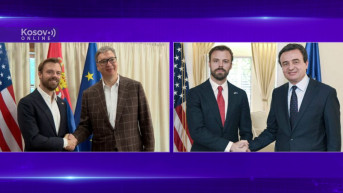
The messages from Washington delivered by Brendan Hanrahan, a senior official at the U.S. State Department’s Bureau of European and Eurasian Affairs, to officials in Belgrade and Pristina have so far remained behind closed doors. However, according to analysts, his visit to the region demonstrates that the United States continues its strategic engagement in the Western Balkans. Hanrahan is believed to have “warmed up the ground,” paving the way for future visits.
Written by: Dusica Radeka Djordjevic
Hanrahan arrived in Belgrade from Sarajevo, where, according to a statement from the BiH Presidency, he reiterated that the U.S. remains a strong and committed partner to Bosnia and Herzegovina and is continuing to strengthen bilateral relations based on peace, stability, and shared economic goals and prosperity.
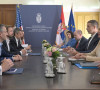
The Trump administration official held talks in Belgrade with Serbian President Aleksandar Vucic and Foreign Minister Marko Djuric.
“We particularly focused on the strategic partnership between Serbia and the U.S. and the development of cooperation in all areas—from energy to artificial intelligence—emphasizing that productive economic cooperation should form the foundation of our bilateral relations. I underscored that Serbia remains firmly committed to preserving peace and stability, to dialogue as the only path to resolving outstanding issues, and to respect for international law,” Vucic said after meeting with Hanrahan.
“The relations between Serbia and the U.S., which already feel like a breath of fresh air, have a promising future,” Foreign Minister Djuric expressed during his meeting with the U.S. official.
Djuric briefed him on the situation in Kosovo and expressed serious concern over the ongoing provocations, intimidation, and violent actions by Pristina. He stressed that such actions severely undermine the continuation of the dialogue and added that stronger international pressure on Pristina is needed to prevent escalation and create conditions for continued talks.
After Belgrade, Hanrahan arrived in Pristina, where an unusual venue was chosen for his meeting with acting Prime Minister Albin Kurti—at the residence of the U.S. Ambassador.
According to a statement from Kurti’s office, the discussions focused on current political developments, regional cooperation and relations with Serbia, Kosovo–U.S. relations—including investments, diplomacy, and defense—as well as Kosovo’s progress on its Euro-Atlantic path. Kurti affirmed that Kosovo would always be a reliable partner to the United States.
In Pristina, Hanrahan also met with KFOR Commander Enrico Barduani, who briefed him on the security situation in Kosovo and the wider region. It was also announced that the U.S. official would meet with opposition representatives—Democratic Party of Kosovo leader Memli Krasniqi and Democratic League of Kosovo official Hykmete Bajrami.
According to Petar Donic of the New Third Way, Hanrahan’s visit to Sarajevo, Belgrade, and Pristina can be seen as a preparatory step for a potentially higher-level visit from the U.S. Given Hanrahan’s background, Donic believes the Trump administration is continuing the policy of emphasizing economic diplomacy from its previous term.
He recalls that Hanrahan previously worked on economic issues with U.S. Secretary of State Marco Rubio during Rubio’s time in the Senate.
“This is a mild influence of people with private-sector experience entering government. He has now visited what are essentially hotspots in the Balkans—Bosnia and Herzegovina, with its situation between the Republic of Srpska and the Federation; Serbia; and Kosovo. It’s a risk-mitigation strategy, so even if nothing follows, red flags haven’t been raised. They’ve sent lower-level officials to prepare the ground,” Donic told Kosovo Online.
He explained that the State Department’s method involves first sending a series of diplomats or State Department officials who are not at the highest level to prepare the ground, “warm it up,” talk with key stakeholders, and then prepare for a higher-level visit based on those insights.
Donic believes it is highly likely that Hanrahan conveyed specific messages from Washington regarding the dialogue, even though the U.S. side has not released an official statement.
“Previously, it was said that this region was not a focus for the Trump administration due to other significant geopolitical hotspots. Yet, over the past month, we’ve seen Trump mention Serbia and Kosovo multiple times, and there was a meeting in Washington between the Secretary of State and our ambassador. Now we’ve had this visit, which suggests something is being prepared, though we still don’t know what. Moreover, a new U.S. ambassador to Belgrade—who is considered favorable to Serbia—is expected, though he hasn’t formally assumed his post yet. All of this could indicate a revitalization of more significant diplomatic and political activity between the U.S. and Serbia. But Americans approach these matters thoroughly and gradually. So, this was likely the first layer of talks,” Donic said.
This diplomatic revitalization, he adds, also applies to Pristina, as from the U.S. perspective, these are “connected vessels.”
“If they want to stabilize and resolve a situation that the European Union has, from their point of view, handled slowly and ineffectively, they will certainly want to address all interconnected issues—Kosovo and Serbia, Serbia and Bosnia, and the broader region as a whole,” Donic pointed out.
Political analyst Dorajet Imeri sees Hanrahan’s visit to Kosovo as proof of the U.S.’ continued strategic involvement in the region, aimed at maintaining its long-term goals in the Western Balkans.
“Despite the difficulties Kosovo is facing in forming its institutions, the U.S. continues to act according to its strategy in the region. They regularly send diplomats to promote their agenda. It’s clear that the U.S. needs a reliable partner in Kosovo, and for that reason, the new government must emerge from a functional majority in the Assembly. An unconstituted Assembly and a caretaker government cannot function at full capacity,” Imeri told Kosovo Press.
However, he also highlighted that the absence of a U.S. ambassador in Kosovo—and in the region more broadly—could signal a lack of active interest from the U.S. under the current circumstances.
“This reflects the policy of the current administration, which can be interpreted as a more withdrawn approach toward the Western Balkans. The delay in appointments is a signal of pessimism—that the U.S. may no longer see our region as a priority,” Imeri stated.
Democratic League of Kosovo MP Armend Zemaj said the visit of the high-ranking U.S. official demonstrates that, despite a packed global agenda, the U.S. still maintains an interest in Kosovo.
However, he too finds the delay in appointing a new U.S. ambassador to Kosovo troubling.
“We haven’t had a U.S. ambassador in the country for some time, which is concerning for me and for the LDK. The lack of representation at that level could be interpreted as a message to the government and political class that interest in the partnership must be mutual, not one-sided,” Zemaj said.
He also believes that Kosovo’s political deadlock has drawn the attention of the U.S., which could help in resolving the current political stalemate.


0 comments