
KFOR troop reduction: A sign of improved security or new questions for the Serbian Community?
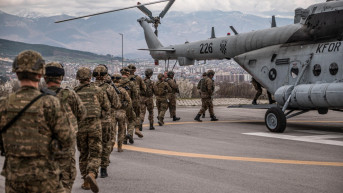
The United States has announced a reduction in the number of its troops serving in the KFOR mission, and analysts interviewed by Kosovo Online assess that the move represents a significant step forward in terms of Washington's perception of the region and reflects an improved security environment. However, opinions remain divided regarding the implications of this decision for the Serbian community in Kosovo. While some argue that there is no longer any threat to the community, others warn that transferring part of KFOR's responsibilities to the Kosovo Security Force (KSF) could increase pressure on Kosovo Serbs.
Written by: Jelena Novakov
NATO Supreme Allied Commander Europe spokesperson Martin O'Donnell stated that NATO has no plans to withdraw from Kosovo and that the gradual reduction of KFOR's presence is not a matter of troop numbers but rather of mission optimization and maintaining security throughout the region.
According to officials from the U.S. European Command, the decision to reduce troop numbers is based on an annual assessment conducted by the Supreme Headquarters Allied Powers Europe (SHAPE), which recommended adjusting the force posture on the ground.
The U.S. European Command also announced that the American contribution to KFOR would be adjusted gradually and in accordance with risk assessments. Former U.S. Ambassador to NATO Douglas Lute stressed that KFOR remains a strong multinational force in which the balance between American and European contributions is essential to the mission's effective functioning.
NATO Secretary General Mark Rutte estimated that troop levels would return to those in place before 2023, decreasing from approximately 4,700 to between 3,000 and 3,500 personnel. His Deputy, Radmila Shekerinska, emphasized that NATO's commitment to security in Kosovo remains unwavering and that, in the long term, security issues can only be resolved through dialogue between Belgrade and Pristina.
At the same time, the Swiss Senate approved an increase in the size of its contingent, while other countries, including Ireland, the United Kingdom, and Germany, have also reaffirmed their commitment to the KFOR mission.
The United States and the Region
Petar Ivic, an associate of the Pupin Initiative, told Kosovo Online that the reduction in KFOR personnel reflects a broader continental trend from the U.S. perspective, but warned that the decision could prove to be a double-edged sword because part of KFOR's responsibilities may be transferred to the Kosovo Security Force.
Ivic explained that the administration in Washington has decided to reduce its military presence in Europe because it no longer considers Russia to be a major conventional military threat.
"Following Russia's less-than-successful military campaign in Ukraine, the United States now views Russia as a second-tier conventional military power. Nevertheless, Russia still possesses significant nuclear capabilities. Even so, the United States is reducing the number of its deployed troops, as well as its military equipment and assets, across the European continent," Ivic said, adding that KFOR is part of this broader trend.
He further noted that the current U.S. administration is generally shifting its strategic focus toward the Indo-Pacific while expecting Europe to assume greater responsibility for its own defense and security.
He also pointed out that Washington now views Serbia and the wider region more positively, considering Serbia a stabilizing factor, which, in his view, has contributed to the announcement of a reduction in KFOR troop levels.
"On the one hand, this is a positive development because it changes the narrative of the 1990s, when the region was viewed as inherently unstable and Serbia as the principal aggressor and source of instability," Ivic emphasized.
However, he cautioned that the withdrawal of part of the force could also prove to be a double-edged sword, as it would mean that some responsibility for maintaining security in Kosovo would be transferred to the Kosovo Security Force.
"That is one of the potential unintended consequences. We know that the KSF is not particularly well-disposed toward the Serbian community and that it has created numerous problems. However, this is an issue that will ultimately have to be resolved through dialogue, and I believe it will become increasingly pressing as KFOR's personnel numbers continue to decline," Ivic concluded.
A More Stable Situation
Political analyst Nexhmedin Spahiu told Kosovo Online that the reduction in KFOR personnel is good news because it indicates that the security situation in Kosovo has improved, adding that, in his opinion, there is no longer any threat to the Serbian community.
"This is good news. It means the situation is better and more secure. NATO has most likely assessed that there is no threat. That is certainly positive news," Spahiu said.
He added that the development is only negative for those who regard KFOR's presence as that of "permanent tourists in Kosovo."
In his assessment, the overall situation in Kosovo has improved, while future developments will primarily depend on internal political issues, particularly the ongoing disputes among political actors.
"However, these disputes are nowhere near the level that could lead to a civil war in Kosovo. The only external threat Kosovo faces would be an attack by the Serbian army, and NATO has probably assessed that such a scenario is unlikely, which is why it is reducing troop numbers," Spahiu said.
Speaking specifically about the Serbian community, he maintained that it is no longer exposed to any significant security threat.
"There is no longer any danger to the Serbian community in Kosovo unless a war were to break out between Serbia and Kosovo, and in such a war everyone would face danger," Spahiu said, adding that integration and legal issues remain the key challenges that need to be addressed.


0 comments