
Kosovo and the temporary suspension of U.S. donations – Who is affected?
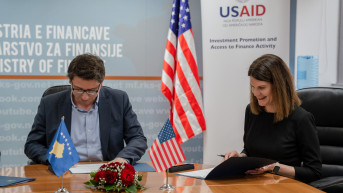
The temporary freeze on foreign aid, among the first foreign policy actions by U.S. President Donald Trump, will also affect Kosovo. According to data from the U.S. government's "Foreign Aid" website, $70.3 million was allocated for Kosovo during the year 2023. According to a Kosovo Online interlocutor, the suspension of donations will primarily impact projects implemented through the USAID agency, which is associated with 10,000 jobs in Kosovo over the past five years.
Written by: Dusica Radeka Djordjevic
The Trump administration has ordered a three-month pause on almost all foreign developmental aid to conduct a review to ascertain if there are cases of fraud, unwarranted spending, and abuse, and also to see what aligns with the president's "America First" policy.
In the fiscal year 2023, as reported by Voice of America, the USA spent just under $70 billion on developmental aid, most of it through the United States Agency for International Development - USAID.
A significant portion of the aid to Kosovo comes specifically through this agency, which, as stated on their website, has dedicated more than a billion dollars since 1999 to foster economic growth and democratic development in Kosovo.
For the year 2024, data on the "Foreign Aid" website are not yet complete, but based on available information for 2023, the amount of $70.3 million in aid for Kosovo was intended to enhance energy security, security sector reform, education, infrastructure, the civil sector, improving transparency and accountability in municipal procurement processes across all 38 municipalities...
The decision to suspend most American grants for 90 days, according to Agim Shahini, president of the Kosovo Business Alliance, will significantly negatively affect Kosovo, but he notes that American aid will only be permanently discontinued for those who are not aligned with U.S. policy.
"Most likely, the Trump administration will look at the direction this aid is going and whether those receiving it are grateful to the U.S. If they consider that the policy of a state receiving the aid does not align with U.S. policy, they will definitely discontinue the aid permanently," Shahini stated for Kosovo Online.
The White House decision, he adds, will definitely affect projects implemented through USAID, and will also relate to the assistance America provides to the Kosovo military and police, and even to funds intended for students or other parts of society.
"However, I believe that the U.S. will have a good policy towards Kosovo. Everything will also depend on how the new government in Kosovo will act towards the U.S. state and the White House. The new Kosovo government needs to be cautious, serious, and specific in what it wants, whether it is serious and whether it is a government of trust for the U.S. If we end up with a government that is not aligned with the American spirit and Trump's policy, then we will not have good days," Shahini evaluates.
Dragoslav Raseta from the organization New Third Way mentions to Kosovo Online that concerning the U.S. decision to stop foreign aid, for now, it only talks about programs and grants coming from USAID, which during 2024 allocated about 40 million euros in aid to Kosovo.
"The USAID aid arriving in Kosovo is mainly tied to better functioning of local self-government, management bodies, that is, to the building of institutions that are more resistant to corruption. Looking at the past five years, research shows that 10,000 jobs in Kosovo can be directly linked to aid that has come from USAID. Many private entrepreneurs in Kosovo have said that these 'training wheels' provided by USAID have greatly helped them and enable them to become quickly independent and not be dependent on the Kosovo government, to be competitive and competitive in the market," Raseta states.
He also notes that USAID has greatly assisted in the exchange of goods between Serbia and Kosovo, and that last year Serbia received $33 million in aid from this agency, a similar amount was also received by Bosnia and Herzegovina.
The decision of the new American administration is, as he assesses, unusual and says that it is not exactly clear what the idea behind it is, because it is very hard to believe that the State Department can process hundreds of thousands of grants and donations given by USAID in just 90 days, especially considering it involves an amount of money between $60 and $70 billion annually.
Asked whether Kosovo should expect the continuation of financial aid once the verification period expires, Raseta notes that the criteria by which the verification will be conducted are unclear. "As for the administration of Donald Trump itself, it has claimed that the foreign policy of the aid recipients must be in line with U.S. foreign policy, but the State Department is more focused on ensuring that projects are not duplicated and that there must be scrutiny on how this money is used, that there is no corruption, and the like. I think, first and foremost, the new Republican government and the State Department want to appear as strong and great fighters against spending that is aimless and wasteful, as they often like to call the Democrats, but when we look at Congress, USAID enjoys the trust of both parties, which is why I do not believe there will be any significant changes after these 90 days," says Raseta.
He points out that a large part of the aid that goes through USAID and the international assistance provided by the U.S. has not been discontinued, as aid of several billion dollars for Egypt and tens of billions of dollars for Ukraine and Israel still flows uninterrupted.
"I think the Americans are still aware that they must not jeopardize some of their national interests, which USAID has successfully built over the past few decades," Raseta assesses.
Through USAID, as well as some other American organizations that offer assistance to Kosovo, according to Aleksandar Sljuka, a collaborator of the NGO "New Social Initiative," it receives a significant amount of money. About $100 million, as he states, goes to empowering and building the capacity of various institutions. "This decision applies not only to new projects but also to existing ones and it is the institutions that will mostly feel the negative consequences of such a decision. Besides them, certainly, civil society organizations that have numerous projects, which are not only USAID projects which are the most representative and probably the most helpful, but we also have NED and INL and numerous other organizations that will probably also be affected by this decision. There is also assistance from the U.S. Embassy which is given directly, independently of organizations, and which is provided to civil society organizations or some institutions," Sljuka told Kosovo Online.
He recalls the measures imposed by the European Union on Kosovo a year and a half ago, which related to funds from pre-accession funds and deprived Kosovo of the opportunity to develop, which is why he believes that the freezing of U.S. funds will be a big blow.


0 comments