
Kosovo judiciary and social networks: when a viral message becomes a verbal offense
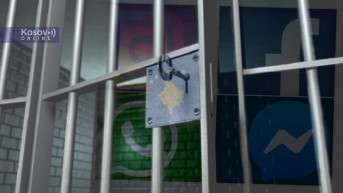
Arrests and Sentences Have Happened Before: For Slogans, Flags, and T-Shirt Inscriptions. Then Viral Became Verbal. Last week, the Basic Court in Pristina sentenced Saša Zlatanovic to five months in prison for posting a video on social media. According to sources consulted by Kosovo Online, there is no doubt that this is a verdict for a verbal offense, and they also warn that punishments for social media posts could be a new form of pressure on the Serbian community.
By Arsenije Vuckovic
The verdict against Zlatanovic stated that by posting the video on social media, he insulted the KLA (Kosovo Liberation Army) logo and Albanian mothers, thus committing the crime of "deliberately inciting and spreading hatred, division, and intolerance among national groups."
A similar case occurred in mid-June with the arrest of a young man from Leposavic.
The Kosovo police mistreated them, sprayed them with tear gas, and arrested them for singing songs about Kosovo. They were fined 200 euros each, with the possibility of halving the fine if paid within 15 days.
"We are afraid because we no longer know what is allowed and what isn't. We could be detained for various reasons; we are threatened, and I think it's dangerous for young people to live here," said one of the detained youths.
So far, several cases of Serbs being detained for social media posts have been recorded. However, the verdict against Zlatanovic is the first case where someone has been handed a severe sentence for a video posted on their account.
In early October last year, a Serb, L. J., was arrested at Jarinje, accused of illegally carrying weapons.
The investigation revealed not only that he did not have a weapon on him or in his home, but that the indictment was based on a photograph. The entire case ended absurdly because his lawyer, Asdren Hoxha, proved that the weapon shown in the incriminating photo was not real.
"I believe it is necessary to inform you that my client did not possess any weapon that could be confiscated. A search was conducted in his apartment, and no weapon was found; nothing was unlawfully confiscated. The case involves some old photos where he is seen with a weapon, and we managed to explain that it was not a real weapon. When we presented our evidence, the Prosecution agreed that there was no need for this person to be detained, which we are essentially satisfied with," said Hoxha at the time.
According to Albanian media, Kosovo institutions have been continuously requesting Facebook to provide them with account holder information for criminal investigations since 2013.
"From January 2013 to May 2021, Kosovo requested Facebook's assistance 228 times. Twenty requests for account information were made in just the first half of this year, and 48 were made in 2020. Nearly 50% of the requests were rejected, as stated by the company, because they concerned user data," reported Gazeta Express in 2021.
Since then, there has been no data on how many such requests have been made or for which criminal investigations.
"A 'Spectrum' of Repression"
For Duško Celic, an assistant professor at the Faculty of Law at the University of North Mitrovica, the punishment of Serbs for social media posts is "part of a spectrum within a system of repression."
"The news of a Serb being punished with a draconian sentence for a verbal offense is, unfortunately, not a surprise to me. I'm afraid we can expect similar, perhaps even worse, occurrences in the upcoming period leading up to the elections. This is just one aspect of the broader spectrum of that repression," Celic told Kosovo Online.
Celic adds that almost all rights of Serbs in Kosovo are being violated.
“Human rights of Serbs in Kosovo and Metohija are endangered in nearly every segment. We are now talking about the right to justice, the right to a fair trial, and the right to freedom of speech, but rights to property, rights of detainees, cultural rights, language rights, and the right to express national identity are also being violated. Unfortunately, in this regard, we can talk about a kind of apartheid being imposed on Serbs in Kosovo and Metohija,” Celic emphasizes.
These are all reasons why he expects a reaction from the international community, especially from the institutions involved in Kosovo.
“I expect a reaction from the international community, particularly from those missions still active in Kosovo and Metohija. Primarily, I’m thinking of EULEX, UNMIK, the Council of Europe, and the OSCE. Simply put, their mandate includes monitoring human rights in Kosovo and Metohija, and I expect an urgent response. This cannot continue to happen, so to speak, with the lights off. This darkness must be illuminated. It must be shown that in the heart of Europe, there is a territory where almost nothing of the basic rule of law exists,” Celic states.
"Cancel Culture"
Marija Marsenic, a sociologist at the Institute for European Studies, believes that the punishment of Serbs for posting content on social media represents a new form of pressure and is part of a broader process of political repression, which in sociology is studied as the "practice of cancel culture."
"The punishment of Serbs in Kosovo and Metohija for social media posts can be interpreted as part of a broader process of political repression, ethnic tensions, and attempts by the so-called Kosovo authorities to control the narrative. This can be seen as the revocation of yet another human right, namely the right to freedom of speech," Marsenic told Kosovo Online.
According to Marsenic, this type of restriction on freedom of speech and the control of social media posts or publicly expressed statements does not reflect the level of democracy in Kosovo, but rather the practices of authoritarian regimes.
"This can include fines, detentions, or other forms of repression against individuals who express views contrary to the main narrative."
“The intention behind these punishments is to intimidate the Serbs in Kosovo and Metohija, effectively leading them to self-censor in order to avoid the mentioned penalties and consequences. This step clearly points to a reduction in democratic freedoms and an increase in repression against the Serbian population,” Marsenic emphasizes.
She adds that in sociology, such phenomena are defined as the practice of "cancel culture."
"This new form of pressure or repression against the Serbian population in Kosovo and Metohija can be identified in sociology with the practice of so-called cancel culture, where individuals, in this case, Serbs, are 'canceled' or 'nullified' for holding views perceived as contrary to the dominant narrative within the community they belong to. The practice of so-called cancel culture, which I expect the so-called Kosovo authorities to implement, will involve scrutinizing social media accounts and analyzing all possible posts that contradict the dominant narrative in order to find new reasons for arresting Serbs, intimidating them, and repressing them," Marsenic warns.
Marsenic adds that sanctions of this kind are a form of discrimination based on ethnicity.
"Such sanctions against Serbs for their online activities represent a form of discrimination based on ethnic belonging and involve the selective enforcement of laws concerning interethnic tolerance. The actions of the so-called Kosovo authorities aim to demonstrate power and strengthen political control, to intimidate and create an atmosphere of fear and violence, and to promote the ethnic and social marginalization of Serbs, further isolating them and deepening the conflict within the Serbian community in Kosovo and Metohija," Marsenic concludes.
Political Processes
Aleksa Tojcic, a legal expert from the Center for Social Stability, states that the legal proceedings against Serbs in Kosovo courts for social media posts are politically motivated, making them indefensible from a legal standpoint.
"In legal terms, it is difficult to discuss a defense strategy because these are politically motivated processes. Such quasi-institutions, when we talk about Kosovo and Metohija, certainly will not consider any legal arguments. What remains for our people in Kosovo and Metohija is to be wise and not fall for these attempts by Albin Kurti to escalate the situation further. I believe his goal is to drag us all into conflicts that would not be beneficial for Serbia or the Serbian people at this moment," Tojcic told Kosovo Online.
Tojcic doubts that the international community will take concrete actions beyond issuing strong statements and condemnations.
He sees the statement by French President Emmanuel Macron as encouraging, particularly his commitment to improving conditions for the Serbian community and the formation of the Community of Serb Municipalities (CSM).
"The EU has not yet made any concrete moves that could practically confirm their words or their supposed condemnations. However, what can give us some encouragement is the position expressed by French President Emmanuel Macron, who stated that he will continue to monitor the situation of Serbs in northern Kosovo and Metohija and will actively advocate for the formation of the Community of Serb Municipalities. I think this is something that can be seen as encouraging regarding that issue," Tojcic emphasizes.


0 comments