
Kurti and the consolidation of power: Uncertainty over the presidency or a political game
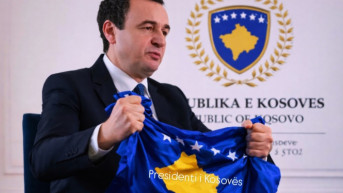
The statutory deadline for Kosovo to elect a president expires the day after tomorrow, on March 5, yet no political agreement or proposal for a consensus candidate has been reached. No party has so far proposed the re-election of President Vjosa Osmani. However, interlocutors of Kosovo Online note that she is not yet out of the race, although they assess that she represents a certain threat to Albin Kurti’s authority. They add that a situation in which a president is not elected would suit those seeking to consolidate their power, while warning of the possibility that the uncertainty surrounding this issue may be a coordinated game among the main political actors in Pristina.
Written by: Jelena Novakov
In recent days, Prime Minister Albin Kurti has met with representatives of the opposition, but the talks ended unsuccessfully and no candidate was nominated, despite his claims that the primary objective is to avoid new snap elections.
DPK leader Bedri Hamza has demanded that his party nominate the president, stating that he opposes the re-election of Vjosa Osmani, while Lumir Abdixhiku declared that no name had been proposed to the LDK and that his party seeks a consensus candidate. According to media reports, Kurti also met with incumbent President Vjosa Osmani to discuss ways to overcome the crisis and avoid new elections, although the outcome of that meeting remains unknown.
Despite these meetings, officials from Self-Determination and the opposition have exchanged accusations of deliberate obstruction and attempts at blackmail. The head of the parliamentary group of the Alliance for the Future of Kosovo, Besnik Tahiri, assessed that the meetings were merely a public performance, while the crisis in Kosovo continues to deepen.
The Self-Determination Movement currently controls both the Government and the Assembly of Kosovo. Analyst Azdren Shala assessed that Kurti is implementing what he described as a dangerous political project aimed at concentrating power, and that an even stronger result in potential new snap elections could provide him with the opportunity to exert unimpeded control over the institution of the presidency as well.
In that context, Kosovo Online’s interlocutors highlight disagreements between Kurti and Osmani, whose international standing allegedly undermines the Prime Minister’s authority and, as they claim, makes her difficult to control. They also pointed to the possibility that the uncertainty over the presidency is part of a coordinated political game.
Vjosa Osmani’s mandate expires on April 4, and no later than thirty days prior to that date she must either be re-elected or a new president elected. If this does not occur, according to former Constitutional Court judge Kadri Kryeziu, Kosovo would automatically proceed to new snap elections.
Electoral Capital and Concentration of Power
University professor Kolë Krasniqi told Kosovo Online that failure to elect a president would undermine the constitutional order and would benefit those seeking to consolidate their power.
“From a legal and constitutional perspective, the non-election of the President of the Republic of Kosovo is not a neutral situation, but one that produces institutional uncertainty and undermines the functionality of the constitutional order,” he said.
He stressed that such a development would benefit political actors seeking to create crisis and polarization by turning a constitutional deadlock into electoral capital, as well as those aiming to concentrate power in order to avoid an independent president with, as he noted, a genuine constitutional balancing role. In addition, Krasniqi stated that the situation would also favor those “calculating with early elections, hoping to benefit from the dissolution of the Assembly,” as well as actors who prefer Kosovo’s institutional weakening at the international level, particularly in the context of the dialogue with Serbia and Kosovo’s integration processes into the European Union and NATO.
“In reality, the non-election of a president benefits only those who profit from institutional and systemic uncertainty. In a constitutional state, the public interest and legal order must take precedence over party interests and short-term political calculations. For all citizens of Kosovo, their highest interest should be the stability and functionality of the state – not paralysis,” Krasniqi assessed.
A Coordinated Game
Aleksandar Mitic, Senior Research Fellow at the Institute of International Politics and Economics in Belgrade, assessed that the uncertainty surrounding the presidential election is a “coordinated game” among key political actors in Kosovo, but emphasized that Vjosa Osmani’s status in the West raises concerns for Prime Minister Albin Kurti.
“The fact is that in recent months she has been the only one exercising a full mandate, while other institutions were in technical mandates, and she used that to position herself as effectively as possible internationally. That clearly strengthened her role, which may cause certain concerns for Kurti, who cannot fully control her,” he told Kosovo Online.
Nevertheless, Mitic maintains that this is a coordinated game among key Albanian actors in Pristina.
“I still argue that this is a coordinated game among the key Albanian players. For the opposition, new elections could be beneficial, but the question is what has changed in a few weeks that would significantly improve their chances of forming a government, since they already had that opportunity last year,” Mitic added.
Kurti’s Decision
Analyst Azem Vlasi stated that it is in no one’s interest for a new president not to be elected, but that everything is in the hands of Prime Minister Albin Kurti. He assessed that if Kosovo were to go to new elections due to the failure to elect a president, it would be the greatest “political folly.”
“Moreover, it would resemble deliberate sabotage of the state. Three elections within a year would amount to conduct against state interests,” Vlasi said.
The key question, he stressed, is why there are “games” over the presidential election when Vjosa Osmani is, in his view, the best possible candidate.
“Why is there no alternative candidate already, if someone would be better than her? I believe everyone will come to their senses and vote for Vjosa. Everything is in the hands of Albin Kurti and Self-Determination. No one understands such persistence on his part to bypass Vjosa,” Vlasi told Kosovo Online.
The President as a Challenge to Kurti
Historian Stefan Radojkovic assessed that Kurti does not want a presidential candidate who could threaten his authority or question what he described as his almost unlimited power.
“He does not want an opponent within the judicial branch, nor does he want someone who would be overly committed to defending the Pristina administration and its constitutional framework,” Radojkovic told Kosovo Online.
Regarding Vjosa Osmani, he noted that she has not entirely dropped out of the presidential race, but that the final word will rest with Kurti.
“Everything must be viewed through his desire to be the undisputed authority within the Pristina administration and within his theory of the ‘third republic.’ He, like his Self-Determination Movement, wants the Pristina administration to be absolutely independent, particularly from Western European partners and allies. In that sense, he will not want to give those states any leverage with which they could curtail or limit his power,” he said.
Radojkovic also noted that new snap elections could potentially enable Self-Determination to elect a president independently.
“Everything depends on Albin Kurti’s decision. He is now in the driver’s seat; he decides on everything. If he is sufficiently ambitious, he may even allow for no president to be elected now and instead seek additional votes and mandates so that Self-Determination alone would have the necessary quorum and votes to elect the president he wants,” he said.
Commenting on the opposition’s option to attempt to prevent Kurti from consolidating power by triggering new parliamentary elections, Radojkovic observed that the opposition is still recovering from its electoral defeat and that it remains unclear whether DPK and the Alliance for the Future of Kosovo are prepared to risk new elections in hopes of a better result.
“Will the opposition dare to do so, considering the disarray within the LDK and Abdixhiku’s recommendation that its MPs vote as they see fit – without a clear directive from the party leadership? This suggests that part of the opposition is demoralized by the latest results and may prefer a period of recovery rather than new elections. On the other hand, we will see whether DPK and Ramush Haradinaj are ready to obstruct and test themselves again in snap elections, believing they might achieve a more favorable result if there is no significant participation of the Albanian diaspora,” he said.
Radojkovic concluded that failure to elect a new president would most benefit the Serbian community, for whom, he argued, new snap parliamentary elections – potentially resulting in a weaker showing for Self-Determination – would be the most favorable outcome.
“The power of Self-Determination could be diminished, considering that Albin Kurti secured this number of mandates primarily thanks to diaspora votes. If snap elections were held, they might suit part of the opposition – though I am not certain how willing they are to repeat such a process – and they would certainly suit the Serbian community, as limiting Albin Kurti’s power as much as possible would be in its interest,” Radojkovic concluded.


0 comments