
Kurti in a tight spot in Kosovo - What does he want with his attempts to influence elections in the region?
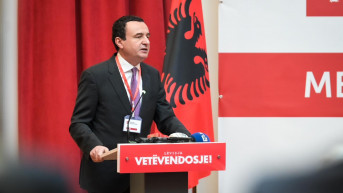
Kosovo's Prime Minister Albin Kurti was not deterred by the failure of the Self-Determination Movement's branch in Tirana in the 2021 parliamentary elections in Albania, where he himself voted. Last month, he cast his net among voters in North Macedonia, and in the recent local elections in Presevo and Bujanovac, he openly supported the favorites among the Albanian candidates. His compatriots accuse him of dividing Albanians in the region due to such policies, while analysts see the outcome of his actions as a power struggle with Edi Rama.
In the Presevo elections, six Albanian lists participated, and in Bujanovac four. Kurti supported the Democratic Action Party (PDD) in both municipalities, attending its pre-election rally in Pristina. This party, led in Presevo by Ardita Sinani, who is also Kurti's advisor, won the most mandates. However, in Bujanovac, their candidate Ragmi Mustafi, an advisor to the Deputy Prime Minister of Kosovo Besnik Bislimi, received the fewest votes of all Albanian parties participating in the elections.
Vlora Çitaku, Vice President of the opposition DPK, described Kurti's support for one party as "stoking the fire of division" among Albanians.
"I still haven't managed to understand Kurti's enthusiasm for divisions, but that has never brought any benefit to Albanians. Irresponsible to the extreme," Çitaku believes.
Kosovo's Infrastructure Minister Liburn Aliu, originally from Presevo, also considers Kurti's participation in PDD's pre-election rally a mistake, stating that "Prime Minister Kurti should unite." Meanwhile, former Presevo municipal president Shqiprim Arifi announced that fewer Albanians voted in these local elections than ever before and that the Albanian community in Serbia has said "no" to the divisive politics of Kosovo's Prime Minister Albin Kurti.
If divisions among Albanians are a consequence of Kurti's actions in the region, what is his motive?
According to some views, he is competing with Albanian Prime Minister Rama over who will have dominant influence over Albanians in the region, while others believe he is trying to divert public attention from the failures of his own government.
Aleksandar Mitic, a research associate at the Institute for International Politics and Economics, assesses that Kurti is pursuing a policy that is quite aggressive in pushing a pan-Albanian agenda, and that similar ideas, though in a more moderate form, are also proclaimed by Albanian Prime Minister Edi Rama.
"Albin Kurti is someone who advocates certain ideas and political principles that are acceptable not only to those in Kosovo but also in Albania and North Macedonia. However, his agenda is part of a larger common thread of the Greater Albania idea. He advocates it in a somewhat more radical way compared to Edi Rama, who takes a completely different, more polished approach initially, but with the same intentions and goals," Mitic told Kosovo Online.
According to reports, Kurti is encouraged by the fact that he received support for the escalation of discrimination against Serbs in Kosovo and Metohija, as seen through processes in the Council of Europe and the NATO Parliamentary Assembly.
"It is obvious that he will continue with his agenda, and the fact that some Western officials will say that they have sent him a certain message through diplomatic channels not to destabilize the region and to focus only on Kosovo and Metohija does not really affect him. So, I expect the continuation of such policies," says Mitic.
Demo Berisa, President of the Matica of Albanians in Serbia, emphasizes for Kosovo Online that Kosovo Prime Minister Albin Kurti's desire to control Albanians in the region and beyond is proving catastrophic.
"He is trying to partially copy Mr. Rama, as we see what Rama is doing with Albanians in other countries, specifically in Greece and Italy. However, it has been shown that Albin Kurti has completely divided voters in these local elections, which also had low turnout and many participants. We will certainly see Kurti's continued influence in Presevo, but he will completely lose influence in Bujanovac, as his party is the third strongest among the Albanian parties there," says Berisa.
He highlights that the final PDD convention was in Pristina, not in Presevo or Bujanovac, which indicated the continuation of Albin Kurti's policy of interfering in regional elections. "He did the same in North Macedonia, he tried in Albania. He has created new divisions in the politics of the 'Presevo Valley,'" notes Berisa, who believes that a coalition will be formed around Arber Pajaziti, who received the most votes in Bujanovac, and that this municipal structure will turn towards Belgrade, not Pristina.
In the elections in North Macedonia last month, the Self-Determination Movement participated within the opposition bloc VLEN, and Bekim Çoku, Kurti's advisor, secured a seat in the Assembly.
Political analyst Petar Arsovski told Kosovo Online that Albin Kurti wants to establish himself as the regional leader of Albanians, a position that Pristina and Tirana have long competed for.
"Tirana and Pristina have always had a certain paternalistic approach towards Albanians in the region. Considering that Edi Rama has invited Macedonian-Albanian politicians several times for some sort of joint coordination, I think Kurti feels this as some kind of imbalance, which he is trying to overcome by projecting his political aura in both North Macedonia and Albania, especially in North Macedonia," says Arsovski.
Regarding how such a policy could impact the region, our interlocutor says that it will certainly be negatively perceived in North Macedonia, especially among ethnic Macedonians.
"Ethnic Albanians view it more calmly and tolerantly. Much will depend on whether the region continues to move towards the EU or not. If the region continues to move towards the EU, such regional coordination will become political folklore, but if it halts on the path to the EU, it will create tensions or local regional instability," Arsovski believes.
Albanian journalist and analyst Ben Andoni points out that the influence of Kosovo Prime Minister Albin Kurti in Albania has begun to decline because, he says, "his experiment in the elections in Albania did not receive a proper evaluation" and he is now trying to extend his influence to the "Presevo Valley" and North Macedonia.
"The latest events, especially the elections in North Macedonia and the recent elections held in Serbia, indicate an extraordinary influence of Kurti. Primarily on the 'Vlen' coalition in North Macedonia, where his people managed to secure participation in the government. This was not well received in North Macedonia, particularly by Ali Ahmeti," Andoni told Kosovo Online.
He adds that relations between Kurti and Albanian Prime Minister Edi Rama have been tense for a year now because Rama's idea is the same as Kurti's, as he also wants to extend his influence over the entire Albanian area.
"Rama is the prime minister of a large country and his goal is to divert attention from internal problems in the country, while Kurti's intention is to divert attention from part of internal politics and a series of economic failures. I believe this will worsen in the future because citizens are more interested in internal politics than in what happens outside," says Andoni.
According to Pristina political analyst Artan Muhaxhiri, Kurti's engagement in the region has no concrete success, and he sees it as a "symbolic style of politics without long-term effect."
"In Albania, he experienced a fiasco, in North Macedonia his wing also lost the elections, although they will be in the government there, they were second by votes among the Albanian population. Now he has supported the former mayor in Presevo but lost in Bujanovac. Prime Minister Kurti has not had great success in Kosovo in economic development to be able to project that management model elsewhere," Muhaxhiri told our portal.
When asked if such a symbolic policy by Kurti could provoke negative reactions in the region, this analyst says that regional leaders understand Kurti's populist way of thinking and do not see it as a risky approach.
"Kurti has so many problems in Kosovo that he absolutely cannot have enough time to deal with the problems of other countries and other people, since we have a deep economic crisis and many other problems in Kosovo, we are under EU sanctions, so he should work more on solving Kosovo's problems and then try to improve the lives of Albanians in other countries because they have their political representatives. It is very difficult to influence political parties and leaders in other countries because you need a lot of people, financial resources, and party structures for that, which Kurti does not have. He improvises a lot with these supports, and I do not think it will have a long-term effect," Muhaxhiri concludes.

0 comments