
Law enforcement or “Soft ethnic cleansing” – What are Kosovo Serbs facing?
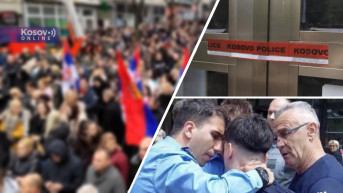
While officials in Pristina consistently claim they are merely upholding the law and that everything is in order, a growing number of voices—such as Balkan expert Marko Prelec of the International Crisis Group—describe the current reality as “soft ethnic cleansing.” Unilateral actions and the muted response of the international community are placing the continued existence of Serbs in Kosovo under serious threat, warn commentators for Kosovo Online.
Written by: Djordje Barovic
“We submitted a list of 50 concrete actions undertaken by Pristina that contribute to escalation and persecution of Serbs in Kosovo and Metohija by Kosovo institutions and the Kosovo Police,” said Petar Petkovic, Director of the Serbian Government’s Office for Kosovo and Metohija, following a meeting with the new EU Special Representative for the Belgrade–Pristina Dialogue, Peter Sorensen, in Brussels.
He emphasized that Sorensen was informed about the ongoing systemic pressure and harassment faced by Serbs at the hands of Pristina's institutions and security forces.
Responding earlier to claims by Kosovo’s chief negotiator Besnik Bislimi about alleged privileges enjoyed by Kosovo Serbs, Petkovic reminded that more than 600 attacks on Serbs had been documented, six individuals had been shot, Serbian children harassed by police, Serbian institutions forcibly shut down, and property seized.
“Twenty percent of Serbs have left the north due to Kurti’s reign of terror,” he stated.
A Policy of Systemic Discrimination
Marko Prelec, a Balkan specialist with the International Crisis Group, referred to the current situation as a form of “soft ethnic cleansing.”
“This won’t earn me friends in either Croatia or Kosovo, but Albin Kurti strongly reminds me of the late Croatian President Tudjman—a leftist nationalist. This quasi-legal repression amounts to a kind of ‘soft’ ethnic cleansing—not aimed at eliminating the minority but at marginalizing it,” Prelec wrote on social media platform X.
However, Dusko Celic, Associate Professor at the Faculty of Law in North Mitrovica, argues that the term “soft ethnic cleansing” is too mild.
He prefers the term “systemic discrimination,” which, in his view, includes elements of ethnic persecution and even apartheid.
“If institutions in Pristina selectively enforce laws depending on whether someone is Serb or Albanian—or don’t enforce them at all—if police, prosecution, and judiciary are being misused, if there's a widespread attack on property rights, and the right to free expression, then we’re no longer dealing with ‘soft’ ethnic cleansing but with open and deliberate discrimination,” Celic explained.
He agrees with Prelec that there are strong parallels between the current treatment of Serbs in Kosovo and the treatment of Serbs in post-war Croatia, particularly in regard to property rights.
“In Croatia, over 22,000 tenancy rights were stripped from Serbs. A similar pattern is now seen in Kosovo, with dual refugees in Lesak and Leposavic losing housing rights. When comparing Croatian legislation to what we may loosely call legislation in Pristina, clear similarities emerge, along with logistical parallels in how Serbs are treated,” Celic noted.
He further highlighted that Pristina’s political leaders have never hidden their cooperation with advisory circles in Zagreb, and the effects of this influence are now evident.
Asked whether the formation of the Association of Serb-majority Municipalities (ASM) could improve the situation, Celic expressed skepticism. He believes the Brussels agreement framework has lost both its authority and enforcement power.
“Given what Kurti has done over the past two years—effectively dismantling the local self-government system in Serb-majority areas, stripping it of powers and misusing others by installing Albanian-controlled administrations—the ASM, even if established today, would be an empty shell,” he said.
For Celic, the only viable solution lies in establishing substantial autonomy for Kosovo Serbs.
“There must be a new mechanism for protecting both collective and individual rights—one that includes fully autonomous Serbian institutions in Kosovo and Metohija. Without that, Serbs will not be able to withstand this ethnocentric policy pursued by Kurti, or any future government in Pristina,” Celic warned.
A Facade of Coexistence
Srdjan Barac of the Center for Social Stability notes that the most disheartening aspect is that this process is unfolding in plain view of the international community, with Serbs being denied even a semblance of normal life.
“‘Soft ethnic cleansing’ has become a constant in Kosovo. Daily life sends the clear message that Serbs will not be allowed to live normal lives,” Barac said, citing the recent example of a Serbian high school graduate being harassed by police on his graduation day as symbolic of broader intimidation.
He asserts that Kosovo is undergoing a coordinated plan of ethnic cleansing.
“Step by step, Serbs are being stripped of everything—institutions are shut down, kindergartens and schools are raided. Each act sends a message about the real intentions behind the policy,” Barac explained.
He sees this as a consistent strategy by Pristina, regardless of who is in office.
“Whether it’s Albin Kurti, Vjosa Osmani, or someone else, the message to Serbs remains the same: We will continue to drive you out,” Barac said.
According to him, the solution must begin with a shift in the international community’s approach.
“If the international community truly wanted to act, it could. The first responder should be KFOR, followed by EULEX, and only then Kosovo Police. That would demonstrate that international agreements, laws, and charters are being respected in Kosovo,” Barac asserted.
Instead, he claims, the Kosovo Police act “with no regard for the rules governing security forces.”
“They behave like criminals, aiming to intimidate Serbs even further. And yet, we see no meaningful or forceful international response that would change the situation on the ground,” he added.
A System of Marginalization
Historian Aleksandar Gudzic from Gračanica also believes that Kosovo is witnessing the creation of conditions for the disappearance of the Serbian population, describing the current situation as “an advanced system of apartheid.”
“We now have a system of extraordinary apartheid on Kosovo—discrimination and marginalization of Serbs brought to perfection,” Gudzic told Kosovo Online.
Commenting on Prelec’s remarks, Gudzic emphasized similarities between the fate of Serbs in Croatia and Kosovo.
“Comparing the treatment of Serbs in Croatia and Kosovo reveals a pattern—creating conditions for the Serbs to simply vanish,” he said.
As evidence, he pointed to the fact that four Serb-majority municipalities in northern Kosovo are now governed by Albanian mayors, and that Pristina refuses to organize new elections, invoking technical regulations.
He likened the situation to the era of Slobodan Milosevic and his treatment of Kosovo Albanians.
“Today, Albin Kurti is doing exactly what Milosevic’s regime did to Albanians in the 1990s. And that view is shared not only by Serbs, but also by many Albanians,” Gudzic claimed.
He added that Kosovo authorities use every opportunity to worsen the position of Serbs.
The policies, he continued, also mirror those of Croatian President Franjo Tudjman.
“Prelec is right to say Kurti resembles Tudjman, who during the 1990s and 2000s obstructed the return of Serbs. Today, we see similar ‘war crimes indictment lists’ being used to deter and marginalize Serbs in Kosovo,” Gudzic explained.
Gudzic believes the solution lies in economic empowerment of Serbs and a diplomatic insistence on legal protection.
“We must rely on diplomatic efforts and insist on the rule of Kosovo’s own laws and regulations. But most importantly, we need to focus on economically strengthening the Serbian community—making them more independent and less vulnerable to pressures from Pristina,” Gudzic concluded.



0 comments