
The Law on the Independent Media Commission: Everyone against, one in favor
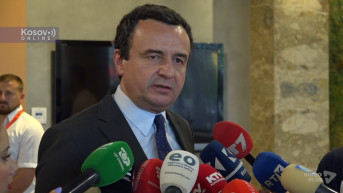
The Law on the Independent Media Commission, which the Kosovo Assembly passed a few days ago, has managed to achieve something unexpected: uniting Belgrade, Pristina, and the international community, both politically and professionally. All relevant media associations, foreign ambassadors in Kosovo, and the opposition in Pristina agreed that the law is unacceptable. Everyone except the ruling Self-Determination Movement, which, despite months of criticism, "unbearably easily" decided to adopt the law. If everyone is against it and only one party is for it, nothing good can come from it, agree the interlocutors of Kosovo Online.
Written by: Dragana Savic
International media law experts, on behalf of the Council of Europe, the European Union, and the OSCE, provided detailed recommendations, but they were ignored. It is no surprise that no representatives of Serbian media in Kosovo were invited to participate in drafting the law.
The Association of Journalists of Kosovo has called on President Vjosa Osmani to address this issue, stating that "free media and media pluralism are the cornerstone of a democratic society, and when this foundation begins to shake seriously, the president of the country has an obligation to speak out."
While waiting for Vjosa, U.S. Ambassador to Kosovo Jeffrey Hovenier declared it "unreasonable" that Pristina, which aims to join international organizations, is passing laws contrary to European norms.
The editorial offices of Serbian media in Kosovo are the most concerned, reasonably predicting the misuse of numerous provisions to discipline and, if necessary, shut down disobedient outlets.
Ivana Vanovac, president of the Society of Journalists of Kosovo and Metohija (DNKiM), highlighted for Kosovo Online that one of the key criticisms is legal ambiguity, meaning that the provisions of the law are not fully specified, particularly in the most sensitive parts, such as the imposition of monetary penalties.
"In that section, there is a provision that if a media outlet violates the ethical code, it can be fined between 200 and 40,000 euros, without further gradation or specification of which infraction corresponds to which amount," Vanovac explains.
According to her, there is also a problem with issuing licenses to electronic media, which are referred to as "video content sharing platforms" in the new law.
"That part of the law is extremely unclear, so we still don't know whether it requires only registration with the Independent Media Commission or if it is necessary to apply for some kind of license. If you receive a license, it can be revoked at some point based on something. And if we have a licensing system, then we are talking about the most open form of censorship," says the DNKiM president.
Furthermore, the members of the commission are chosen by the Kosovo Assembly. "When something is chosen by the Kosovo Assembly and given a four-year mandate, with the possibility of re-election, that is quite negative," she points out. She emphasizes that it is now important for the journalistic community to do everything to prevent Kurti's attack on Serbian-language media.
"Kurti will now, using this law, do everything to ensure his power and try to secure a new mandate. He will not hesitate to attack even Albanian-language media that report critically about him, especially Klan Kosova," she adds.
Journalist Visar Duriqi says that the Law on the Independent Media Commission has been criticized by everyone except the ruling party in Kosovo. If everyone is against it and only one party is for it, he adds, nothing good can come from it.
Duriqi tells Kosovo Online that the mentioned law will most likely end up in the Constitutional Court. If that does not happen, he emphasizes, the law will provide the current government in Kosovo with the power to control the media.
"If this law is not stopped by the court, it will give the ruling party the power to send more of its people to the commission's board, which means that decisions will be more influenced by the government (from seven to 11 people). Two problematic aspects of the law are the high fines, which could go up to 40,000 euros, and the fact that there is no appeal; you have to pay and then you can initiate a procedure against the commission in court, which usually takes years to resolve," he added.
Marko Milenkovic from the NGO "New Social Initiative" reminded Kosovo Online that the Serbian community and media complained about not being sufficiently included in the drafting of the law. Still, the biggest argument is that the suggestions that came primarily from experts and media representatives were not considered at all. Therefore, this law does not have a consensus in society and does not represent the needs of media workers, media houses, or the entire community in Kosovo.
"We have the most objections to the hindering of the work of electronic portals and media that report online or in electronic space. They will face difficulties; we still don't know what the registration of all these media will look like. We have information that media that have been operating or funded through donations and functioned as non-governmental organizations will now have to register as businesses and apply for registration. However, we still don't know what that procedure will look like, what the criteria are, whether it is just a matter of submitting documentation to be registered, or whether the commission, which will be composed and reflect some political structure from the parliament, will decide on this," Milenkovic explains.
"Imagine there is a media outlet that at some point does not please the authorities, that is, its critical stance bothers that political establishment. That means that the political establishment will have no problem getting rid of that media outlet thanks to the possibility of acting through commission members and fines of up to 40,000 euros," Vanovac explains.
Journalist and former president of UNS, Vladimir Radomirovic, says that with the Law on the Independent Media Commission, Kosovo's Prime Minister Albin Kurti is trying to intimidate the media to work in his interest.
"Albin Kurti's fight for a monopoly on information in Kosovo and Metohija has been going on for a long time, and now that fight has entered its final phase. This law that has been passed means censorship, an attempt to intimidate anyone who thinks critically. The law is equally aimed at Albanian media that are critical of Kurti's government and Serbian-language media, but it is clear that Serbian media will be the first to be targeted and will suffer the most consequences from this harmful law," Radomirovic told Kosovo Online.
Milenkovic emphasizes that the fines are enormous, especially for small media outlets, raising doubts about whether they can continue to operate after the passage of this law.
"It seems somewhat clear that the primary goal is the control of media, media reporting, and media houses. The fact that the commission will be chosen by the parliament, the number of commission members has increased, and the parliament can also dismiss the commission at any time if it is not satisfied with its work. This is one of the criticisms from Council of Europe experts, indicating that there will be some political control over the work of this body and that there is a desire to control the media houses themselves," he believes.
This will certainly be included in reports that will go to the European Parliament and will impact Kosovo's European path and potential membership or candidacy for the European Union, Milenkovic concludes.
The adoption of the Law on the Independent Media Commission affects all media in Kosovo, journalist Zoran Stankovic told Kosovo Online.
He emphasized that the rules of the Independent Media Commission have already been demanding.
"What is being announced now may literally lead to some media outlets shutting down, and on the other hand, I think it also affects media freedom. I believe it impacts the independence that perhaps doesn't really exist, but in any case, if there is even a little bit of it, now it will cease to exist altogether. Not to mention the drastic fines, which, if any media outlet receives, and there is a very high likelihood of that, mean that with just one such fine, any media outlet could close its doors and lock them," Stankovic said.
The goal of adopting the Law on the Independent Media Commission, he emphasizes, is media control.
"The goal is to have all media under control and for the media to literally work for the authorities and a certain group. So, anything that would not align with their goals would immediately be punishable in some way. Because, as our people say, 'every word has a tail,' and every news piece, every piece of information, especially for us who are in a situation where we receive information from central Serbia and Kosovo, can very often be misused. It could be presented as if we were working, for example, against the Kosovo regime or for some other reason. Naturally, this would automatically extinguish freedom of speech if we want to survive. We would survive, but without freedom of speech," concluded Stankovic.


0 comments