
Legal or political muddle: Why is Kosovo not Ukraine?
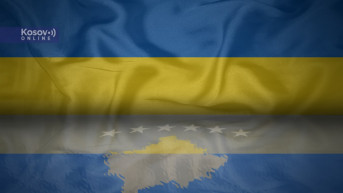
Even without Rama, it was already complicated. Russia does not recognize Kosovo but cited that case when annexing part of Ukraine. The West recognizes Kosovo but views Russia’s actions as classic aggression. Both Kosovo and Serbia support Ukraine's sovereignty, yet Ukraine firmly recognizes Serbia's integrity over Kosovo. Last week, Albanian Prime Minister Edi Rama further complicated this situation by stating that "artificial parallels" should not be drawn between the two cases because Kosovo is an "inseparable part of international reality." According to experts interviewed by Kosovo Online, the key term in this discussion is sovereignty.
Written by: Arsenije Vuckovic
"Any artificially drawn parallel between Kosovo and Ukraine should grab the attention of anyone in this building, but Kosovo is an inseparable part of international reality. It should not be held hostage by anyone with false claims and justifications, starting with the five member states that do not recognize Kosovo," Rama declared in his speech at the 79th regular session of the UN General Assembly.
Around the same time, Kosovo’s Prime Minister Albin Kurti told the Associated Press that the Balkan region has enjoyed the highest level of peace, freedom, and democracy over the past 25 years, but warned that this could reverse if Russia wins in Ukraine and, as he claims, "fuels Serbian expansion."
For Serbia's Foreign Minister Marko Djuric, there is no doubt about Kosovo, but he reaffirmed that Serbia would continue to support the territorial integrity and sovereignty of Ukraine in line with international law.
Ukrainian Ambassador to Belgrade Volodymyr Tolkach was also unequivocal in stating that Ukraine would continue to support Serbia's territorial integrity and sovereignty.
After his meeting with Serbia’s Minister for Human and Minority Rights and Social Dialogue Tomislav Zigmanov, Tolkach emphasized that Ukraine and Serbia share many similarities in terms of history, multiethnic composition, and European integration.
The Integrity Precedent
Professor Aleksandar Zivotic from the Department of History at the Faculty of Philosophy in Belgrade says that both the West and Russia use Ukraine and Kosovo to serve their own interests, and that the key similarity between these two cases lies in the issue of respecting territorial integrity.
“Certainly, the Kosovo problem is not just a point of reference but something that can be characterized in a broader sense as a precedent Russia uses to explain its own policy. However, it does so from a very different position, emphasizing that the system of international law was undermined and that the existing norms no longer apply. On the other hand, Russia can certainly influence significant decisions through its position in the Security Council,” Zivotic told Kosovo Online.
On the other hand, Zivotic believes that for the West, the Kosovo issue is entirely different from the one in Ukraine.
"The West certainly uses the Kosovo issue, but not in the context of Ukraine, given that the West continuously emphasizes that Kosovo is a special case. Indeed, the West could not otherwise justify its policy if it insisted on respecting international norms in other cases while those norms were not respected in this one. Therefore, they must insist that Kosovo is a special case, and they have consistently done so," Zivotic explains.
He adds that the key similarities in both cases lie in the violation of territorial integrity and the root causes of the issues.
"The fundamental similarity is in the matter of international law and respect for a state's territorial integrity. Just as Ukraine's territorial integrity is threatened, so is Serbia's," Zivotic concludes.
As a second significant similarity, Zivotic points to the causes of both issues.
"This is primarily an armed rebellion by a portion of the population, compactly settled in a specific territory, against the central state authority. In all other aspects, of course, we cannot look for further similarities, as we are dealing with different geographical areas, different historical and political legacies, and distinct habits of the population," Zivotic emphasizes.
Sovereignty and Satellites
University professor Nexhmedin Spahiu believes that Russia uses the Kosovo precedent for its own direct interests.
"Of course, Russia uses the Kosovo precedent. Russia has always supported Serbia, but when its direct interests are at stake, it has shown that it is willing to sell out Serbia's interests for its own gain. When necessary, Russia has drawn a parallel between Crimea and Kosovo," Spahiu tells Kosovo Online.
Commenting on the recent statement by Albanian Prime Minister Edi Rama, Spahiu says that there are far more differences than similarities between the cases of Ukraine and Kosovo.
"First of all, the difference is that Ukraine is a UN member, recognized by Russia, yet it faces aggression. Kosovo is recognized by 117 nations, but it is not a UN member. That’s a significant difference. Another difference is that in Ukraine, there are parts that might not want to remain with Ukraine, but no genocide or crime has been committed or attempted by the Ukrainian authorities against them. In Kosovo, NATO intervened because a million people were expelled and more than 10,000 were killed. That is a huge difference," Spahiu argues.
The similarity between Ukraine and Kosovo also lies in the denial of sovereignty.
"The similarity is also in the denial of sovereignty, in this case, the sovereignty of Serbia by Kosovo. It is completely denied, especially in the areas predominantly inhabited by Serbs. On the other hand, Russia denies the sovereignty of Ukraine in some of its regions," Spahiu believes.
He further adds that the key parallel between Kosovo and Ukraine is that both are on the "Western side."
"The parallel is that both Ukraine and Kosovo are on the 'Western side,' acting as satellites within the Western sphere. That is an important fact," Spahiu concludes.
The West and Baba Yaga
Foreign policy analyst Mirko Dautovic stated that the violation of sovereignty and territorial integrity in both Serbia and Ukraine is the key parallel between these two cases, and that Kosovo uses Russia as a kind of Baba Yaga to frighten the West.
"What are the actual parallels between Kosovo and Ukraine? In both cases, we have the violation of a country’s sovereignty and its territorial integrity. NATO intervened in Kosovo in 1999, followed by the unilateral recognition of Kosovo by Western countries, which made the situation even worse. In the case of Ukraine, we have Russian aggression and the annexation of five regions. There is a clear parallel between these two cases. And in both cases, there is the justification that this was done due to alleged war crimes committed by the authorities, whether in Belgrade or Kyiv, against the Albanian population or the Russian-speaking or Russian population in eastern Ukraine. That is the main parallel," Dautovic told Kosovo Online.
He emphasizes that everything else falls within the realm of which truth one chooses to believe.
"The issue is whether you'll believe that genocide occurred in Kosovo, or that genocide occurred in Donbas, in eastern Ukraine.
Depending on your perspective, you might accept that saving a population from genocide is a higher priority than the sovereignty of a country. And that is consistent with the 'responsibility to protect' doctrine," Dautovic argues.
According to him, this type of uncertainty allows for different interpretations of the Kosovo precedent.
"A skilled diplomat will use every argument in their arsenal. Yes, it can be said that Russia certainly uses Kosovo, specifically NATO's bombing, as a precedent. Don't forget, when Western countries recognized Kosovo, they said it was a sui generis situation, meaning it was an exception in and of itself and not comparable to other cases. But, as you know, once you set a precedent, you can always claim that any new precedent is sui generis. Russia definitely uses the precedent set by Western countries regarding Kosovo to justify its own violations of international law by annexing other countries' territories," Dautovic points out.
On the other hand, Dautovic adds, Kosovo also uses Russia, but in a different way.
"In the sense of a kind of Baba Yaga, scaring the Western alliance by suggesting that Serbia is waiting for Russia to somehow enter the Balkans and, through Russian forces, presumably invade Kosovo, Montenegro, Bosnia, and thus realize the plan for a Greater Serbia. And, you know, Serbia has given certain signals that could be interpreted this way. At least, it could have been interpreted that way in 2022, maybe even 2023. But this year, 2024, it is undeniable that Serbia has sent signals indicating that it is also in the Western camp, aligning itself with Ukraine and Israel. In this way, Serbia has effectively distanced itself from Russia," Dautovic concludes.



0 comments