
The impact of investment giants in Ukraine and parallels with Kosovo: How much are natural resources a motive for war?
"Ukraine has fertile land, energy potential, and rare minerals, which are very important in the development of high technologies. In Kosovo, there are significant coal reserves by European standards, but NATO primarily had its geopolitical goal in 1999."
Prepared by: Milos Garic
Independent candidate for U.S. President, Robert Kennedy Jr., recently stated that the conflict in Ukraine is led by the globalist business with the investment fund BlackRock at the helm.
"Few people understand what the war in Ukraine means for big business. It's not just about weapon procurement and reconstruction contracts. Ukraine's vast agricultural land, one of the most fertile in the world, is ripe for the taking, and American companies like BlackRock are at the forefront," Robert Kennedy wrote on social media a few months ago.
In December 2022, as reported by the media at that time, Ukrainian President Vladimir Zelensky struck a deal with BlackRock's CEO, Larry Fink.
"Zelensky and Larry Fink agreed to focus in the near future on coordinating the efforts of all potential investors and participants in the reconstruction of our country, directing investments into the most relevant and effective sectors of the Ukrainian economy," states the announcement published on the website of the President of Ukraine.
It should be noted that the European Commission mentioned at the end of 2022 a figure of $600 billion needed for the post-war reconstruction of Ukraine. In the meantime, things have become more complicated, and this is increasingly being discussed by parts of the American public and media. Thus, the editor and columnist of "The American Conservative" Devlin Bradley wrote a rather direct article in which he literally called BlackRock "the buyer of Ukraine."
According to the Statistical Review of World Energy conducted annually by British Petroleum, Ukraine has about 33 billion tons of coal, enough for 390 years of exploitation. The Donetsk Basin or Donbas, with its deep mines, covers 90 percent of Ukraine's coal production. Of course, significant amounts of other strategic resources on and under Ukrainian soil, like titanium, uranium, gas, are also mentioned. By comparison, Kosovo also ranks among the largest coal deposits in Europe, with an estimated more than 14 billion tons.
While the situation regarding the war in Ukraine is very concerning and increasingly difficult for global security, there are inevitable associations with what happened in Serbia in 1999.
The Role of "Trepca" and Bondsteel
The real reasons why NATO decided to attack the then Federal Republic of Yugoslavia have been debated for 25 years, and it has long been clear that the story of humanitarian intervention due to the alleged endangerment of Albanians was just a convenient alibi for achieving other goals of U.S. foreign policy at that time.
Famous American economist and professor at Columbia University, Jeffrey Sachs, said a few days ago that the goal of the NATO aggression on Yugoslavia was not to save the "oppressed" Muslim population in Kosovo, but rather to dismember Serbia to achieve America's goals. He is just the latest in a series of intellectuals in the West who have decided to speak openly about this.
What are the hidden interests of powerful political, military, and financial circles when we talk about the NATO war for Kosovo's separation from Serbia, and how similar is this to the current events in Ukraine?
Former Serbian Prime Minister Nikola Sainovic believes that both the war in Kosovo in 1999 and the bombing of the Federal Republic of Yugoslavia, as well as Western involvement in the conflict between Russia and Ukraine, are the result of America's ambitions to strategically position itself and establish military control closer to the East. The role of natural resources in Kosovo, he adds, is also not small.
"However, I believe that this was not decisive for the bombing and aggression against Serbia. 'Trepca' represents a mining wealth for Serbia and the region, but it is almost invisible in Europe. Therefore, no war would be fought over it, because so much money was spent on that war that it could have bought both Trepca and the entire power industry," says Sainovic for Context.
According to him, the main goal of the NATO pact in the Balkans was to reach the Black Sea.
"The mineral wealth of Kosovo, no matter how large, is not valuable enough to wage war over, especially considering that the U.S. and Europe have economic mechanisms to obtain the necessary natural resources from any part of the world. War for resources is as old as humanity itself. In history, empires that have dominated entire continents have been the bearers of wars for resources. Tragically, even people were once considered resources. This is certainly a characteristic of all wars, including those we are now discussing. However, the dominant aspect now is geopolitical, namely the control of space, primarily with a military motive, to oppose the opposing force. Thus, controlling Eastern Europe after the fall of the Berlin Wall is NATO's strategic goal that was 'aided' by the collapse of the Soviet Union," explains Sainovic.
"That is," Sainovic notes, "also the reason for the admission of Bulgaria and Romania into NATO and the EU.
"Within that plan is also the southern wing of this eastern NATO flank, which includes us. Turkey was once the most convincing NATO ally in this area, but it remains an ally in the physical sense because there are huge bases there, but things are changing and Turkey is no longer so reliable. NATO needs to have another stronghold behind the front, which is at sea. Therefore, the Albanian factor was chosen as an ally," Sainovic pointed out.
The biggest problem with the Albanian corps, he notes, is that the state of Albania is surrounded by mountains and has a geographically unfavorable position.
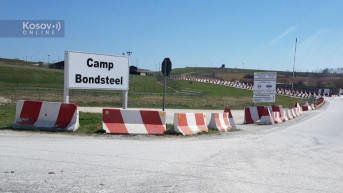
"Therefore, after the bombing of the Federal Republic of Yugoslavia, NATO decided to build a base on the other side of the Prokletije Mountains – in Kosovo. When you land in Tirana and look at Durres, you see mountains in front of you, the maneuverability is poor, no matter how large the army, and that is why a base is needed on the other side of the Prokletije – in Kosovo. The main goal that was realized after the bombing was the construction of Camp Bondsteel. It can accommodate 10,000 soldiers, although it currently has 300. I thought that this base would be at the airport in Pristina and I was surprised what a base in Urosevac in the middle of nowhere, until I saw the highway that connected Pristina, passed through the Kacanik gorge and connected two airports, Skopje and Pristina. And the base is in between. Then the highways went to Durres, where a military port and air base are also being built. This is the main military significance of Kosovo for NATO, or rather America," Sainovic explains.
Sainovic states that a very similar situation applies when it comes to interference in the war in Ukraine. According to him, the only goal is to bring NATO closer to Moscow.
"When you look at a large map of Ukraine and Russia you will see that the goal of NATO is, for example, to enter Kharkiv. Once it enters Kharkiv, it is south of Moscow, which is, as soldiers say – an attack from the flank. That's why there's so much Russian resistance to prevent this from happening. That the greatest reserves of ores and coal are precisely in the Krivoy Rog zone is true, and whoever controls it will use it, but there are other ways to enter privatization, it doesn't have to be because of war. In this case, war is because of the military-strategic position. Someone benefits from this, like Clark or Albright in Kosovo, but those are minor things compared to the size of the war. The war would not be fought just because of ores because some Western company, as they have bought up other old ones, could buy that too," Sainovic assesses.
Millions into the logistics network
He explains that anyone who gains an advantage and power in an area, also gains advantages when it comes to the use of natural resources.
"Land has already been privatized in Ukraine. All mineral wealth and everything else will go to whoever invests now, in this case, America. They will gain long-term control as they did after World War II, as a master, not as a dominant political partner," added Sainovic and repeated that Kosovo's mineral wealth is indeed valuable, but it was not the motive to wage war in 1999.
If it were otherwise, Trepca would, he says, already be operating at full capacity, but that has not happened.
"On the other hand, the highways and logistics network that support Camp Bondsteel, which cost hundreds of millions, have been made and function," concludes Sainovic.
Political analyst Srdjan Graovac for Context points out that it is difficult to precisely assess what the main drivers of certain global processes are.
"Are they economic or geopolitical? They intertwine. We see this now in Ukraine. The USA is trying to achieve its geopolitical interests through support for Ukraine. Billions of dollars in aid are at stake, not only for armaments but also for the economic survival of that country. Ukraine could not survive without it, it would collapse very quickly. However, we must emphasize, when talking about the influence of capital from the West, that it primarily protects itself. Powerful investment funds take those natural resources that can return their investment and secure profit. Ukraine has fertile land, energy potentials, and rare minerals, which will be very important in the future and development of high technologies, which will mean securing the superiority of certain countries," explains Graovac.
This should be taken into account when talking about Kosovo as well.
"Here the same interests intertwine. However, it seems that in Kosovo, geopolitical interests were more important than economic ones. The economic ones are of course in play, but they seem to be secondary. In Kosovo, we know, there are companies in which actors of political decisions on behalf of the USA, during the bombing of Serbia and the recognition of unilateral Kosovo independence, have realized their direct interests. From Madeleine Albright, Wesley Clark and onwards. However, the geopolitical interest was more important. Establishing Camp Bondsteel primarily," concludes Graovac.



0 comments