
NATO Summit in Washington: (Un)fulfilled Expectations
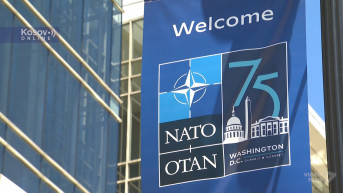
Before saving Ukraine, Biden must use the NATO summit to save himself, wrote CNN ahead of the Alliance's gathering in Washington. Indeed, many awaited the summit only to gauge the cognitive (in)ability of the American president, who, ironically, called Zelensky "President Putin" and confused Kamala Harris with Donald Trump. Biden, therefore, met expectations. But what about the summit?
Written by: Dragana Savic
Kurti used NATO's 75th anniversary to nostalgically recall that "without the Alliance and the bombing of Serbian police forces and the army, the liberation of Kosovo would not have been possible," accusing Serbia of aggression and expansion.
While the Kosovo prime minister believes in NATO, officials from Belgrade insist they believe in dialogue.
"We are not a member of NATO. We are a neutral country. But we want to, by using and relying on the power of dialogue, expand understanding of the Serbian position on our strategic national issues—from Kosovo and Metohija to the regional situation," emphasized Serbian Foreign Minister Marko Đuric on the summit's sidelines.
The sidelines seemed as heated as the main stage, although the primary program—focused mostly on demonstrating unified support for Ukraine and criticizing China—was also marked by tensions.
Ukraine's path to NATO was described as "irreversible," though Kyiv would have preferred a more concrete timeline for this process. Other countries awaiting NATO membership did not fare much better, as analysts note that there is fatigue regarding expansion within both NATO and the EU.
There may be fatigue regarding expansion, but not regarding the expansion of influence, with NATO increasingly focusing on the Indo-Pacific.
As for the Western Balkans, it remains a strategically and essentially important stronghold for the Alliance. So important that the 1999 bombing was used at this year's summit to rebrand NATO, resetting it to its original settings and presenting it as a force for good triumphing over evil worldwide.
International relations expert Mirko Dautovic told Kosovo Online that the Western Balkans played a "backstage role" at the Washington Summit, where the 1999 bombing was presented as a glorious period for NATO and a model for what the Alliance should do in the future.
"And Kosovo's Prime Minister Albin Kurti published an op-ed in the New York Times, on the front page, and appeared with General Wesley Clark on Christiane Amanpour's show, where they actually used that 1999 year. This completely repackaged what happened in history, but you can see that it served as a founding myth. So, all these organizations have a founding myth, and this is a refounding myth," Dautovic states.
He assesses that the messages to Ukraine from the summit were full of support, "but mild support," and reminds that Ukraine was already promised NATO membership in 2008, at the Bucharest Summit.
"Now the word 'irreversible' has just been added to Ukraine's path to NATO, which is essentially just a strong diplomatic term that means nothing. So, you only need to strengthen the message, but there is no effect. Ukraine is not a NATO member and will not be able to become a NATO member until the war with Russia is over. Since that is not in sight, there's nothing to it," Dautovic states.
Regarding the messages to China, he notes that there may have been slightly stronger words, "but in the end, there are no consequences there either."
"The loss of Taiwan, South Korea, Japan - that is dangerous. Losing control over the Malacca Strait, Singapore, where all the goods from the Middle East, Europe, and India to the Pacific pass through. This is the center of economic activities, and it is returning to Asia. So, India, Southeast Asia, China, Japan, where it was 500 years ago, so it is clear - in this shift of American attention - that they are fully aware of where the real danger is for the current system under American hegemony," says Dautovic.
Security studies researcher Nikola Vujinovic told Kosovo Online after the concluded Summit in Washington that Kosovo remains a "burning fire" and that the security issue is not significant "only due to the behavior of the Republic of Serbia."
"If Serbia were to behave as the so-called Kosovo government of Albin Kurti does, there would indeed be enormous problems. Therefore, it remains a problem, but its escalation depends on geostrategic factors," Vujinovic believes, adding that the strengthening of NATO in the Balkans aims to discourage such a development of the situation.
The Western Balkans remain strategically important, and their strategic importance will only grow as Russia approaches this region.
"The latest information is that, on the margins of this summit, Romania, Bulgaria, and Greece signed certain agreements to create various logistical routes that will bring US and other NATO member troops into the Black Sea basin. We have a base in Albania that is developing, a base in Romania that is developing, and the strengthening of NATO naval forces in the Black Sea. The only enemy can be Russia," our interlocutor explains.
On the other hand, he points out that "support for forces that have a conditionally anti-Serbian stance" is getting stronger.
"They are getting encouragement, if nothing else, by silence. The military is being strengthened in Kosovo and Metohija, Turkey is strengthening the Bosnian military, etc. We have practical steps indicating that NATO considers this its stronghold. Thus, the right wing in a potential conflict with Russia is being strengthened. And not only with Russia but also with the Middle East, Iran, etc.," says Vujinovic.
The message about Ukraine's NATO membership is, he emphasizes, a "fig leaf for Ukraine, so Ukraine does not give up its fight with Russia," but neither Moldova nor some other countries received any positive signals.
"I don't think further expansion was a priority of the discussions, and I am not sure since NATO, like the EU, has that expansion fatigue. Old members are not overly happy about receiving new states because they are not admitting Norway, for example, which is a developed and capable state, but rather some states with problems, like Ukraine or even Moldova or Georgia," Vujinovic notes.
Analyst from North Macedonia Petar Arsovski told Kosovo Online that the Western Balkans will become a risky area if they do not move forward towards NATO and European integration, adding that the main message from the Washington Summit is that NATO is strong and will not allow prolonged conflicts, like the war in Ukraine.
He adds that the message for candidate countries is that there is some perspective.
"In this sense, I think NATO is trying to show that it has successfully adapted to the new challenges of the new era because we are already facing a bipolar geostrategic situation, and I think NATO's transformation is not complete. This is the end of the beginning," Arsovski states.
According to him, security in Europe depends on how unified NATO is, how much unity it can maintain on the eastern front, and most significantly, on the situation in Ukraine and Moldova.
"There is political pressure from NATO and the EU to stabilize Ukraine and Moldova as territories and to strengthen the axis that starts from Poland and ends in Turkey on NATO's eastern side, but the Western Balkans cannot be left out. NATO integration of the Western Balkans is not sufficient; it must also integrate into the EU. So, I think NATO is trying to establish connections with other international structures," Arsovski believes.
The message from the NATO summit is that this alliance and the EU will not allow another crisis in Europe—neither in Bosnia and Herzegovina nor in Kosovo, Professor of Security Studies Avni Islami told Kosovo Online.
Islami believes that Bosnia and Herzegovina and Kosovo in the Western Balkans are potentially at high risk of destabilization, given that the policies of Serbia and Kosovo are not the same.
"Given that Serbia does not recognize the state of Kosovo, which has been internationally recognized by more than 100 countries, the talks are not progressing as they should to achieve a comprehensive agreement and mutual recognition. The message from the NATO summit is that this alliance and the EU will not allow another crisis in Europe, neither in Bosnia and Herzegovina nor in Kosovo. I believe the NATO summit was a clear message to Serbia and Kosovo to continue their mutual talks to achieve lasting peace not only in Kosovo and Serbia but also in Bosnia and the Western Balkans in general," Islami states.
He adds that Serbia is not interested in becoming part of NATO and the EU because Serbia traditionally coordinates its policies with Russia.
"Russia is interested in expanding its influence in Kosovo, Macedonia, Bosnia and Herzegovina, and Central Europe. Therefore, there are two opposing policies," Islami emphasizes, adding that it is important to have discussions with the representatives of Kosovo and Serbia, "as well as to achieve lasting peace in Bosnia."



comments