
New global balance at the 80th UNGA – What does it mean for the Western Balkans?
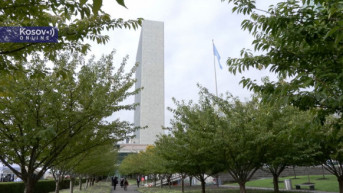
Recognition of Palestine, Donald Trump’s speech in which he reiterated that he “stopped seven wars in seven months,” and clear discord among leading countries on key issues—Ukraine and the Gaza Strip—marked the jubilee 80th session of the UN General Assembly. For analysts, this is an indication that the UN has lost the power to solve global problems. Sources for Kosovo Online also believe that “behind the scenes”—on the margins of the General Assembly—a diplomatic offensive by Serbia was noticeable, as were dissonant tones within the delegation led by Kosovo’s president Vjosa Osmani.
Written by: Djordje Barovic
“Dialogue has no alternative and it is the only way to achieve a just solution in accordance with international law, with respect for mutual obligations. Just as in the past, my country will continue to fight for peace—patiently, methodically, and in good faith,” Aleksandar Vucic said in his address to the UN General Assembly during the second day of the General Debate, at which leading world leaders presented their views on global problems.
Vucic said that “Serbia will never forget its history, its people and its sanctities,” and pointed to the difficult position of Serbs in Kosovo.
He appealed to the international community to help change this.
“Compassion is not enough; we need action,” said the President of Serbia.
Nevertheless, at the UN General Assembly the open questions of the Western Balkans were overshadowed by the war in Ukraine and by increasingly fierce clashes in the Gaza Strip.
A consequence has been a “wave” of recognition of Palestine by leading world countries, most of which are also permanent members of the UN Security Council.
According to the Croatian portal Index, almost twice as many countries have recognized this state as have recognized Kosovo.
As they report, Palestine has been recognized by 157 UN member states, i.e., 81 percent of all members of the organization, while a total of 84 states had recognized Kosovo by this year.
Some countries—such as Madagascar and Libya—have in recent years withdrawn or frozen their recognition, the Croatian portal notes.
The UN General Assembly is traditionally also an opportunity for meetings of world leaders on the sidelines of the gathering.
Serbia’s Foreign Minister Marko Djuric stated that the country held “an incredible array of meetings,” at which the Kosovo issue was discussed, as well as the strengthening of economic ties with other states.
A key meeting on strategic dialogue was held by Serbia’s President Aleksandar Vucic with U.S. Secretary of State Marco Rubio.
Osmani later met with Rubio as well, but during a reception organized by the U.S. Mission to the UN.
“Osmani in a way smuggled herself into the UN building—she received from another state a so-called ‘secondary pass’ for entry to the UN, over which we have already lodged a note with the United Nations,” Djuric told reporters.
On the other hand, numerous analysts in Pristina warn that the Kosovo delegation did not fulfill the purpose of its trip to New York.
“Look at the State Department website—you can see there whether Rubio had a meeting with the president. If someone went there to have their photo taken while shaking hands with someone, that’s a different story. Where is the photo showing they had a formal meeting? These are fairy tales,” asked political analyst Dardan Gasi.
Shkelzen Maliqi assessed that “what is happening with Kosovo’s diplomacy is a scandal.”
Albanian activist Uk Lusi, who lives in the United States, goes a step further. He claims that the meetings of Osmani and Gervalla in New York were “uncoordinated and without substance,” as well as amateurish.
“And that is not because we lack professionals in diplomacy, but because they are being misused and not listened to when advised to place state interests above the interests of leaders,” Lusi believes.
On the other hand, some media go further, claiming that the reasons for the Kosovo delegation’s lack of success in New York should be sought in the “poor relations” between Osmani and Gervalla, which is why joint meetings were lacking.
Dynamics and Distancing
Milos Pavkovic, Strategic Director at the European Policy Centre, tells Kosovo Online that this is the result of the “dynamics of internal relations in Kosovo.”
“We see there is no government; there is a serious political and constitutional crisis. When we take into account that the President of Kosovo and the Foreign Minister do not come from the same political groups, it becomes clearer why relations are like that and why there is a lack of coordination,” Pavkovic stresses. He also sees as one of the key events the recognition of Palestine by permanent members of the UN Security Council—alongside the “evident absence of the U.S.”
“This is the largest wave of recognition of a state since 2008 and the case of Kosovo’s self-proclamation,” Pavkovic points out.
Another important moment from the UNGA session, he says, was the speech by U.S. President Donald Trump, who criticized “migration and green policies,” and, at the same time, the video message by China’s President Xi Jinping.
“What came as a big surprise was the speech by the Chinese president (Xi Jinping), who was not physically present in the hall but addressed the Assembly by video, emphasizing China’s clear ambition to become a leader in environmental protection, i.e., the ‘green transition,’ which is a somewhat unexpected message,” Pavkovic believes.
He adds that the UNGA session was also marked by discussion and attempts to seek answers regarding the conflict in Ukraine and the issue of Israel and Palestine.
“These matters were examined in depth within various speeches,” the analyst specifies.
Commenting on the participation of the Western Balkans at this year’s UNGA session, Pavkovic says that the topic was not represented in the speeches of representatives of the world’s most important states.
“President Vucic’s speech was certainly of interest—he referred to Belgrade and Serbia not as a ‘buffer zone’ but as a bridge for future negotiations in various armed conflicts, and of course to the issue of Kosovo and Metohija and the importance of the territorial integrity and sovereignty of UN member states. These were the key points he touched upon, linking them with the ongoing global political crises,” Pavkovic says.
“Pale” Conclusions
For political analyst Nexhmedin Spahiu, the “mass recognition” of Palestine is also what marked the 80th session of the UN General Assembly in New York.
“That was to be expected. Many countries had long announced recognition of Palestine after everything that has happened in Gaza. This is also the most important issue for humanity. Still, it is no small matter—we are dealing with genocide in the 21st century, which can become an example for all other countries. If it is not stopped now, it could be applied elsewhere in the world,” Spahiu tells Kosovo Online.
He notes that developments in the Gaza Strip should have produced far more “radical conclusions” instead of “pale” ones.
“This is the key issue the UN General Assembly must deal with, and thank God it is; however, the conclusions are still ‘pale’—not as radical as might be expected,” Spahiu emphasizes.
Commenting on the meeting on the margins of the UNGA between Serbia’s President Aleksandar Vucic and U.S. Secretary of State Marco Rubio on strengthening the strategic dialogue between the two countries, Spahiu says this is “a big deal for the good of both Serbia and the region.”
Spahiu points out that relations between Serbia and the U.S. “drew radically closer” during the period when Marko Djuric was ambassador in Washington, and later became foreign minister.
“Within that context, the announced meeting between President Vucic and Rubio, the Secretary of State for foreign affairs, is an opportunity for relations between Serbia and America to draw closer still. Of course, when mentioning the contribution of Serbian diplomacy, we cannot forget that America was the one that bombed Serbia 26 years ago. But considering that factor, the rapprochement between the two countries is still a major development, and I think it benefits Serbia and the entire region,” Spahiu believes.
“A Place for Negotiations”
For security studies researcher Nikola Vujinovic, the 80th session of the UN General Assembly in New York showed that this institution is no longer a place for negotiations.
“The UNGA session showed two key things. First, that the historic bell tolled for the recognition of Palestine by the United Kingdom and France. Thus, four out of the five great powers—permanent members of the UN Security Council—became supporters of Palestine and the two-state solution. The second is something unspoken, but evident from the very start of the General Assembly—that unfortunately the UN is no longer an institution for negotiations, that the great powers can do whatever they want, and there is no framework to stop them,” Vujinovic tells Kosovo Online.
He adds that a big surprise is that U.S. President Donald Trump “changed his rhetoric again.”
“True, policy has not changed yet, but the rhetoric has. Just a few days ago Ukraine was on the verge of disappearing, and now it seems Russia is on the verge of disappearing. So once again it is clear that Trump and the administration he leads do not quite understand international politics and diplomacy as they should,” Vujinovic observes.
On the sidelines of the UNGA session, a meeting was held between the foreign ministers of the Western Balkans and the foreign ministers of the ‘Friends of the Western Balkans’ group.
Vujinovic notes that this is “a good sign.”
“I’m glad the Friends of the Western Balkans forum was held on the margins of the session, although I think (Donika) Gervalla had no place there as the representative of an unrecognized state. Still, it is good that such forums are held because it is a sign that there is room for dialogue. We have not yet descended into open conflict,” Vujinovic stresses.
Assessing the participation of Western Balkan representatives at this year’s UNGA, Vujinovic believes there are different “categories” in how they presented themselves.
“We have Serbia’s participation, which I would say went excellently. The meeting with Rubio shows that best, as do a series of bilateral meetings and President Vucic’s speech, which resounded through the General Assembly. And unfortunately, we have other examples, such as Kosovo’s ‘state-likeness’ through Vjosa Osmani, who showed what it looks like when you are, like a tourist, unwelcome in New York. We witnessed that she had to sneak in to enter the UN,” Vujinovic says.
He adds that apart from Serbia’s representatives, Balkan leaders generally played a less noticeable role.
“We have Zoran Milanovic, who wants to recognize Palestine, while Croatia as a republic does not. North Macedonia—silence. Montenegro was not even ‘visible’,” this analyst notes.

0 comments