
The new policy of the Council of Europe: Declaration of sovereignty that does not apply to all and where it leads
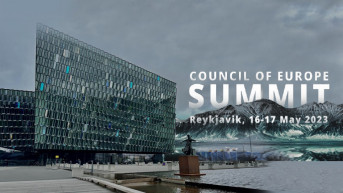
When the leaders of the member states of the Council of Europe gather today in Reykjavík to adopt the Declaration on the Territorial Integrity and Sovereignty of Ukraine, Moldova, and Georgia, but not all other countries, during the two-day Summit, it will be another demonstration of double standards, say Kosovo Online interlocutors. and the application of rules and laws as they suit the interests of the great powers. They add that this will officially bury international law and principles in yet another international organization.
The insistence of the "greats" that the territorial integrity of some countries is more important than the borders of others, in this case Serbia, our interlocutors point out, is a message that for them the issue of Kosovo's independence is a done deal and that Belgrade should also come to terms with it, but also a kind of invitation to those states that do not recognize Kosovo to do so.
Neither Serbian President, Aleksandar Vucic nor Prime Minister, Ana Brnabic will travel to the Summit in Reykjavík, because Belgrade's amendment to add "all other members of the Council of Europe" to the document on respecting the territorial integrity of Ukraine, Moldova and Georgia did not pass. As revealed by Serbian Minister of Foreign Affairs, Ivica Dacic, "Germany did not like it" and that was why Belgrade would be represented at the Summit in the capital of Iceland at the ambassadorial level, or rather, the head of the Mission of Serbia to CoE, Aleksandra Djurovic, would be present.
The president of the Presidency of Bosnia and Herzegovina, Zeljka Cvijanovic, is not going to the capital of Iceland either, because, as she said, "she does not want to witness yet another mockery of international law."
For Nemanja Zavisic from the Center for Social Stability, there is no doubt that the adoption of such a declaration as is being prepared in the CoE will show that international law is interpreted arbitrarily and that in most cases international organizations are only instruments for the implementation of policies in the hands of the great powers.
"In international relations, the medieval rule that the stronger oppresses is clearly valid again. It is certainly very unfavorable for small countries, and in that sense, our fight for the preservation of Kosovo and Metohija as part of Serbia, which is based on respect for international law, will be increasingly difficult," Zavisic says.
The fact that Serbia will be represented at the Council of Europe meeting in Reykjavik at the ambassadorial level and will not vote for the declaration on the protection of the territorial integrity of Ukraine, Georgia, and Moldova, that is, will abstain during the vote; Zavisic considers it being the right decision.
"The reason for making such a decision by our state leadership is certainly the shameful and illegal decision of the Committee of Ministers of the Council of Europe from April to start the procedure of admitting the fake state of Kosovo into that regional organization. Unfortunately, by making such a decision, the most powerful countries within the CoE seem to have wanted to reward Kurti for trampling on all the rights and freedoms of the Serbs in Kosovo and Metohija, but also for the "successful" implementation of the elections, in which only 3 percent of the voters participated. It is obvious that these were completely "legitimate and legal" elections in accordance with the highest European standards, the principles of freedom and democracy, and the award to Kurti came as a logical sequence of events. However, it was completely to be expected that it would produce deep political consequences, and one of them will already be seen at the announced summit in the capital of Iceland," Zavisic says.
He believes that Serbia's participation at the ambassadorial level at the CoE Summit sent several important messages.
"First of all, it should be underlined that our country remains firmly and consistently on the line of defense of international law and equal respect and appreciation of the sovereignty and territorial integrity of all internationally recognized states. This is precisely why we acted in an extremely constructive manner and proposed an amendment to the resolution in which it is written that the wording "to respect the territorial integrity of all other member states of the Council of Europe" should be added to the text of the document. Unfortunately, for purely self-interested political reasons, our proposal was rejected, because obviously in international relations, especially viewed from the point of view of the great powers, the most important principle is the principle of double standards. What is valid for Ukraine, Georgia, and Moldova is obviously not valid for Serbia. In this way, unfortunately, international law was buried in yet another organization," Zavisic points out.
He says that Serbia respects the territorial integrity of all countries, but that in this way it will let everyone know that we expect everyone to treat us equally when it comes to our borders.
"Therefore, the decision of the Council of Europe will not be unanimous this time, but the voice of libertarian Serbia will be clearly heard and seen," our interlocutor says.
He adds that this decision of the Serbian state leadership is in line with the announcement of President Aleksandar Vucic about deep and essential changes in our foreign policy.
"I expect that in the coming period, during every vote in all international organizations, we will be guided primarily by the principle of reciprocity. We will respect and appreciate our friends, but even more, we will take care of who behaved how when it comes to our vital interests. In this way, we will send a clear message to everyone who counts on our vote and support in the future, that for good relations it is necessary that it be mutual. In the previous decade, Vucic showed great skill in conducting foreign policy, and I am absolutely sure that this decision is also in the best interest of our people and the country, and in this way, I offer full support to our leadership in the fight for Kosovo and Metohija," Zavisic believes.
Slobodan Zecevic from the Institute for European Studies also states that what now applies to Ukraine and other countries of the former Soviet Union, obviously does not apply to Serbia. That is, to respect the integrity of all the former republics of the former SFRY, except for Serbia.
"It is a reflection of the geostrategic situation in today's world, where the Western world simply respects the integrity of countries when it fits into their geostrategic plans, and when it doesn't, they don't respect it. I think that this is one of the precedents that is causing these instabilities in the whole of Europe. Because it is no longer known when territorial integrity is valid and when it is not, that is, it is relativized and in one case it may be valid, but in another, it is not," Zecevic says.
He continues that this will lead to the creation of some precedents for the dismemberment of the Russian Federation, which the Russians, he says, know very well.
"It is precisely this that leads to geostrategic conflicts between Russia and the West. The disintegration of Yugoslavia, and even today the attempts to do it to Serbia, can serve as a precedent for breaking the integrity of the Russian Federation tomorrow," our interlocutor says.
When asked whether the international order as the world had known it until that moment, which had begun to be "abolished" with the breakup of Yugoslavia, through the bombing of Serbia and the declaration of Kosovo's independence, now definitely ceased to exist, Zecevic points out that "the international order has always rested on the law of the strongest".
"It was always the strongest who dictated international law and relations. After the Second World War, the victorious powers, the US and the USSR, along with Great Britain, France, and China, were the ones who established that new international order, the United Nations and the Security Council. Today, the fight is on who will be the winner in this geostrategic conflict, and now each side wants to impose its own vision of international law and order. Unfortunately, we did not do well in that story," he says.
Zecevic points out that the refusal to include in the declaration the formulation of support for the territorial integrity of all Council of Europe members sends a certain message to Serbia and those countries that do not recognize Kosovo.
"The message sent by the most influential members of the Council of Europe is that Kosovo is an independent state. The direct message to Serbia is - 'make peace with it, Kosovo is an independent state'. And it will be accepted wherever it can in international organizations, that is, where Western countries can gather a majority for Kosovo's membership. This is also a message to those who have not recognized Kosovo - 'it's time to do so,'" Zecevic explains.
He says that by deciding not to be represented at the Summit at the highest level, Serbia has made it clear that it is dissatisfied with the entire relationship and that it insists on not recognizing the independence of Kosovo.
"For us, the fact that we are part of Europe is both a blessing and a problem. In that sense, we also have advantages from that, because Europe is still the area where people live probably the best in the world, but on the other hand, our geostrategic position was destabilized in 1945, then in 1990, then in 1999, and so on. We have completely lost the advantages we should have had thanks to the victory in the First and Second World Wars," he states.

0 comments