
OSCE Summit in Skopje: Betrayed expectations or a bitter pill of sobriety?
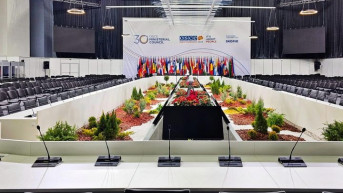
In the capital of North Macedonia, the 30th Ministerial Council of the Organization for Security and Co-operation in Europe concluded today.
The summit in Skopje brought together 57 OSCE participating states and 11 OSCE partner countries, with the general conclusion being that instead of a "new beginning" and a return to founding principles and the "spirit of unity", the organization demonstrated powerlessness and division over key security challenges in the world.
Vice President of the Forum for International Relations and former Ambassador to the OSCE, Branka Latinovic, assessed for Kosovo Online that the main message at the OSCE Ministerial Council in Skopje had focused on the war in the eastern part of Europe and emphasized the importance of adopting a declaration in the fight against corruption. Latinovic highlights that the main messages were directed towards the Russian Foreign Minister, Sergey Lavrov, and thereby to Russia, regarding the need to respect the Helsinki Final Act, among other things, as the first and most important principle of respecting the territorial integrity and sovereignty of states, and to bring that conflict to an end.
"In that context, there were also the corresponding absences of a number of participating states, considering the presence of the foreign ministers. Other topics related to what is current in the work of the OSCE, namely its bodies, primarily related to climate change, but also everything happening in Europe and around us, including our region. It is important to emphasize that the most significant document adopted during the first day of the summit, in my opinion, is the Declaration signed by the foreign ministers of the region in the fight against corruption. This acknowledges the importance that the OSCE has in the region and provides support in the fight against corruption, helping states, primarily in strengthening legal instruments and police cooperation to reduce this not only regional but global problem to the minimum possible level", Latinovic said.
Long-time correspondent for Politika in Skopje, Zeljko Sain, highlighted for Kosovo Online that no matter how pessimistic or negatively one viewed the two-day summit in Skopje, the positive aspect was that all significant statesmen had still attended the OSCE Ministerial Council.
According to him, the fact that all these significant statesmen did not meet does not necessarily mean there is no perspective for peace, as their presence showed that they must negotiate and come to an agreement about the future.
"We couldn't expect it to happen suddenly, all at once. The Russian Foreign Minister has not been invited to OSCE sessions for two years, and we couldn't expect that to happen now, for him to sit down with him and Secretary of State Blinken because we know that these are two individuals, representatives of states, who are very responsible for peace in the world, and based on their actions, we currently have an informal division between East and West. One of the fundamental messages that can be sent from here, from all foreign ministers, is that we can hope for a dialogue on peace in the world", Sain said.
He also emphasized that the OSCE Ministerial Council was very important for North Macedonia.
"For Macedonia, this event is very important because it once again showed that there are no big or small, but there are very significant, worthy ones who advocate for a certain situation", Sain added.
As he says, a country with two million inhabitants that emerged from the breakup of the SFRY has managed to show, as in the case of the "Open Balkan", that one of the most significant situations is peace.
"It has been shown how the 'Open Balkan' formula can be transferred to larger international organizations, where discussions take place at full capacity, as it was today. Actually, small countries can be an example of how to do it and ensure that every person has basic rights, that the rule of law is restored, and that politicians must take care and must make conscientious and significant decisions for peace in the world. And that will resonate from Skopje this time", Sain said.
The unanimous assessment is that divisions within the OSCE have never been greater, and the blockade of certain decisions has almost called into question the future of the organization. When asked whether the participants in Skopje had witnessed the beginning of the end or the recovery of the OSCE, Sain says that, nevertheless, they witnessed the revival of the organization.
"I don't believe that we witnessed the destruction of an international organization. I think we witnessed more the revival of an organization that advocates for peace in the world and provides inputs on how things should be done", he emphasized.
As he says, just like in every family, state, or in every change of a system, there are flaws that need to be overcome, and the OSCE has faced such situations.
Top of Form
"I think that happened in Skopje, with Blinken landing here, talking as a strategic partner with the Macedonians, and at the same time, Lavrov came, who did not have the right to talk as a strategic partner with Macedonia because it is a part of NATO. But when you take a look at their arrivals, it means that a dialogue toward peace can be expected, but it cannot happen overnight", Sain concluded.


comments