
On paper, the ban on Serbian imports was partially lifted nine months ago – but what’s the reality?
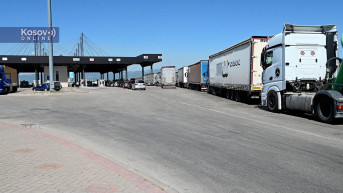
Nine months after the decision to partially lift the ban on imports of Serbian goods, Kosovo authorities continue to keep border crossings—through which these goods previously entered Kosovo—closed, with the exception of Merdare. There, trucks wait up to 24 hours due to lengthy inspections. While the official excuse may be the delayed arrival of scanners meant to be installed at the crossings, the real reason is political, argue interlocutors of Kosovo Online, who stress that the economic damage is felt by businesses and the Serbian community.
Written by: Dusica Radeka Djordjevic
At Merdare, truck queues stretch for several kilometers.
"Neither forward nor backward. Poor conditions, we sleep on the street, waiting. It’s really tough—the goods are waiting for delivery, and nobody asks," said Darko, a truck driver from North Macedonia, who had already waited 20 hours when Kosovo Online reporters found him at the crossing.
According to another driver, Berisha, waiting times vary by day. His longest wait was 24 hours.
"It’s not our fault—not the drivers, not the companies. This is a government issue. The other crossings should have been opened a long time ago," he said.
There were expectations as early as October last year that the remaining crossings would reopen, but the condition was that scanners be installed—scanners that have yet to arrive. Germany, which is participating in the procurement, is expected to deliver them next year.
"Considering the time required for manufacturing and delivery, as well as multiple global crisis zones, the scanners are ideally expected to arrive in 2026. Due to the technical complexity of the project—since X-ray cargo scanners are not finished products but need to be assembled—this process takes time and careful planning," the German Embassy in Pristina told Kosovo Online.
Agim Shahini, president of the Kosovo Business Alliance, believes all crossings should be reopened for Serbian goods, as doing so would not endanger either Kosovo’s or Serbia’s economy—instead, it would facilitate the flow of goods, capital, and people.
He views the opening of Merdare alone as a political move by Kosovo in response to past events.
"The scanners are still somewhere in transit, never arriving. They’re beneficial to all, but scanners should not be used as an excuse to close all border crossings with Serbia—goods don’t just come from Serbia but from all over the world," Shahini emphasized.
He added that Merdare is congested, with long lines and delays.
"Each truck has to wait at least 48 hours. Drivers have to sleep there, without access to showers, incurring high costs. When a truck is stationary, it consumes fuel and generates losses instead of income. The total losses on both sides amount to several million," he said.
According to Shahini, Kosovo faces daily pressure due to its political decision—from the EU, businesspeople, importers, and transporters alike. He believes it’s no longer time for Kosovo to harm Serbia or vice versa.
"It’s time to support each other, to open the borders, to extend a hand, to acknowledge we can’t live in isolation or be everyone’s adversary. Neither Kosovo nor Serbia. Now is the time to open the borders and unite the Balkan economy," Shahini told Kosovo Online.
Stefan Surlic, Assistant Professor at the Faculty of Political Sciences in Belgrade, told Kosovo Online that EU countries have so far made no efforts to push Pristina to unblock crossings for Serbian goods.
"We see there are no sanctions, which means that the Kurti government’s policy has been: 'As long as we can do what we want without serious consequences, we’ll keep going.' But this certainly violates CEFTA rules. A measure in place for nine months causes enormous harm—not only to the economy but also to people accustomed to these products, who want to buy and trade. It primarily affects the Serbian community. But there's no political will," Surlic emphasized.
He added that Pristina currently has a “technical excuse,” since the German scanners haven’t arrived yet—though they should have by now.
"Scanners should have been installed at Merdare first, to avoid the daily congestion and queues, and then at the other administrative crossings. But in essence, as long as there’s no goodwill from Pristina, I believe that even when the scanners do arrive, another technical excuse will be invented to avoid changing the decision," said Surlic.
He believes the German government does not consider scanner delivery to Kosovo a priority at this time.
"That only existed as an option when Sarrazin, as mediator, was strongly invested in ensuring that scanners arrived quickly so Germany could claim a key role in normalizing Belgrade–Pristina relations. After his departure, the matter was shelved, and now there’s no one in the German system responsible for accelerating and unblocking the process," Surlic noted.
Kosovo had imposed a total ban on Serbian goods for a full 16 months—from June 14, 2023, to October 7, 2024—after Serbia arrested three Kosovo police officers.
According to Kosovo Customs data, in the first five months of 2025, €91 million worth of goods were imported from Serbia—an increase of €49 million or 116% compared to the same period last year, when imports totaled €42 million. However, it should be noted that during the first five months of 2024, the import ban also applied to finished products even through Merdare—only raw materials, fertilizers, and certain semi-finished goods were allowed to enter Kosovo.


0 comments