
Presidential “game of cat and mouse” – Does Kurti have an alternative to Osmani?
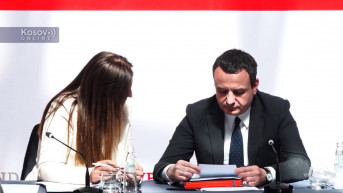
A compromise over a presidential candidate or new snap elections? Political analysts from Belgrade and Pristina describe the current situation in Kosovo as a “game of cat and mouse,” assessing that both Self-Determination, led by Albin Kurti, and the opposition are bluffing. Opinions, however, are divided as to who will be able to hold out longer. While some believe Kurti will not jeopardize his electoral victory by backing Vjosa Osmani for a second term, others argue that he owes her political loyalty precisely because of that victory. The question arises: is there a compromise solution?
Written by: Petar Rosic
Although it seemed that Osmani was Kurti’s strongest ally and the most certain candidate for president, analysts have warned in recent days that this would pose too great a risk for Kurti. Blerim Canaj points out that it is more likely she would take the post of Minister of Foreign Affairs, while career diplomat Albert Prenkaj believes the opposition should propose a presidential candidate.
Other analysts share similar views. Imer Mushkoljaj assesses that Kurti has publicly hinted that there may be another name for the position.
“The signal Kurti sent is not only about the elections. I think it is more a signal that someone will nevertheless be found or proposed who can achieve a much broader consensus than merely within Self-Determination,” he said.
Political analyst Azdren Shala even mentioned a specific name. He said he had information that, instead of Osmani, the former mayor of Srbica would be proposed as president.
“My information indicates that Bekim Jashari will be the Self-Determination candidate proposed for President of Kosovo,” Shala stated.
Three Steps Before Re-Election
On the other hand, Osmani confirmed that she is seeking another term at the helm of Kosovo, noting that the final decision rests with the future convocation of the Assembly. Commenting on her cooperation with Kurti, she said they had always shared a “common goal.”
Kurti himself, however, was more cautious regarding support for the incumbent president. He said it was necessary to meet with Osmani to discuss her interest in another term, adding that securing the presence of 80 MPs in the chamber at the time of the presidential vote represents a significant challenge.
“First, we must form the Assembly and the government. We also have to vote on the budget. I believe these are the most important steps. So, there are three steps before we come to the re-election of the president,” Kurti said.
A Favor for a Favor
Miloš Pavkovic of the Center for European Policy assesses that it would certainly be wiser for the leader of Self-Determination to offer a non-party figure as a presidential candidate—someone the opposition could not easily reject—but that it is unlikely to happen because, as he told Kosovo Online, Kurti “owes Osmani a favor.”
“She called early parliamentary elections on a date that most benefited Self-Determination. On the other hand, she also achieved significant diplomatic successes with several recognitions last year, some of them at the height of the election campaign, which definitely contributed to Self-Determination’s victory, as Osmani and Kurti are often viewed as a political duo,” Pavkovic said.
For all these reasons, he does not expect Kurti to “betray” Osmani now and propose another candidate.
“Despite everything, I think the final decision will be to re-nominate Vjosa Osmani as the ideal candidate of Self-Determination, at the cost of risking renewed political instability,” he said.
Pavkovic adds that, based on the past five years of Kurti’s time in power, it can be concluded that he is not inclined toward compromises, especially not with the opposition.
“This is another reason why I do not expect him to seek a compromise presidential proposal in cooperation with the opposition. If, however, we speak of some other compromise solution within Self-Determination, whoever the movement’s candidate might be, I think they would meet the same fate as Konjufca did for prime minister or as their original candidate for Speaker of the Assembly last year. So it is equally problematic,” he noted.
Elections as a Risk for the Opposition as Well
He believes a potential compromise solution would exist only if a prominent non-party figure were proposed.
“Someone who was a member of the KLA in the 1990s or a distinguished citizen of Kosovo, against whom the opposition would find it difficult to justify opposition. However, again, knowing Kurti, I do not think this is the path he will take; rather, he will stick to the duo with Osmani,” he said.
He explains that Kurti would thereby risk new snap elections if he failed to secure a two-thirds majority in the first two rounds of the presidential election in the Assembly.
“If there is no two-thirds majority in the first two rounds, the vote is by absolute majority, but a quorum of 80 MPs is required, which Kurti currently does not have. This is a challenge because if the president is not elected even in the third round, the Assembly is dissolved and snap parliamentary elections are called,” he pointed out.
He describes the issue of new elections as a “game of cat and mouse.”
“As unfavorable as they could be for Kurti, they could be equally unfavorable for the opposition, which was thoroughly defeated in these parliamentary elections. And that is where Kurti clearly sees his advantage and likely assesses that the opposition is not ready for new elections and will ultimately give confidence to his candidate,” Pavkovic concluded.
A Different View from Pristina
Pristina-based analyst Nexhmedin Spahiu, however, sees the situation differently. He believes the leader of Self-Determination must not risk the opposition rejecting the presidential candidate he proposes.
He told Kosovo Online that Kurti is gauging public opinion and has enough time to test attitudes toward his candidates.
“He releases one name, then another, then a third. This time he is listening to reactions to Osmani—whether she will have the votes or not. But he also has other candidates whom he will release after some time to check reactions to them. I believe he must not risk proposing a candidate who will not be accepted, because in that case he would have to go to elections. And now elections no longer fall at a time when the diaspora is here, and he cannot get as many votes as he did on December 28, when the diaspora was present,” Spahiu said.
Multiple Candidates, Low Probability
Spahiu notes that Kurti has several candidates he could propose, but that the likelihood of the opposition supporting any of them is low.
“It is hard to believe that there is a person in Kosovo who would be jointly elected by both the government and the opposition—unless, for example, the Americans and the British insisted on a certain person and exerted pressure on both sides. For now, however, there is no indication that such pressure will occur to elect a president. That is why it remains uncertain who the new President of Kosovo will be,” Spahiu said.
For all these reasons, he assesses that a compromise over the presidency is far more favorable for Kurti than new elections.
“He must not risk the mandate he won with more than 51 percent of the vote, which allows him to govern for the next four years without coalition partners. So, in the end, he will bluff. The opposition will bluff as well, but someone will have to give in,” he said.
Commenting on speculation that Vjosa Osmani could be offered the post of Minister of Foreign Affairs, Spahiu said this would suit neither her nor Kurti.
“That is nonsense. Those are not analysts, but promoters of opposition parties who want to muddy the waters as much as possible. There is no way Vjosa Osmani would move from the position of president to that of foreign minister. First of all, she would not agree to it. Second, if Kurti does not want her as president, he would not want her as foreign minister either. So that is a scenario that will not happen,” he said.
He added that Osmani has threatened Kurti that, if he does not elect her president, she will form a party and become his fierce political opponent.
“How much Kurti fears that is another question. But I think she will either be elected or she will not. If she is not elected, she will form a party and wage a political struggle for the next mandate,” Spahiu concluded.
The Decision Lies with the Opposition
Program Manager of the NGO “New Social Initiative,” Milica Andric Rakic, however, believes that the decisive factor in electing a president is not whom Kurti proposes, but the strategic decision of the opposition—whether it wants to trigger new elections or not.
She told Kosovo Online that if the opposition decides to go to elections, none of Kurti’s candidates will influence that decision.
“However, it should be emphasized that not all opposition actors are equally interested in elections. For example, the Democratic League of Kosovo (LDK), given its poor results and potential leadership changes, might calculate that it is better not to go to elections. Also, Ramush Haradinaj might assess that he could somehow remain below the electoral threshold, and that it would therefore be better not to go to elections,” Andric Rakic said.
Further developments, she added, will depend on whether the opposition can unite around a decision to seek new elections and whether it is ready to take the risk. If such a decision is absent, Kurti is, in her view, in a more comfortable position.
“In that sense, I do not see a risk for Kurti in terms of candidate selection. That is, if the opposition wants to provide a quorum, whichever candidate he proposes will get those 61 votes in the final round,” she said.
She emphasized that the opposition lacks a “lever of power” over Kurti that would force him to choose a compromise candidate acceptable to all.
“It is not about the acceptability of the candidate, but about the fact that the opposition does not feel it is in a position to go to elections and therefore does not have a lever of power over Kurti to condition him into choosing a compromise candidate, a figure acceptable to everyone. Provided there is a quorum of 80 MPs, Osmani herself, by virtue of her authority, could reach the required four additional votes from MPs of non-majority communities with Kurti’s 57 votes,” Andric Rakic concluded.


comments