
Pristina and Sarajevo join forces - is Serbia facing another genocide resolution?
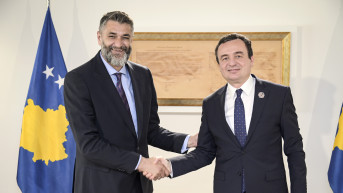
The Pristina Institute for Research and Documentation of Crimes Committed During the War and the Srebrenica Memorial Center have announced the signing of a memorandum of cooperation. Analysts for Kosovo Online assess that Pristina has long been trying to align its policies with the Bosniak elite in Sarajevo and that behind this lies Albin Kurti's attempt to "copy the Srebrenica Resolution," which he would use to confront Serbia.
The cooperation agreement was preceded by a recent visit of the director of the Srebrenica Memorial Center, Emir Suljagic, to Kosovo. Albin Kurti welcomed him during this visit.
During the meeting, the Kosovo Prime Minister stated that for peace in the Balkans, "Serbia must confront its past and be held accountable for the crimes, massacres, and genocides it committed, and those responsible for war crimes must be brought to justice."
Suljagic expressed his gratitude for the "warm hospitality he receives in Kosovo" and reiterated that there is potential for developing cooperation between Kosovo and Bosnia and Herzegovina. Among them, as announced, is an agreement between the Pristina Institute for Research and Documentation of Crimes Committed During the War and the Srebrenica Memorial Center.
Last week, the director of the Pristina Institute, Adem Hetemi, confirmed that the process of signing the agreement is underway and stated that it will enable regional cooperation aimed at documenting all war crimes committed during the wars in the former SFRY.
He added that this means the cooperation will not only be at the local level but also that they strive to regionalize cooperation with other institutions dealing with the documentation of war crimes committed during the Kosovo war and in the Balkans during the 1990s.
Lawyer Tom Gashi has no doubt that the ultimate goal of this cooperation is another UN resolution against Serbia.
"Since we already have one United Nations resolution on Srebrenica for war crimes, I think that everyone from the former Yugoslavia should have the same goal – to uncover all the crimes whoever committed them, but in this situation, we are talking about the Serbian army," Gashi told Kosovo Online.
He explains that a genocide resolution would give Pristina satisfaction "just as they received in Srebrenica," but it also opens avenues for lawsuits in international courts.
"We need to know everything that happened during the war both in Kosovo and in Bosnia, especially when we talk about Srebrenica. You see that this has been hidden for almost 30 years, but in the end, even the United Nations verified it and passed a resolution on the crimes, on the genocide committed in Srebrenica, and I think that contributes to peace, not the opposite," said Gashi.
Igor Vukadinovic, a research associate at the Institute of Balkan Studies, assesses that the Kosovo authorities will attempt to create something similar to what the Bosniaks did with the Srebrenica narrative, but he tells Kosovo Online that the chances of them succeeding are much smaller.
"The connection between the Kosovo authorities, Pristina with Sarajevo, and the Bosniak political elite is something that has actually existed for quite a long time. This cooperation was established back in socialist Yugoslavia - linking the republics for common interests, often against Serbia and Serbian interests. In this sense, Albin Kurti is quite sympathetic to Bosniak interests," says our interlocutor.
Regarding the Bosniak political elite, he notes that they would have recognized Kosovo long ago if it weren't for the Republic of Srpska, which prevents such formal recognition in the joint institutions.
"On the other hand, the Kosovo authorities certainly like the way the Bosniaks politically profit and exploit the topic of history, the topic of war crimes during the war, and in some way, the dehumanization of Serbs that is carried out through this mantra, namely, about Srebrenica, which has lasted continuously for years and which the West has accepted. The Kosovo authorities are not nearly as successful as the Bosniaks from Sarajevo have been in exploiting the topic of war crimes to gain some concrete political benefits," Vukadinovic believes.
He believes that the Albanian authorities in Kosovo will attempt to do something similar in the coming period.
"So, they will try to create a copy of what the Bosniaks did with the story of Srebrenica, but the chances for that are much smaller, given that they entered that narrative much later and began the project of mythologizing a specific war crime to make it a symbol of the entire war and to gain new political points in that way," says the historian.
He recalls that one of the most well-known cases in Kosovo is Račak, but that "it shows more of a setup than a genuine war crime."
"So, it represents more of an excuse and an alibi for the start of the bombing rather than a real mass crime against civilians. In that sense, the Albanian authorities in Kosovo are trying, with significant delay, to approach the topic of the war in the same way the Bosniak elites did. Their motives are actually similar, but the circumstances are quite different. Therefore, I do not expect that there will be any great success from that side," he concludes.
Historian and analyst Srđan Graovac from the Center for Social Stability also believes that Pristina and Sarajevo support each other towards a common goal, which he assesses for Kosovo Online as the independence of Kosovo and the dissolution of the Republic of Srpska.
"On one hand, we are well aware of the strategy of political circles in Sarajevo, which is to use the principle of genocide allegedly committed in Srebrenica in their attempt to dissolve the Republic of Srpska. Albin Kurti has a similar strategy and he does not hide it. If you consider his behavior and his statements in the previous period, you will see that he persistently repeats that there are supposedly four genocides that Serbs committed against Albanians in Kosovo and Metohija," says our interlocutor.
He explains that this narrative of genocide serves as a basis for Kurti's confrontation with Serbia and Serbia's influence in Kosovo, and that the essence of his narrative is similar to that of the Bosniak political elite.
"If Serbs committed genocide in Srebrenica, then the Republic of Srpska is a genocidal creation, and therefore, it should be abolished. Similarly, he thinks, if Serbs committed genocide in Kosovo and Metohija, then Serbia cannot invoke international law, because a people and a state that committed genocide should, in his opinion, be denied certain opportunities and should be pressured to meet his political interests," Graovac states.
He believes that Kurti will insist on this narrative precisely to pressure the international community, to further pressure Serbia to accept the independence of Kosovo, and to insist in the international geopolitical arena that the same rules cannot apply to Serbia as to all other countries.
"When you consider everything, it becomes clear that Pristina has been trying to align itself with political Sarajevo for a long time. Both have a strong lobby in the United States in particular, and this is some attempt at cooperation to support each other towards a common goal," says our interlocutor.
He notes that Serbia has a response to this, citing the debate in the United Nations General Assembly on the Resolution on Genocide in Srebrenica as an example.
"Since the majority of countries were against that resolution, they cannot achieve that moment of mobilizing public opinion on a global level, and that is how we opposed the Srebrenica Resolution. We will have to apply the same principle when it comes to the alleged genocide in Kosovo and Metohija. The only way for us to counter this is to convince the international public that it did not happen, that it is a political deception, nothing more than part of a political strategy. The more allies we gain, the smaller their ability to mobilize foreign public opinion and the international community for their interests will be," concludes Graovac.


comments