
Pristina takes the credit, Serbian goods still struggling to reach buyers
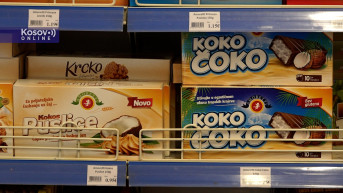
Only a few products from Serbia have made it to the shelves in Serbian areas in Kosovo, even though on November 7, it will be a full month since the Kosovo government announced it was lifting the ban on the import of Serbian goods, which would now be allowed with enhanced control but only at the Merdare crossing. Since then, it has been reported that trucks with goods have been waiting at this crossing for up to two days to enter Kosovo, which explains the disappointment of citizens, especially in areas where Serbian products have not arrived at all. On October 7, Pristina received praise from its Western allies, but the question remains—for what?
Written by: Dusica Radeka Djordjevic
According to citizens interviewed by Kosovo Online reporters, stores still lack cured meats, dairy products, oil, or detergent from Serbia, while chocolates and other sweets have managed to reach the market. Shelves in stores are still filled with goods from the region. Shopkeepers hope that the entry of Serbian goods will be allowed at other crossings as well.
“There are no goods, it’s a lie, they don’t give us anything. We are suffering here in Kosovo,” said Kostadinka Milenkovic from Sevce in the municipality of Strpce for Kosovo Online.
Milorad Stanojevic, also from Strpce, doesn’t expect that the passage of goods will be allowed at other crossings. As he says, “Everything depends on Albin Kurti.”
A shop assistant in Jugomarket in Gracanica, Olivera Maksimovic, said that so far very few Serbian products have reached the store where she works, but they are hoping that suppliers will bring more goods.
“Currently, there are a few Serbian products. From the customers’ reactions, you can see that they are satisfied even with this smaller amount. Ketchup, 'Pionir' products, 'medeno srce' (honey heart cakes), boxes of cakes, and puffed snacks have arrived. Cured meats and dairy products still haven’t arrived, the suppliers haven’t brought them yet,” Maksimovic told Kosovo Online.
Kosovo's Prime Minister Albin Kurti tried to justify the delays at Merdare by saying that customs officers are performing “manual checks of goods, which takes a long time,” and that opening other crossings will depend on when scanners for inspections arrive.
Germany's Special Envoy for the Western Balkans, Manuel Sarrazin, who negotiated with the Kosovo government regarding the lifting of the ban on Serbian goods, recently commented, providing what seemed to be an excuse for Kosovo, stating that otherwise, Kosovo could be excluded from the Berlin Process.
“The current situation at the Merdare crossing is not ideal. It’s not easy to obtain a scanner, or just go to a store and buy one; it’s a process that will take time,” Sarrazin said after Kosovo only partially lifted the ban, and a kilometers-long line of trucks formed at Merdare.
Given the situation after a month, the head of the Center for Regional Cooperation of the Serbian Chamber of Commerce, Aleksandar Radovanovic, told Kosovo Online that the international community should investigate whether it has been misled regarding the lifting of the ban.
“The behavior of Kosovo Customs, which halts work for two days and makes trucks wait for two days at the crossing to complete customs procedures, discourages businesses on both sides. Unfortunately, such behavior from Kosovo Customs doesn’t reflect what CEFTA represents, nor the concept of green corridors, nor the agreement with the international community,” Radovanovic said.
He noted that before the ban was imposed, around 250 trucks crossed Merdare daily.
“Since the ban on the import of finished goods from Serbia was lifted, the throughput has been much lower, given that Kosovo Customs stops work, and on some days, not a single truck crosses Merdare. There have been days when only 30 to 40 trucks from central Serbia, destined for Kosovo, have crossed. The situation regarding the flow of goods is very difficult and frustrating for both sides—especially for transporters who are reluctant to take on transporting goods because they lose five days getting the goods to the Kosovo market, as it has happened that some spend two or three days at Merdare,” Radovanovic emphasized.
The situation has become particularly complicated with the placement of raw materials, for which the ban was never in effect.
"Raw materials were able to circulate through all crossings before the decision was made to allow finished products from Serbia, but now they are also being redirected to Merdare, which has created even more congestion. Additionally, all transit of goods loaded in central Serbia and headed toward Albania is also being directed to Merdare," says Radovanovic.
Saša Sekulic, President of the Association of Serbian Entrepreneurs from Gracanica, believes that what is happening is a "performance by Pristina" and emphasizes the need to allow the import of goods through all crossings.
"Goods have started arriving. We see that a few items are available in the markets, but not in the quantity that should be. We all know the reason—because it is only allowed to enter goods through one crossing. This is a performance by Pristina that we are all used to. We expect that the import of goods will be allowed at all crossings," Sekulic said to Kosovo Online.
Zoran Savic from the NGO Aktiv views the entire situation as a paradox, stating that Kosovo has even been rewarded, as it now represents itself in CEFTA.
"Kosovo was rewarded for the decision it made a year ago to impose a ban, which was in direct contradiction to CEFTA, and then only partially lifted it after a year. The problem also lies in the narrative that has been promoted for years, primarily by the Kosovo government and top officials, as well as the ongoing campaign against Serbian products. There were even protests in Pristina, with students literally boycotting Serbian goods, which is also entirely against the CEFTA agreement," Savic told Kosovo Online.
The most scandalous aspect of the situation, according to Savic, is that the decision to ban the import of Serbian goods was made verbally, and to this day, there is no official document either introducing or lifting the ban.



0 comments