
Protests over verdict against KLA leaders – a return to the past and a message that the “Greater Albania dream” lives on
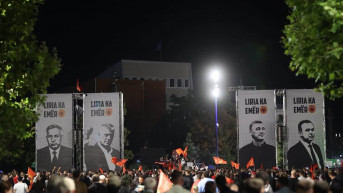
The first-instance judgment of the Kosovo Specialist Chambers in The Hague sentencing four former KLA leaders to a combined 81 years in prison for war crimes triggered a series of protests in Kosovo and among the Albanian diaspora. Kosovo Online’s interlocutors say such gatherings represent a return to the past, but also that the message from Albanians is clear—that they have not abandoned the “Greater Albania dream.”
Written by: Zoran Mirkovic
The wave of discontent was triggered by last week’s judgment of the Specialist Chambers in The Hague, which sentenced Hashim Thaci and Jakup Krasniqi to 25 years in prison each for war crimes, Kadri Veseli to 18 years and Rexhep Selimi to 13 years.
The disbelief caused by the judgment, given the previous conviction among the Kosovo public that the four would soon be released, quickly gave way to anger. Protesters in Pristina attacked the EULEX premises with stones and bottles, while later that same day several windows at the Kosovo Government building were also smashed.
Tensions have since subsided, although KLA supporters continue to gather in Pristina every evening to express their dissatisfaction.
The gatherings feature the now-familiar “choreography”—KLA flags and symbols, Albanian flags, photographs of those convicted, as well as images of Adem Jashari.
Protesters say they will not give up, that they are not tired, but that their “patience is running out” and that all of this is “only the beginning.” During one protest in Skanderbeg Square, those gathered also recited the KLA oath in unison.
A cold shower and a reality check
Historian and analyst Aleksandar Gudzic sees the protests as a consequence of the mythology surrounding the KLA and the fact that the Specialist Chambers’ decision came as a “cold shower,” given that in previous cases Albanian political leaders had mostly been acquitted.
“Just remember how the proceedings against Ramush Haradinaj, Fatmir Limaj and others ended. This judgment therefore came as a cold shower, a reality check, and runs counter to the myth and narrative surrounding the KLA,” Gudzic told Kosovo Online.
Commenting on the fact that protesters recited the KLA oath, he said it was evident that, in the minds of some people in Kosovo, among Albanians and elsewhere in the region, the idea of a “Greater Albania” remained alive and, in fact, had never ceased to exist in the minds of Kosovo Albanian political elites.
“That is the only way I can interpret the oath and such a performance. I fear that the idea of a ‘Greater Albania’ will continue to exist and remain present in the media for one simple reason—Albanians have not confronted their past. In 1945, they were not punished for collaboration with Nazi Germany, and until the Kosovo Albanian political elites are punished, they will continue to behave in this way,” Gudzic said.
He had no doubt that the political forces currently in power in Kosovo would seek to capitalize politically on the judgment and the emotional reaction of the Albanian public.
“As for whether, and to what extent, they will exploit the emotional reaction of the Albanian public for something more, time will tell,” Gudzic added.
A return to the past
Former European Union Special Envoy for Kosovo Wolfgang Petritsch said the protests represented a return to the past and would not last long, stressing that court judgments must be respected.
“It is always difficult to accept judgments handed down by an international court, primarily because of the image these individuals have in their countries of origin, and this applies not only to Kosovo but also to Bosnia and Herzegovina and Serbia. These courts make decisions based on certain criteria, and when the evidence is clear, a judgment follows,” Petritsch told Kosovo Online.
He said that people could oppose a judgment, feel disappointed or protest, but that the judgment nevertheless had to be accepted.
Petritsch expressed confidence that the protests over the convictions of the former KLA leaders would not last long.
He stressed that the judgment was “certainly tragic for those convicted,” but that if they had committed war crimes and criminal offenses against civilians, then it was clear that the judgment had to be accepted.
“That applies to the entire region, including Kosovo. Of course, the judgment does not imply collective guilt. There is no collective guilt, either in Serbia or in Kosovo. What does exist is individual guilt, which must be punished. The rule of law requires that crimes that have been committed be punished,” Petritsch emphasized.
He believes that the legal reckoning that has now taken place, many years later, represents an important contribution that will facilitate reconciliation in the long term.
“That is not the case at this moment, but I am convinced that it will contribute to reconciliation, provided that responsible politicians do not now return to the past, to the time of the war that tore Yugoslavia apart,” Petritsch added.
Albanians have not abandoned the “Greater Albania dream”
Former North Macedonian Ambassador to Albania Risto Nikovski said the Albanian protests over the judgment in The Hague were to be expected because the convicted KLA leaders were regarded by them as “liberators.” He also said their message was clear—they had not abandoned the “Greater Albania dream.”
Nikovski also described the Kosovo Specialist Chambers, like the International Criminal Tribunal for the former Yugoslavia, as a political institution that, in his view, had no legislation of its own and adjudicated according to political norms and rules. He also noted that the convicted KLA leaders had previously been key partners of Western actors, who had now “thrown them overboard.”
“We see images of Bill Clinton embracing Hashim Thaci, Madeleine Albright, Hillary Clinton... And you know what happens in politics—they used them, they became an obstacle, and then they threw them overboard. The same thing essentially happened to Slobodan Milosevic, who was the key figure in the Dayton Agreement. Milosevic de facto pushed that agreement through and, in a way, sacrificed the Serbs in Bosnia and Herzegovina... The same thing happened with Gotovina in Croatia,” Nikovski explained.
He further stressed that the judgment had convicted individuals but not what he described as the underlying event, which he claimed had been “absolutely illegal.”
“The event itself was absolutely an act of force, a form of terrorism, yet the Court did not condemn it. In a way, the Court convicted the leaders, and they should be held accountable, but it de facto validated the illegal secessionist war against Serbia and gave it a legal basis,” Nikovski told Kosovo Online.
Nevertheless, he said that destabilization or a new war in the region was not possible because the United States, which he described as the dominant actor following the breakup of Yugoslavia, did not want that.
“Wars and unrest would bring the Russians back. And if there is one thing the Americans want, it is to keep the Russians as far away from the Balkans as possible. That is why another change of borders in the Balkans is not possible, and that is the positive aspect of all these developments,” Nikovski said.
He nevertheless stressed that the message from Albanians was clear—they had not abandoned the “Greater Albania dream.”
“Rama and Kurti, Rama in particular, openly and publicly state that there are Albanian territories in Macedonia. What is that? Pure irredentism. Those are their dreams, which I believe have for now been pushed aside to some extent because of US policy. Macedonia is next after the events in Kosovo. The Albanian objective is to reconfigure it internally through the so-called Ohrid Framework Agreement, which was Plan B following the events of 2001,” Nikovski warned.
He added that the events in Kosovo in 1999, in the three municipalities of southern Serbia—Presevo, Bujanovac and Medvedja—in 2000, and in Macedonia in 2001 were, in his view, part of the same scenario.
“It was a Greater Albania project supported by the West, by the world’s leading power, with the aim of making Albanians the principal factor in the Balkans because they are its main and only strategic partner. They do not trust the Slavs or Greece, and that is why the Albanians emerged as, and remain, their principal partner. They were also the only ones who fought Milosevic, who was their devil during the breakup of Yugoslavia,” Nikovski concluded.

0 comments