
Quint's Discipline: In theory - criticism, in practice – reward
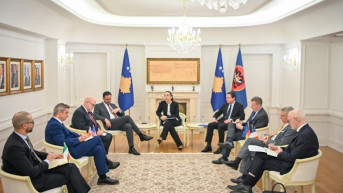
Messages like "Quint demands from Pristina", "Quint requires from Kurti", "Quint criticized Kosovo's decision", which fill the media headlines every day, contain something deeply paradoxical. Considering that these are the United States and the four most powerful European countries, which, as Pristina leaders often emphasize themselves, are the gods who decide the fate of the Kosovo issue, shouldn't their power be stronger than those they hold in their grasp?
Moreover, the opposition constantly accuses Albin Kurti of losing the favor of the gods from Washington and Brussels due to unilateral moves that are not in line with the international community.
It's hard to imagine that Serbs, who are being arrested daily, who cannot withdraw their salaries due to the dinar decree, and who are asked to democratically replace undemocratically elected mayors under impossible conditions, would agree with that.
Is Kurti stronger than the Quint, as both sides may want to portray, or are these just rhetorical ornaments used with the intention of obscuring support for Kosovo in the Council of Europe, granting visa liberalization, and all other concessions made despite unfulfilled obligations?
In conditions favoring one side, normalization of relations becomes practically impossible, or perhaps we haven't understood exactly what it means. Because, as American official O'Brian said a few days ago, for him, there is no significant difference between "normalization of relations" and "de facto recognition."
Of course, the Quint has a way to discipline Albin Kurti, but there is no will for such action, says journalist Ljiljana Smajlovic for Kosovo Online, adding that even the Quint itself is not united in its approach to the Kosovar prime minister, which works in his favor.
According to her, Kurti is "more annoying to Americans" than to Germans, who seem completely satisfied with Kurti.
"Of course, those powers have ways to discipline someone, as Richard Grenell showed us, that's easy. Where there's a will, there's a way. Here, if there's no way, it means there's no will or no unified will of the Quint. Look, when they wanted something from us, they immediately bombed us. If they were in our shoes, they would say, 'wait, we bombed the Serbs right away, maybe we should threaten them with bombing.' Of course, that's out of the question, and I wouldn't suggest it either, but this hypocrisy is really disgusting and intolerable," emphasizes Smajlovic.
She points out that they behave "as if the five most powerful countries in the world cannot persuade this one Kurti into anything."
"The most they can convince him is to send a draft of some decision to his Constitutional Court where it might stay for 20 years. It's ridiculous, none of us believe it, but that's their policy. They have a policy in the Balkans - they support Bosniaks, Croats, Albanians, they don't support Serbs, but they have to maintain good relations with Serbs as the largest and most important country in the Balkans, and that's all they're doing now. This is that idle ride until these major deals in Ukraine are finished," Smajlovic notes.
When reminded of informal messages from the Quint to Serbs in Kosovo that mayors in the north would step down voluntarily if Serbs initiated a petition, Smajlovic assesses it as a well-known tactic.
"That's what's called the salami tactic in politics - you slice off small, thin slices of salami, bit by bit, so that when everything is already meaningless, when Serbs have done what the Quint previously asked of them, then with what justification won't they do just one more small step, and so many small steps, and you end up a complete fooled fool who no longer has any criteria to defend. In the beginning, you defended one principle, the Quint convinces you to make a small concession around that principle, then a small slice of salami around another concession, and in the end, you don't even remember why you advocated and what you were right about. And that's a very skillful way to completely discredit one side in a conflict, they no longer have anything to hold on to," concludes Smajlovic.
Petar Milutinovic from the Institute for European Studies tells Kosovo Online that the EU is trying, as much as possible, to force the government in Pristina to implement what was agreed upon in the Ohrid Agreement, but he emphasizes that the entire normalization process has been politicized by decisions such as granting visa liberalization to Kosovo, even though it has not fulfilled any of the agreements.
"Since June last year, we have, for the first time, seen the EU introducing restrictive measures towards Pristina in the negotiating process in a somewhat ambiguous manner. This is very often violated by member states," our interlocutor emphasizes.
As he points out, a certain amount of financial resources has been frozen, although it is a very small amount compared to what is foreseen through the IPA 3 program for financing Western Balkan countries.
He adds that the EU has stronger mechanisms than just restrictive measures to pressure Kurti.
"One of the strong, tough mechanisms is to not grant visa liberalization to the so-called Kosovo at all. However, that didn't happen, they got it, and we can absolutely say that it's a political decision that will harm the entire dialogue and normalization of relations between Belgrade and Pristina. Visa liberalization is something that can be characterized as a carrot in negotiations, you do something and then you get visa liberalization. However, they didn't do anything, they didn't implement what was agreed upon in the Ohrid Agreement, yet they got visa liberalization, which is a political decision and it's very paradoxical," believes Milutinovic.
He says that this example shows that the "process of normalization of relations has been politicized, that everything really comes down to cheap political points" and reminds that Kosovo has major problems with the rule of law, functioning of judicial institutions, and democracy.
"Even though minority rights are not respected in Kosovo's territory, now you have this situation where tomorrow Kosovo will be a full-fledged member of the Council of Europe like other states, and that is a classic political decision, which will truly set a precedent and open Pandora's box," he notes.
According to him, there are certain differences among the Quint countries themselves regarding their approach to the Kosovar Prime Minister.
"This is a rivalry that has existed since ancient times in the process of normalizing relations between Belgrade and Pristina - that America has one approach, that the EU has another approach. However, in this case, it is the EU whose approach is definitely the most important. Here, it has always been about negotiations mediated by EU institutions and the most powerful member states," emphasizes Milutinovic.
He adds that America now has other foreign policy priorities, in the domain of Eurasia, in conflict with the Russian Federation in the territory of Ukraine.
"This is now an additional complicating factor for the whole process of normalizing relations between Belgrade and Pristina. Because it is in everyone's interest in this election year to end this and finish it in the most favorable way for all parties, to finally close this 'front' so that they can later move on to other fronts," concludes Milutinovic.
Diplomat and former Ambassador of Serbia to the United Nations Branko Brankovic assesses for Kosovo Online that the Quint countries neither can nor want to force Kurti to fulfill what he promised, because, he emphasizes, great powers have never put out fires and crises, but have always created them.
Brankovic believes that the Kosovar Prime Minister is "a pawn and a kind of puppet in the hands of the West," and the West has long been trying to find something that could justify the bombing, "but they can't find it."
"It's high time for both the Quint and everyone else to stop insulting our intelligence. We know very well that Kurti is not his own man; he has to ask for approval from the American ambassador when he leaves or enters his office. Not to mention that he can make decisions one way or another. That's something that definitely doesn't hold water, and these stories of 'they told him this, then they told him that' - that's misleading," says our interlocutor.
Brankovic assesses that among the Quint members, there's no difference in attitude towards Kurti.
"They've entrenched themselves so deeply in foolishness, respecting and following inappropriate American policy, that they have no way back. If they try to fix anything, they lose power, and they don't want that. If they were to admit now that this or that wasn't right, whether it's about Ukraine or Kosovo - and everyone is facing new elections - they would fall instantly. And Europe is in a particularly precarious position," believes Brankovic.
He also highlights that due to the situation in Ukraine, "where the West is losing," there's an attempt in one way or another to remove Ukraine from the headlines.
"These great powers, they never put out fires and crises, but they always create them. Whenever they need there to be some crisis somewhere to divert public attention from something they don't like, they do it," notes Brankovic.
According to him, when it comes to "pushing Kosovo into the Council of Europe," there is despair evident on all sides. He also recalls what he deems as a startling assessment by Dora Bakoyannis that there is a functional democracy in Kosovo and adds that "there can't be a greater hypocrisy than that."
Moreover, out of the three conditions Bakoyannis previously stated for membership in the Council of Europe, only one has been met - the return of the country to the Decani.
"I pose a serious question: When you're so generous, why don't you admit Serbia to the EU first, and then say 'fulfill this and that.' No, instead, they ask us to fulfill first," notes this diplomat.
Kurti is playing a different political game compared to the international community in Kosovo and compared to his predecessors: he wants to show that he's different from them, that he has real power, and he wants to project that power in Kosovo onto the international community, emphasizes Kosovo online analyst Artan Muhaxhiri.
"Previous leaders had the idea that support from the international community would make them more powerful in Kosovo, and Kurti has a reverse logic: that power in Kosovo will strengthen his position in relations with the international community," says Muhaxhiri.
As he points out, there is also a logical aspect to such a political stance of the Kosovar Prime Minister.
"He wants to show that even small countries can have power compared to great powers. However, since Kosovo has a very specific political context, I don't think this is an appropriate approach because Kosovo needs a lot of support from around the world, and with this approach, the most important projects will be delayed. They won't be canceled, but they'll be postponed until a solution is found," believes our interlocutor.
But now even the Quint reacts to such Kurti's approach, and it's much harder to work with him than with previous leaders, he adds.
"He wants to have such an image, and when he was in opposition, he criticized previous leaders who did everything the international community told them to do. All of this is part of his political image, and he wants to present himself as a powerful leader who can say 'no' to the international community," says Muhaxhiri.
According to him, the Quint has ways to discipline Kurti and points to the European integration processes that countries can block whenever they deem it necessary.
"Furthermore, Kosovo needs to be part of many international organizations. This membership cannot be achieved without the help of powerful states. We see what's happening with the Council of Europe. You have to make compromises, to give something, in order to get something. That's why the decision about the country of the Decani Monastery was made. He [Kurti] was absolutely against that decision for years, but now he has done it because he saw there was no other solution. The same thing is happening now with the draft of the CSM [Communitx of Serb-majority Municipalities]. The US, Germany, Italy are pressuring Kurti to send the draft to the Constitutional Court. I think Kurti has limited room to maneuver. He can do whatever he wants, but it will have consequences," concludes Muhaxhiri.

0 comments