
Reading habits in the region: Technology advances, but books are holding their ground
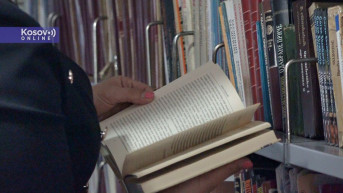
Despite the rapid development of technology and digital media and the ever-increasing use of mobile phones, books continue to have a loyal readership across the region. Although information is more accessible than ever and much of our free time is spent in front of screens, many people still choose to unwind with a book and remain convinced that books are here to stay because, as readers and publishers told Kosovo Online, people need them.
Written by: Jelena Milenkovic
Technology can offer speed and instant access to information, but reading a book provides a unique experience. That is why, despite all the technological changes, books remain an important part of culture and everyday life across the region.
While younger readers mostly turn to required school reading and popular literature, developing their reading habits along the way, older readers tend to choose contemporary literature, fiction and historical novels.
Pages need to be turned by hand
Visitors to the Belgrade International Book Fair are convinced that books will survive, seeing their continued existence as part of the continuity of human development.
“They will definitely survive. You need to hold a book in your hands; you need to turn the pages,” Jelica Milicevic, a Serbian language teacher at the Secondary Technical School in Velika Plana, told Kosovo Online.
Drawing on her experience, however, she warned that children were reading less because, in the era of artificial intelligence, plot summaries and character analyses were available to them “at the click of a button.”
“The brain, like any other organ, atrophies if we do not exercise it. And I am afraid that with information available at the click of a button, they will not be able to exercise their minds. They receive information quickly and do not have the opportunity to think about it, develop critical thinking, form their own judgments or argue their views. That is the problem,” Milicevic said.
Eighteen-year-old Mihajlo from Belgrade is proof that there are still avid readers among the younger generation. He says he enjoys reading because it helps him relax.
“Definitely better than a phone,” the secondary school student said.
Zarko Radakovic, a writer and translator of Peter Handke’s works, said that he generally read everything, although most often he read the books he was working on himself. Asked whether books would be able to compete with digitalization, he said they would not—but that they would certainly survive.
“As something unique, not to say archaic. People need it. Digitalization cannot be avoided; it is pulling all of us in one direction, but as something that represents continuity within us, the book has to survive. Readers will become something of a sect—those who love it will belong to that group, while others will not read at all. I see everyone looking at their phones in the streets, but readers exist and will continue to exist. Whether the book fair will continue to exist in its present form, I do not know,” Radakovic told Kosovo Online.
Publishers, meanwhile, have the impression that people are reading more than before.
“Books are changing somewhat in length. Attention spans are not what they used to be, but I do not think books are losing anything. Digital content, electronic versions of books and audiobooks, which are becoming increasingly common, complement today’s fast-paced lifestyle. A physical book is more suited to the comfort of home, while other formats are useful in situations where taking out a book is impractical. But it is still a book, and copyright is always protected. Authors are satisfied and publishers do not lose much. The important thing is that people read; the format is not that important,” Aleksandar Tanurdzic, an editor at the Prometej publishing house, said.
He added that readers were increasingly turning to books on geopolitics, including works that delve deeply into the past.
Required reading for younger readers, contemporary literature for older generations One of the most important cultural institutions in Leposavic, the Sveti Sava Public Library, offers book lovers a wide range of titles and a refuge from the pressures of everyday life.
The institution strives to bring books closer to all generations, particularly the youngest, and to make them as accessible as possible despite the challenges it faces.
According to librarian Tanja Niciforovic, required school reading is among the most sought-after material, while older readers most frequently choose contemporary literature, bestsellers and crime novels, as well as historical and family stories.
“Children most often ask for required school reading, and among the titles I would single out Lassie Come-Home, The Paul Street Boys and The Bait. Among adult readers, contemporary literature, bestsellers and crime novels are popular, as are historical and family stories. Nora Roberts and Jo Nesbo are currently among the most sought-after authors,” Niciforovic told Kosovo Online.
She pointed out that families and parents played an important role in developing a love of books and could help establish reading habits from the earliest age by setting an example themselves.
“It is very important for a child to grow up surrounded by books. When children are read to, when they grow up with stories and picture books, books become a natural part of their childhood. Even a few minutes of reading together each day is a major step toward helping a child develop a love of books and an interest in the written word,” she said.
She noted that it was particularly important for residents of smaller communities to have equal access to high-quality literary content.
“Investing in a library collection is, in fact, an investment in education and therefore in the cultural development of the entire community. Our library strives to provide readers with the broadest possible access to books despite all the challenges we face in Kosovo and Metohija,” Niciforovic said.
For that reason, she stressed that books should not be viewed as an obligation but as an opportunity to learn and discover more about ourselves and the world around us, because books broaden horizons, enrich knowledge and help us better understand ourselves and others.
Pristina: People are reading less, but books still have their devotees
Some residents of Pristina still enjoy reading and have not given up on printed books, although others admit that books are, unfortunately, finding their way into their hands less and less often.
Booksellers are dissatisfied with declining interest, but lovers of the written word remain committed and believe that books will never lose their value.
One Pristina resident told Kosovo Online that she read extensively, enjoyed classics and bestsellers, and recommended the book Tell Me Who I Am.
“Young people should read to enrich their vocabulary and to imagine something better than the present,” she said.
On the other hand, one young man admitted that he did not read much and preferred to spend his free time watching content.
“I don’t read; I just watch things. I read quite a lot at school, but not so much now,” he admitted.
A lawyer said that the nature of his profession required him to read a great deal of professional literature, but that he lacked the time for other books. As a recommendation, he singled out a work by Serbian Nobel laureate Ivo Andric.
“I recommend Ivo Andric’s The Bridge on the Drina. There are many wonderful books to read, there is the internet, the possibilities are varied and there is a broad range of reading material, but there is little time because of family, professional and everyday obligations,” he said.
The impression among street booksellers, however, is somewhat different.
They believe people are reading less because they are buying fewer books.
“I don’t know why that is. Perhaps people today are not like they used to be; we read more. Some say it is because of technology and that people read in other formats. Maybe that is true, but you can see that people are falling behind.
Their vocabulary is not rich, because when you talk to someone who reads, you immediately notice that they are well-read,” bookseller Florim Beciri said.
Macedonians are reading and increasingly turning to domestic authors
The impression in Skopje is entirely different. Elizabeta Popovska of the Matica publishing house says that interest in books remains strong and may even have increased slightly, while Macedonian readers generally turn to books that help them relax and are increasingly choosing domestic authors.
“I can freely say that interest in books still exists. It may even have increased slightly. As for what people read, there is no rule. Fiction is the most popular, but there are also people who enjoy books on science, politics and history,” Popovska told Kosovo Online.
She is particularly pleased that domestic writers are increasingly being read and that more Macedonian authors are emerging on the literary scene.
“They are being given an opportunity, the public is reading their work, they continue to write, and that is excellent,” she said.
Popovska said that books were most commonly purchased by readers ranging from around 20 or 25 years of age to those in their 50s and 60s. She is also pleased that many pensioners continue to read.
“Pensioners aged 70 and over read and regularly come to buy books, which is a very good sign that older age groups are reading as well, even though some of them may have problems with their eyesight. But middle-aged readers are the most numerous. That does not mean younger people do not read. We also have a young readership, teenagers and even younger children, but they are represented to a lesser extent,” Popovska said.
comments