
Reception of foreign prisoners in Kosovo: Pristina’s political interest — a security risk for the region
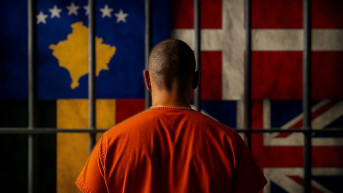
The agreements Kosovo is considering with Denmark and Belgium on the reception of foreign prisoners, as well as a plan to open an asylum center for the United Kingdom, have sparked intense debate across the region. Interlocutors for Kosovo Online from Pristina, Belgrade, and Tirana agree that political interests lie behind the economic gains, and that such arrangements carry serious security risks. While some warn that Kosovo’s society is already vulnerable and that accepting convicted criminals and asylum seekers could further undermine stability, others stress that the consequences could affect the entire region.
Written by: Petar Rosic
On May 23, 2024, Kosovo ratified an agreement with Denmark under which 300 Danish inmates will be housed in the prison in Gnjilan.
Under the agreement, the transferred inmates will not be Danish citizens and will not be high-risk. They will not be convicted of war crimes or terrorism and will not have severe mental disorders.
In return, Kosovo will benefit from around 200 million euros, to be invested in the Kosovo Correctional Service and renewable energy sources.
The Denmark–Kosovo agreement has also inspired Belgium. Belgium’s Minister of Justice Annelies Verlinden and Minister for Asylum and Migration Anneleen Van Bossuyt paid a three-day diplomatic visit to Albania and Kosovo earlier this month. As they stated, the aim of the visit was to address overcrowding in Belgian prisons and to combat organized crime, the Belga news agency reported.
Albania was asked to take back its nationals currently in Belgian prisons, while Kosovo was envisaged as a destination to rent or build a prison for convicts who are not Belgian citizens.
Osmani: Cooperation in Justice, Security, and Defense
Unlike the Belgian officials, Kosovo’s President Vjosa Osmani did not mention a prisons agreement after the meeting. In a statement, she said that “close cooperation between Kosovo and Belgium in justice, security, and defense represents a model of European partnership that strengthens peace, stability, and a shared perspective,” while also highlighting the need for Belgium to take a leading role in advancing Kosovo’s EU membership prospects.
In contrast to Kosovo, the Albanian authorities did not accept any “immediate solution” proposed by the Belgian ministers. According to Albanian Post sources, official Tirana made it clear that each prisoner would be handled under the existing extradition and prisoner-transfer agreement between the two countries, with an individual assessment in every case.
Ahead of last week’s Western Balkans Summit in London, UK Prime Minister Keir Starmer also presented a plan to set up a series of centers in the region to accommodate rejected asylum seekers after they have exhausted all avenues of appeal in the United Kingdom.
Kurti: We want to help
Three countries in the region—Albania, Montenegro, and Bosnia and Herzegovina—rejected the British offer. Montenegro’s Prime Minister Milojko Spajic emphasized that Montenegro “is not part of the migrant-smuggling route in the Balkans,” while Albania’s Prime Minister Edi Rama said that although Albania has a special agreement with Italy on the treatment of asylum seekers, it would never accept the establishment of return centers for migrants on its territory.
Kosovo’s caretaker Prime Minister Albin Kurti, however, saw an opportunity.
He confirmed that the Government of Kosovo had offered to take in migrants from the United Kingdom because, as he put it, Kosovo has an obligation to reciprocate for the role that country played in the peacekeeping forces “that protected Kosovo from the regime of Slobodan Miloševic.”
“We want to help the United Kingdom. We consider this both a friendly and a political obligation,” Kurti said.
Foreign policy expert Donika Emini described Kurti’s offer as a desperate attempt to bolster bilateral relations.
According to her, it is still unclear what exactly Kosovo is seeking from the United Kingdom in return for a service that is quite problematic, given that Kosovo has already signed an agreement with Denmark to accept prisoners in Kosovo.
Human Rights Watch: People Used as a Political Tool
Human Rights Watch also voiced grave concern. Judith Sunderland, the organization’s Director for Europe and Central Asia, stated that it is unacceptable to use people—whether convicts or asylum seekers—as a political instrument for gain, as that leads only to human-rights violations.
She assessed that these agreements demonstrate “a worrying willingness of European states to renounce their obligations,” adding that “it’s no surprise that Kosovo and other countries are trying to take advantage of the EU and UK’s apparent obsession with outsourcing responsibility to a third country.”
Analyst Alma Lama from Pristina likewise opposes the idea of building prisons for foreign convicts, arguing that such a practice could pose serious problems, especially regarding respect for human rights.
“The agreement with Denmark, which has already been concluded, has been viewed by Kosovo’s government more as an investment in facilities and infrastructure—but that comes at a price. People who do not belong to Kosovo’s society could be brought here, and I think there should be serious concern about human rights,” she told Kosovo Online.
Kosovo Already Has Enough Problems
She added that Kosovo already faces many societal problems and that foreign prisoners should not be brought to Kosovo.
“They should be returned to their home countries or to the country where they were imprisoned. Bringing foreign prisoners to Kosovo, as well as asylum seekers from European countries—which is also under consideration—is not the right course of action, and Kosovo’s institutions should not do this for any reason. We have many problems as a society, and accepting them is not a good solution,” she said.
Lama emphasizes that her position does not apply to prisoners of Kosovar origin.
“As for convicts of Kosovar origin, of course that is acceptable—indeed, it may even be necessary for them to be transferred to Kosovo, since they are citizens of Kosovo. That applies to Serbs and to people of any other nationality. But when it comes to prisoners from other countries, I am completely opposed. I do not think this benefits Kosovo’s society in any way,” she is emphatic.
With regard to migrant reception centers, she recalls that the EU has readmission agreements with Turkey and with certain African states, which are costly but function because those countries are a “way station” for irregular migrants.
“Kosovo, Albania, and the Balkan region have nothing to do with such migrants. We have our own migrants and asylum seekers in Europe whom we can always take back, but not to have migrants brought here from Africa and the Middle East, as they would move about freely—and we also face challenges with extremism. In my view, it is not a good idea to bring such people into a society that already has its own vulnerabilities,” the Pristina-based analyst concludes.
Economic gain smaller than the political
By contrast, Nikola Vujinovic, a researcher in Security Studies from Belgrade, believes these agreements are more politically than economically significant.
“Although this is, so to speak, a ‘neat’ form of economic investment, the economic gain from it is much smaller than the political gain,” Vujinovic told Kosovo Online, adding that such agreements will not, however, speed Kosovo’s path toward international organizations.
“The Albanian community presents this as gratitude toward the states that supported their independence. Essentially, it is an attempt to secure political favors in the future, when certain obstacles—such as the path to the European Union or the Council of Europe—might be removed,” Vujinovic explains.
He warns that implementing these agreements could pose a serious risk not only to Kosovo but to the entire region.
“If we look at the figures cited in the media, we are talking about around three hundred inmates whom the Belgians are considering bringing to Kosovo. Prison breaks are common, violence is present, and these are not benign cases of traffic offenses or unpaid taxes—they are serious criminals: murders, organized crime, the narco-mafia. It is no coincidence that Belgium is insisting on this issue, bearing in mind who leads key criminal groups in Western Europe,” Vujinovic warns.
He adds that the prisoners who might be deported would not only be from Kosovo, but also from Albania, Montenegro, and North Macedonia, which would turn Kosovo into a hub of security threats.
“How will security function? Will it be at the level of Kosovo’s prison institutions or at the level of Western prison systems? Prisons in the West are much more rigid than ours in the region, and we must bear that in mind. Will it be that way—I don’t know. I hope it will, if the plan is implemented at all,” Vujinovic concludes.
Lack of transparency
Political analyst Ben Andoni from Tirana likewise assessed that the agreements offered by Denmark and Belgium on receiving foreign prisoners raise numerous questions—from potential human-rights violations to security risks and a lack of transparency.
“The first issue that arises here is the question of human-rights violations. After these individuals serve their sentences, will they return to Belgium or not? Those who have residence permits can return, but the others, who do not, will most likely remain in our countries. After their assets are frozen, they have nowhere else to go, so they will remain here in Albania and in Kosovo,” Andoni warned in comments to Kosovo Online.
He added that the public, both in Albania and in Kosovo, is concerned about the lack of transparency surrounding these agreements.
“The media have been forced to obtain information unofficially, from second- or third-hand sources—most often Danish, and now Belgian. On the other hand, they want to exploit the needs of Albania and Kosovo, which seize every opportunity to draw closer to the West, especially in the integration process—more pronounced in Kosovo, which still has not obtained candidate status,” the analyst noted.
According to him, Denmark and Belgium are “very adept” at using this situation to avoid overcrowding in their prisons.
“How the public will accept this is still unknown. In Tirana there is great apathy and almost complete disinterest, while in Kosovo this issue has not become central either, because Albin Kurti is facing major difficulties in forming a new government and the possibility of snap elections,” Andoni said.
A security threat
The analyst also warns of security challenges that could arise if prisoners from Belgium were transferred to Albania or Kosovo.
“Some of these people are high-risk individuals. Wiretaps of Sky phones have proven their involvement in criminal activities. Those intercepts revealed murders, money laundering, as well as the use of the Port of Antwerp for smuggling. Albanian criminal groups already play an important role in Europe, and their return to the region would undoubtedly pose a threat,” Andoni warned, again underscoring Kosovo’s strong desire for international support.
“Above all, Kosovo wants to be respected by external actors, and it is ready to sign almost any agreement to strengthen relations with international partners,” Andoni concluded.



0 comments