
Is Kosovo becoming a “Return Center” for migrants and prisoners from the EU?
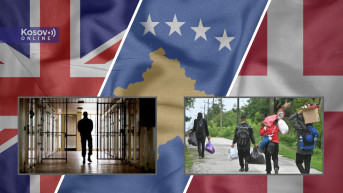
When they don’t know what to do with them, the “smartest” solution is to send them to “third countries.” EU countries are increasingly considering relocating all migrants whose asylum applications have been rejected—or whose processes remain unresolved—to so-called “return centers.” After it was confirmed that Kosovo would “host” Danish prisoners, it has also emerged as a potential destination for asylum seekers, under consideration by the United Kingdom. Western countries are seeking to offload a “burning issue,” while Pristina sees this as a chance to draw closer to its allies, according to commentators speaking to Kosovo Online.
Written by: Djordje Barovic
According to the Danish Prison and Probation Service, the first convicts from Denmark are expected to be transferred to a prison in Gnjilane, Kosovo, in 2027.
This has resolved the concerns raised by human rights organizations and correctional facility observers regarding the detention conditions of 300 prisoners from Denmark, as well as 200 others already serving sentences in the designated facility.
In the meantime, the United Kingdom is considering Kosovo as one of the destinations for migrants whose asylum applications have been rejected.
And it’s not the only country considering such a solution to its “domestic issue.”
According to Bloomberg, the U.S. government may also request that Western Balkan countries, including Serbia, accept deported migrants.
This idea has been circulating in the EU for months.
In late October last year, European Commission President Ursula von der Leyen sent a letter to EU leaders urging them to consider establishing “return centers” outside the Union.
The Western Balkans were immediately “targeted,” though a senior CDU official at the time stated that the region was “unsuitable” for such a plan.
As the idea resurfaces, the Balkans are once again back in the picture, and Pristina’s officials have already declared they are “open to discussions.”
Government spokesperson Përparim Kryeziu told Radio Free Europe that Kosovo “wants to help the United Kingdom, a friend, partner, and ally, including its Labour government.”
“We believe it’s fair to say that we can start discussions on this topic, but all our state institutions must be involved, and the final decision will depend on their recommendations. Many questions will need to be answered in advance,” Kryeziu said.
Pandora’s Box
Rados Djurovic, director of the Asylum Protection Center, told Kosovo Online that accepting Danish prisoners had effectively opened “Pandora’s box,” with many EU countries now considering Kosovo as a potential site for housing migrants whose asylum claims have been denied.
“I would say that the agreement with Denmark on transferring convicted individuals to serve sentences in Kosovo has actually paved the way for other countries to consider placing not just convicts but also migrants and refugees there. This is what has opened Pandora’s box. However, it’s questionable whether Kosovo or other Balkan authorities would so readily accept such arrangements when it comes to migrants,” Djurovic said.
He explained that setting up migrant reception centers outside destination countries—including the EU—is meant to send a clear message to potential migrants that coming to Europe will be fraught with complications and that staying won’t be easy.
“Europe chronically struggles to return people who have been denied asylum. Many of those who are no longer allowed to stay cannot be returned to their countries of origin due to technical and legal challenges. Only about 20% of rejected asylum seekers who were ordered to leave the EU have actually returned. These camp measures and offshore relocations are meant to signal that unless you are a genuine refugee, you should not expect to stay in Europe,” Djurovic emphasized.
He warned that the proposed reception model has several specific issues, the most critical being that migrants placed in such centers cannot stay there permanently.
“There needs to be a resolution. One solution would be returning them to their countries of origin. I don’t believe Kosovo has the capacity or readmission agreements necessary to implement such decisions,” Djurovic noted.
This aspect, he said, is crucial to the concept of “return centers” outside the EU.
“In the future, if we speak of return centers not only in Kosovo but around the EU, the host countries would need the capacity to organize repatriation,” he added.
He pointed to the earlier agreement between Albania and Italy on migrant reception as a precedent.
However, he doesn’t view potential Kosovo agreements as exploitation, but rather a matter of mutual interest—economic, political, or geopolitical.
“These agreements require the consent of both parties. There has to be a shared interest—financial, economic, political, or otherwise—for the host country and the country organizing the centers. I don’t see this as coercion,” he said.
He stressed that a major security concern lies in the influx of people who cannot be returned or moved elsewhere.
“You can never have the capacity to indefinitely detain such people. Legally, it's not feasible either. That would likely mean releasing them, leading to renewed border crossing attempts via the Balkan route, potential smuggling involvement—all with the goal of returning to the same countries that deported them,” Djurovic explained.
He warned that such scenarios only benefit human smugglers.
“Policies that shift responsibility to neighboring countries, instead of addressing issues within destination states, inevitably fuel smuggling. Along with pushbacks and such arrangements, smuggling operations only strengthen. These people aren’t sent back to start fresh—they’re just stuck in limbo,” he concluded.
Two Aspects
Pristina-based political analyst Artan Muhaxhiri believes that if the UK chooses Kosovo as a return center, it would signal a strong partnership, but transparency and institutional readiness are crucial.
“This issue has two aspects: political and institutional. Politically, it’s very welcome because it shows Kosovo as a partner of the UK. But institutionally, there’s a big question mark,” Muhaxhiri told Kosovo Online.
He said it remains unclear how prepared Kosovo’s institutions are and pointed to a lack of transparency.
“We don’t really know if our institutions are ready. If this is to be turned into a positive, it requires professionalism. Otherwise, it’s a missed opportunity,” he warned.
He cautioned against repeating the lack of transparency seen in the agreement with Denmark.
“The government didn’t inform citizens about how this would be handled, what the capacities were, etc. That created a negative perception. If they want to benefit from such a deal, the government must be fully prepared,” he added.
He does not believe such arrangements would threaten Kosovo’s or the region’s security.
“They will be under strict control,” he emphasized.
He said the same applies to Danish prisoners, especially in terms of financial implications.
“The Kosovo government must assure citizens that no resources will be diverted from local prisons to this project. It must show it can manage additional responsibilities,” Muhaxhiri clarified.
He also believes the UK will thoroughly assess all aspects before implementation.
“If Kosovo succeeds, it would be a major recognition for the government. But if it fails or encounters problems, it will be a missed opportunity,” he concluded.
Allies and Services
Marko Savkovic, senior advisor at the ISAC Fund, told Kosovo Online that by relocating reception centers to third countries, EU states aim to resolve a “burning issue,” while Pristina sees this as an opportunity.
“Authorities in Pristina likely view this as a way to get closer to countries they consider allies—to do them a favor. Whether they have the capacity is secondary; they could build what’s needed, and Western governments would support that to solve a pressing issue,” Savkovic said.
He added that migrant issues have largely flown under the public radar.
“This may not be the ideal opportunity, but it’s the one they have. Governments use what’s available. Pristina is doing the same,” he stated.
He emphasized that migrant policy is now a top priority for many global and European leaders, with the UK currently focused on negotiating a similar agreement with Albania.
“More than 50,000 irregular migrants were rejected in the UK last year. These people now need to be returned to their countries of origin,” he noted.
A key challenge, he said, is that many migrants destroy their documents upon arriving in the West, making repatriation nearly impossible.
“In this case, interestingly, the idea is to transfer people temporarily to countries willing to host them while decisions about their fate are made,” Savkovic explained.
He recalled that in 2023 Albania signed a similar agreement with Italy to host two centers for migrants Italy wanted to relocate.
Any country agreeing to host such a center would effectively become an “instrument” of the country relocating the migrants—Kosovo included.
“I’d say it’s an instrument, but if successful, it could elevate Kosovo to a genuine partner status,” he said.
He added that such centers would not pose a security threat, as everything would be conducted under strict controls.
“Kosovo previously repatriated individuals from Syria who were former ISIS fighters or family members. It was one of the top countries per capita for foreign fighters, yet no significant deterioration in security occurred. Whether dealing with migrants or prisoners—these two categories must be distinguished—everything will happen in controlled settings,” he said.
Savkovic concluded that the entire process would require proper guarantees and bilateral agreements.
“The Italian plan was halted by the courts, so those centers never materialized. There are always risks—for human rights, security, or that nothing comes of it at all. But I don’t believe this poses a safety threat,” he concluded.




0 comments