
Reparations for victims of crimes committed by former KLA leaders – important for families, but a complex path ahead
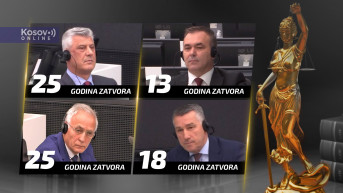
Victims of crimes committed almost three decades ago, for which the Specialist Chambers in The Hague convicted former KLA leaders Hashim Thaci, Kadri Veseli, Rexhep Selimi and Jakup Krasniqi, are expected to receive reparations from the four convicted men, and the Court has already initiated the relevant proceedings. The amount of compensation will be determined on the basis of the evidence submitted and will depend on whether the harm suffered was pecuniary or also involved physical and psychological suffering, Kosovo Online’s interlocutors point out. They note that the reparations proceedings could take time, but that any form of compensation for family members would be welcome even after so many years of waiting for justice.
Written by: Dusica Radeka Djordjevic
The day after the Specialist Chambers in The Hague found Hashim Thaci, Kadri Veseli, Rexhep Selimi and Jakup Krasniqi guilty of the war crimes of arbitrary arrest and detention, cruel treatment, torture and murder, sentencing Thaci and Krasniqi to 25 years in prison each, Veseli to 18 years and Selimi to 13 years, the Trial Panel decided to conduct reparations proceedings.
There are 156 participating victims in this case, and their counsel has been ordered to submit a request for reparations by October 14. The Prosecution and the Defense will have until November 4 to submit their responses.
The number of victims in this case is considerably higher than in previous cases before the same court.
In the case of former KLA member Salih Mustafa, for example, who was convicted of war crimes and sentenced to 15 years in prison, there were eight victims, and the Court ordered Mustafa to pay them a total of EUR 207,000 in reparations. In the case of Pjeter Shala, who was also convicted of war crimes and sentenced to 13 years in prison, the Court ordered that EUR 208,000 in reparations be paid to the eight victims.
At present, it is impossible to estimate the total amount that each of those convicted in the “Thaci et al.” case may be required to pay to the victims. Some legal experts in Pristina believe, however, that the reparations process has been initiated too soon, given that appellate proceedings are still to follow.
Collective and individual reparations
Slavisa Vuksanovic, legal representative of the Association of Families of Kidnapped and Missing Persons from Kosovo and Metohija, told Kosovo Online that the reparations the former KLA leaders convicted in The Hague may be required to pay to victims and their families, if ultimately awarded, would be very important to the families.
“If we are talking about missing parents, spouses or children, and also about those who survived torture, who were held captive and, by sheer chance, managed to be released from captivity by the KLA terrorist group through the intervention of the International Committee of the Red Cross, any form of compensation for family members would be welcome at this point, although that prospect is still a long way off,” Vuksanovic said.
According to him, persons of Serbian ethnicity who have been granted victim status in this case are laypersons with no legal expertise, which is why he believes that Serbia, through its competent institutions, should assist them in preparing the necessary submissions and forwarding them to the Victims’ Counsel before the Specialist Chambers in The Hague.
“The families expect the competent state authorities and institutions to assist them in preparing their claims for compensation. This includes compensation for material damage, as well as compensation for physical and psychological suffering,” he explained, noting that 156 persons of all ethnicities have been granted victim status and were represented in The Hague by a single Victims’ Counsel.
He also pointed out that reparations proceedings could take a long time.
“The Trial Panel will decide, in what is known as a non-hearing session, on the amount of reparations to be awarded to each victim. Given that we have seen both collective and individual forms of reparation, the Court will also decide whether all 156 victims will receive collective reparations or whether a specific amount will be awarded individually to each victim,” Vuksanovic noted.
He said that in the proceedings against Salih Mustafa, three victims received EUR 30,000 each, one received EUR 60,000 and another EUR 80,000, adding that the greater part of the compensation related to material damage, while the portion relating to psychological and physical suffering was considerably smaller.
Possible seizure of assets
The amount of reparations to be awarded to the victims will be determined by the Court in The Hague, lawyer Zoran Zivanovic explained to Kosovo Online, adding that the Victims’ Counsel must submit the evidence on which the compensation claims are based.
Such evidence includes medical certificates, documentation of injuries, where applicable, evidence relating to psychological harm, and evidence showing whether victims’ families suffered financial losses because they lost the support of an income-earning family member who was killed or went missing.
“The Court can order only the accused to pay compensation—that is, the four individuals whom it considers responsible for the unlawful acts that caused harm to the victims. Whether Kosovo or any voluntary donors would become involved if they are unable to pay that compensation, I am not sure. That would be more a matter of goodwill than anything else,” Zivanovic said.
According to him, before compensation awarded by the Court can be recovered, it must first be established whether the convicted person has assets.
“Compensation can be recovered in various ways, primarily through enforcement proceedings initiated before domestic courts in jurisdictions where the convicted persons have assets. Proceedings can be initiated for the possible seizure of their property, whether real estate, movable property of significant value, bank accounts, interests in companies, shares and so forth. All of these assets can be seized in order to enforce payment. It may even be possible to challenge certain legal transactions if the convicted person has meanwhile disposed of assets that he previously owned,” Zivanovic said.
Given the large number of victims in this case, he added, the question is whether each of the convicted individuals has sufficient assets to cover the compensation awarded.
“Everything depends on the amount and nature of the damage, particularly whether it is pecuniary or non-pecuniary. Did the victims sustain injuries that left them disabled? Did they suffer less serious injuries? If, for example, it is claimed that a victim sustained injuries resulting in disability, this must naturally be established through medical findings, reports and, where appropriate, expert assessments.
The amount of compensation depends on all of these factors,” he added.
Zivanovic said that there were also indirect victims—families whose members had been killed or had gone missing.
“In this case, they are treated as victims as well, although they were not themselves subjected to the attacks, because they suffer the consequences of those attacks. Those consequences may include pecuniary damage in the form of, for example, lost or reduced financial support, particularly in the case of minor children who lost a parent as a result of these criminal offenses. Non-pecuniary damages are also awarded for what is known as emotional suffering experienced when a close family member is killed,” the lawyer explained.
What could the appellate proceedings change?
Pristina-based lawyer Ardian Bajraktari believes that initiating reparations proceedings for victims is premature as long as the judgment can still be changed on appeal.
“As a rule, proceedings for compensation of victims begin once a judgment becomes final. However, when it comes to the Specialist Court, anomalies and procedures contrary to the law have continuously characterized the proceedings,” Bajraktari told KosovaPress.
According to him, the decision of the Court of Appeals could also alter the basis on which the reparations proceedings are being conducted.
“We should wait for the outcome of the Court of Appeals’ decision. Given the course that has characterized decision-making in previous proceedings, I believe that there will be no outcome in the appellate proceedings for approximately two years. Initiating these proceedings at this stage could also prove to constitute prejudgment of the case,” he said.
Former President of the Kosovo Supreme Court Fejzullah Hasani takes a different view.
According to Hasani, proceedings concerning a property claim arising from a criminal offense may be conducted in parallel with the criminal proceedings, and there is no need to wait for the Court of Appeals to issue its decision. The purpose of such proceedings, he told KosovaPress, is to enable victims to exercise their right to compensation within the criminal proceedings without having to initiate separate civil proceedings, thereby avoiding the additional costs of civil litigation.
“The issue of compensation for victims is regulated by all laws, including our own. The Criminal Procedure Code provides that matters of a civil-law nature, namely civil claims, may also be decided within criminal proceedings,” Hasani explained.
He nevertheless left open the possibility that the Specialist Chambers, owing to their internal rules and the specific nature of these proceedings, may have provided for a separate reparations procedure.
“From what I have seen, the property claim will be decided together with the principal case. I believe that the written judgment will also contain a decision on the property claim. Therefore, the property claim is decided when judgment is rendered in the principal case, rather than after the judgment becomes final following a decision by the Court of Appeals. This is because the accused also have the right to appeal this aspect—the property claim—to the Court of Appeals,” Hasani said.
He added that the basis for compensation was directly linked to a conviction and that, if an accused were acquitted or the indictment dismissed, the basis for the property claim would also change.
Zivanovic said that if the amount of compensation were determined before the appellate judgment was delivered and that judgment differed from the first-instance judgment—for example, if all four convicted persons or any of them were acquitted, or found not responsible for certain acts involving victims who had been awarded compensation—the reparations decision would also have to be amended.
At the same time, he pointed out that the Court had two options: to refer all victims to civil proceedings, where they would have to establish before the regular courts in Kosovo the amount and types of damage they had suffered, or, as it chose to do in this case, to rule on the compensation claims itself.
“The Court gave three reasons for this. First, it said that during the criminal proceedings it had itself become convinced that a large number of victims had been intimidated, that many had changed their statements and that many had refused to testify. It considered this to be one of the compelling reasons why it would not be appropriate to entrust the Kosovo judiciary with deciding on victims’ compensation claims. The second reason was that a large number of victims had protected identities. If they were referred to the Kosovo courts, their names would have to be disclosed, which would not be appropriate. The third reason given was that, in these circumstances, the most appropriate course was for the Court itself to determine the amount of compensation and rule on the claims,” Zivanovic said.



0 comments