
Return of Serbian judges and prosecutors to the Kosovo judicial system: Why is Haxhiu insisting on accepting their resignations right now?
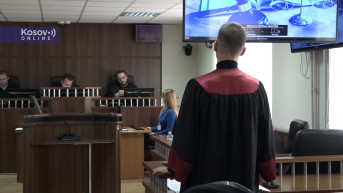
There are many obstacles on the path to reintegrating Serbian judges, prosecutors and administrative staff into the Kosovo judicial system, Kosovo Online’s interlocutors say. They warn, in response to the request by Kosovo’s acting president Albulena Haxhiu — who asked the Kosovo Prosecutorial Council and the Kosovo Judicial Council to urgently complete the procedure regarding the resignations of Serbian judges and prosecutors — that Kosovo’s executive authorities should not interfere in the work of these two bodies.
Written by: Veljko Nestorovic
Serbian judges and prosecutors submitted their resignations on November 7, 2022, as did administrative staff at the Basic Court in North Mitrovica.
The resignations of judges and prosecutors, as well as MPs, came one day after police officers of Serbian ethnicity in northern Kosovo submitted their resignations.
The issue has now been brought back into focus by Kosovo’s acting president, Albulena Haxhiu.
Political scientist Ognjen Gogic, commenting on the request, said that Kosovo’s executive branch should not interfere in the work of these two bodies, and that doing so could potentially threaten the autonomy of the judiciary.
“However, the question remains why these resignations have still not been officially recorded, even though a great deal of time has passed. This is interpreted as meaning that, from the beginning, these two bodies — the Prosecutorial Council and the Judicial Council — actually wanted to leave room for a possible political agreement on the return of Serbian prosecutors and judges to their duties. It was believed that these resignations had not been submitted voluntarily, but under pressure, which is why they have not been officially recorded so far. In this way, space was left open for them to return to their jobs,” Gogic told Kosovo Online.
Gogic says the issue has now been revived because, as he puts it, discussions are taking place behind closed doors, mediated by the European Union, on the reintegration of judges and prosecutors.
If the Judicial and Prosecutorial Councils were ultimately to officially record the resignations of Serbian prosecutors and judges, this would not have any immediate consequences for the Serbian community, because those prosecutors and judges are not currently at their posts, Gogic says.
“The Serbian community gains nothing from the fact that they have been in resignation for three and a half years. What would have a positive effect would be their return to their workplaces. Their return to the prosecutor’s offices and courts would be positive, but no one is preventing them from doing so. Judges and prosecutors can address those councils and withdraw their resignations. The question is why they are not doing that. That would be something that would have a positive effect for the Serbian community. Merely officially recording the resignations would have no effect, because they have not been in those positions for three and a half years. When it comes to the dialogue, that would be a blow to the process. If the resignations were officially recorded, it would mean that only one side had succeeded in obstructing the dialogue, that is, the arrangements being discussed behind closed doors concerning the return of judges and prosecutors. It would be a major blow to the European Union’s efforts to normalize the judiciary in that respect,” Gogic said.
Lawyer and former military prosecutor Dragan Pasic says there are many obstacles on the path to reintegrating Serbian judges, prosecutors and administrative staff into the Kosovo judicial system.
Pasic recalls that the 2013 Brussels Agreement, as well as later additions from 2015, envisaged that Serbs would also hold judicial positions within the Kosovo judicial system, but he stresses that this is clearly not being respected.
“Almost four years ago, they submitted resignations from their judicial positions. Their posts are still vacant, that number has not been filled and, if we were to look at it strictly from a legal point of view, this falls within the competence of these two judicial bodies. However, this issue is now being brought up again because it is obvious that the Kosovo authorities do not want representatives of the Serbian community in judicial institutions. If they did, they would provide the conditions for their work, primarily of a technical nature, which means translation into Serbian, so that members of the Serbian community would have the same rights as all citizens of Kosovo,” Pasic told Kosovo Online.
Dusan Radakovic, executive director of the NGO Advocacy Center for Democratic Culture, ACDC, told Kosovo Online that, had there not been elections on June 7, Serbian judges and prosecutors might already have returned by the end of June.
He says that one perspective is positive — “to initiate the resolution of the problem and bring people back.”
“It is certain that without Brussels, that is, without a serious political dialogue through Brussels, if a government is formed in Kosovo, it will be difficult to return to the negotiating table. Through Brussels, with the top political negotiators, and if Belgrade calls on the people, it will be difficult to have a serious return — of course, provided the institutions also accept it. But I fear this is more of a political moment being used in the political campaign and perhaps represents a way of diverting attention from what will be the political agreements on forming the government and electing the president. The aim is to talk about other topics, and less about the essential issue that is being resolved,” Radakovic said.
Radakovic warns that, if the resignations of Serbs who left the institutions are accepted, this would be a disastrous decision. Above all, in the judiciary, for the next eight years there would effectively be no possibility of restoring Serbs’ trust in Kosovo institutions.
“I have said it — the law is the same for everyone. Whether a judge is a Serb, Dusan, Bekim, or of any other nationality, the law must apply equally to all. Whether some judge interprets the law in the wrong way, whether there is politicization — all of that exists today. But, on the other hand, if the resignations are accepted after three and a half years, I fear we will find ourselves in a catastrophic situation. It will further reduce trust in institutions, lead to emigration, and after that I truly do not see a possibility for people to return. Perhaps a certain number of police officers will return to the police, or some progress may be achieved when it comes to local self-government, but without a return to key institutions, it will be very difficult to rebuild trust,” Radakovic said.



0 comments