
Return of Serbs to the Kosovo Police: A procedural or political problem for Pristina?
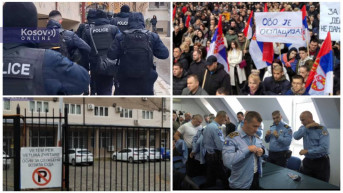
Several non-governmental organizations have warned that the return of Serbs to the Kosovo Police is the only way to reduce tensions and increase security in the four northern municipalities of Kosovo. However, the government insists that Serbian police officers can only return through adherence to procedures, namely regular recruitment processes. Most interlocutors at Kosovo Online believe that the return of the Serbian community to institutions, including the Kosovo Police, has from the start not been a procedural issue, but a political one, and the key issue is whether Pristina wants their return.
Written by: Arsenije Vuckovic
"Continuously deploying police officers in communities that perceive them as 'enemies' carries significant risks that must be recognized and resolved by the relevant institutions and the international community," state a joint communique by civil society organizations from northern Kosovo.
The only sustainable long-term solution they see is achieving ethnic balance within the Kosovo Police in the four northern municipalities.
This has also been stated by the EU, but they expect it to happen only after the elections on February 9.
The Kosovo government does not mention elections, only procedures and recruitment processes.
"Returning to institutions has procedures and employment rules that everyone must respect, without exception," states Preparim Krieziu, spokesperson for the Kosovo government.
Serbs from northern Kosovo left the institutions on November 5, 2022.
Initially, this was done by over 500 police officers, followed two days later by Serbian prosecutors and judges, government employees, administrators, and assembly members...
This was a reaction to a series of unilateral actions by Pristina, which culminated in the suspension of the director of the Regional Police Directorate North, Nenad Djuric.
Problems and Consequences
Security studies researcher Nikola Vujinovic argues that the return of Serbs to the Kosovo Police is not a procedural but a political issue, and it is difficult to achieve because Pristina does not want Serbs in its institutions.
"This problem will be resolved politically, just as it arose. We have a large number of people who have left the institutions who meet all these supposed criteria. Therefore, it is unquestionable that they will meet them again. The question is only whether there will be a political agreement to make this happen. I remind you that the Serbian List and the Serbian community generally left these institutions due to the behavior of Albin Kurti, and this behavior has not changed. The Serbian community, led by the government in Belgrade, must first talk with the sponsors of Albin Kurti to reach this political agreement," says Vujinovic in an interview for Kosovo Online.
Commenting on the NGO initiative from northern Kosovo to expedite the return of Serbs to the Kosovo Police, this analyst believes there are two key issues:
The first is the mistrust of the Serbian community towards Kosovar institutions.
"I fear that trust in these institutions will be problematic even when Serbs are part of them. When you drive from Zvecan to Kosovska Mitrovica, you see a police officer, but you don't know if it's a Serb or an Albanian. And the fear, the insecurity will increase among the people," stated Vujinovic.
The second issue he highlights is the lack of desire by the authorities in Pristina for Serbs to be part of the institutions.
"Kosovar institutions do not want Serbs in their institutions. That's why we had this attempt to prevent the Serbian List from participating in the elections," emphasizes Vujinovic.
Otherwise, he believes, the institutional violence against Serbs in northern Kosovo would cease.
He also believes that the claims of Pristina officials wanting the integration of Serbs are not based on facts.
"It's just at the level of verbal narrative for the international community. Just as the Community of Serb Municipalities has been forming for years and constantly moves from the government, the Constitutional Court to the parliament of Kosovo, so is this story about the desire for Serbs to return to institutions. This desire is just fictitious," claims Vujinovic.
On the other hand, he stresses, distrust is the main challenge of the Serbian community towards Kosovar institutions, especially the police and security sector.
"The behavior in recent months, even the past year, of the Kosovo Police and Kosovar security forces has been so poor towards the Serbian community that I simply cannot imagine a Serbian parent in Kosovo and Metohija looking at it with any trust," explains Vujinovic.
He warns that this problem will reflect on those Serbs who decide to return to the police.
"They must struggle with two woes, if I may call them that. First, the distrust of Kosovar institutions in Pristina, who believe they are just some exponents of 'evil Belgrade'. And on the other hand, their own community. Every day you drink coffee in cafes with your compatriots, who will surely blame you for why you returned, I have no doubt about that, and secondly, they will expect you to change something, and I'm afraid that strength does not exist without the will of the international community," concludes Vujinovic.
Laws and Procedures
Political analyst Nexhmedin Spahiu believes that Serbs are not prohibited from being employed in the Kosovo Police, but Kosovar laws prevent the return of those police officers who left on November 5, 2022.
"Recruitment for Serbs in the Kosovo Police is continuously open, but those who were once in and surrendered their uniforms can no longer apply. According to Kosovar law, if a police officer once renounces his uniform, he can no longer return to the police. This is not the case with judges or prosecutors who resigned because the Judicial and Prosecutorial Council did not accept those resignations and their employment status is currently 'frozen'," Spahiu told Kosovo Online.
Spahiu says it's desirable for the police composition to be appropriate to the ethnic makeup of the area, and this is currently not the case in northern Kosovo.
"It is desirable for the police in an area to be appropriate to the ethnic composition, which for now is not the case in northern Kosovo, but we hope that it will be in the future. When the pressures to not accept the Kosovo Police cease, that structure will be guaranteed. However, the state of Serbia insists on the return of those police officers who have already been, and that is now impossible. Therefore, they do not allow other members of the Serbian community to apply and take those places," claims Spahiu.
Meanwhile, he does not believe that Pristina's refusal to allow the return of Serbian police officers shows that it does not want Serbs in the Kosovo Police.
"I think there are no obstacles for Serbs to be in the Kosovo Police. All those who want to be in the police complete that six-month course or however long it lasts and can be employed. Places are open because since the police officers from the Serbian community left the job in northern Kosovo, the budget of the Kosovo Police is burdened with having to engage police officers from other areas to perform tasks and maintain order and peace," concludes Spahiu.
How to Find a Solution?
Unlike Spahiu, Milos Pavkovic, an associate at the Center for European Policies, is convinced that Pristina is currently not interested in the return of Serbs to institutions, especially the police, because it would then be much harder to control the Serbian community. He emphasizes that the solution lies in a broader political agreement that would entail the total reintegration of the Serbian community.
"From this perspective, it actually seems that Pristina is not interested in the return of Serbs to institutions, especially not as a group, as a community, because in that case, it is much harder to control the Serbian community," highlights Pavkovic for Kosovo Online.
He explains that in the case of individual applications to the Kosovo Police, these people cannot exert a strong influence, and this is obvious if someone applies for the position of police commander in the north because that position requires at least 10 or 11 years of service.
"Therefore, the animosity with which Pristina looks towards the north of Kosovo, especially towards Serbs as a community and towards their political organization, is obvious. And essentially the government in Pristina sees Serbs in the north as a burden that prevents the functioning of institutions, prevents some, let's say, national interests of so-called Kosovo," claims Pakovic. Therefore, he believes, the authorities in Pristina do not want to offer concrete options for the reintegration of Serbs.
"They already partially talk about recruitment, about individual opportunities, but in reality, they fundamentally do not want the full reintegration of the Serbian community into institutions," emphasizes Pavkovic.
He is convinced that the reintegration of Serbs into the Kosovo Police must be part of a broader political agreement that would entail the total reintegration of the Serbian community.
"The reintegration of Serbs into the Kosovo police is not possible based on recruitment and procedures, because Serbs are not interested in returning to institutions at this time or not sufficiently. Returning to institutions must be part of a political agreement. Serbs left the institutions, not just from the Kosovo police, but also from the judiciary, prosecution, local self-government, all institutions, as part of a political message and signal to the central government in Pristina that they are not satisfied with their status in Kosovo. So, in the same way, they must be returned. Not partially, through recruitment, individually, but also as part of a broader political agreement for the overall reintegration of the Serbian community into Kosovar institutions," is convinced Pavkovic.
He warns that if the government in Pristina is not ready for dialogue with the Serbian community about the way of return, then it should not expect reintegration, but only individual cases of return to institutions.



comments