
Rewriting history “to fit the narrative”: How to prevent its misuse?
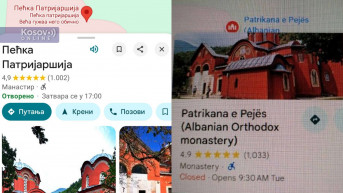
It is not the first time, nor a mistake, nor a case of ignorance of history. For more than two decades, there has been a continuous pattern of renaming Serbian cultural heritage as Albanian. Therefore, finding the Patriarchate of Pec labeled on Google Maps in Albanian as an Albanian monastery is not surprising—though it is both shameful and absurd. This is not about facts but about perfidy—a form of special warfare, manipulation, and the deliberate rewriting of history, experts from various fields told Kosovo Online.
Written by: Dusica Radeka Djordjevic
A cemetery in Vitina where only Orthodox Serbs are buried appeared three years ago on Google Maps labeled as an “Albanian Orthodox Cemetery.”
For years, the authorities in Pristina have been declaring certain Serbian Orthodox churches as Catholic, while diplomats have taken the liberty of referring to medieval Serbian monasteries as Kosovo’s cultural heritage.
Just ten days ago, the Patriarchate of Pec—the spiritual seat of the Serbian Orthodox Church and the resting place of Serbian archbishops and patriarchs—was labeled in the Albanian version of Google Maps as an Albanian Orthodox monastery.
On this occasion, Serbia’s Minister of Culture Nikola Selakovic sent an appeal to UNESCO Director-General Audrey Azoulay, warning of the grave danger looming over the cultural heritage of the Serbian people in Kosovo and Metohija.
“Tendentious Cultural Expropriation”
UNESCO cannot control Google Maps, said Professor Goran Milasinovic, President of the Serbian National Commission for Cooperation with UNESCO, but he pointed out that it is Serbia’s duty, in such uncomfortable situations, to inform the relevant UN bodies, since these are not only sites on the World Heritage List but also on the List of Endangered Properties.
Milasinovic noted that this case will be mentioned in Serbia’s annual report to UNESCO on World Heritage Sites, calling it a form of tendentious cultural expropriation aimed at turning Serbian cultural monuments into Albanian ones. He sees the labeling of Serbian sanctuaries as Albanian on Google Maps as just one in a series of pressures.
“At first glance, it may look like some kind of cultural expropriation. Some might say, well, it’s not that serious—a mistake was made. However, we know this is intentional, and that politics lies behind it. It carries a political message—creating an atmosphere where there are no Serbian traces, which means no Serbian people in Kosovo, making independence an absolute necessity for their side,” he emphasized.
He added that Serbia must remain vigilant and never lose focus.
Associate Professor Jelena Pavlicic Saric from the Faculty of Arts at the University of Pristina (temporarily seated in Kosovska Mitrovica) pointed out that in recent decades we have witnessed a specific attitude toward heritage in Kosovo and Metohija—particularly that created by the Serbian nation over time—which has been destroyed, misinterpreted, appropriated, and historically falsified.
All of this, she told Kosovo Online, represents a complex set of problems and threats to heritage and its survival, since survival is not defined only by physical existence but also by the continuity of its natural heirs—those who recognize the value and identity of the heritage, experience it as their own, and wish to pass it on to future generations.
Attacks on Symbols
“The essence of heritage lies in recognizing its value in the modern age and passing it on to future generations. The value we recognize in heritage motivates us to protect it and create mechanisms for its preservation. But on the other hand, that same value inspires certain groups to endanger it. Why? Because that value represents the symbol of those who created it. When you attack that value, you attack the symbol of a people or community—and by doing so, you seek to target that community itself,” she emphasized.
Regarding the labeling of Serbian sanctuaries in Kosovo as Albanian on the Albanian-language version of Google Maps, Pavlicic Saric said that the incident passed almost unnoticed by the wider public “because we have somehow become used to such things happening.”
“This habituation is a specific problem—it makes us somewhat lazy and leads us toward resignation. This is a question we must ask ourselves: Have we reacted all these years, and what do we do next?” she said.
However, she added, if there were an established mechanism and a clear and well-defined legal framework for responding to abuses of Serbian cultural heritage, this problem likely would not exist.
The protection mechanisms available to Serbia, she noted, must operate through legal and institutional channels, referring to the Republic Institute for the Protection of Cultural Monuments and regional institutes. Moreover, UNESCO sends its own experts, has insight into developments, and reads annual reports from domestic experts on the state of these monuments.
“But on the other hand, we see that this is not only physical endangerment—it is also semantic, happening at the level of meaning. This warns us that we need a holistic approach—perhaps to form new expert teams to deal with these other levels of threat, and even to involve experts who will focus specifically on online manipulations,” Pavlicic Saric suggested.
Natural Heirs
The issue of protecting cultural heritage, she said, is widespread throughout the world, especially in conflict areas.
“These problems occur where the heritage was created by one community—the natural heir—but remains on a territory now inhabited by another nation, which does not see it as its own but as someone else’s, or as disputed heritage, or as what is today called dissonant heritage. Essentially, this is residual heritage that remains in a territory where its natural heirs no longer exist, and it is now a major challenge for researchers around the world,” she explained.
She believes the issue should not be solved only by scientists, historians, art historians, political scientists, and cultural theorists, but involves various interest groups and individuals, and depends greatly on political decisions—as is the case with Kosovo and Metohija.
Revisionism as “Justification”
Historian Aleksandar Gudzic stated that the labeling of Serbian churches and monasteries in Kosovo as Albanian on the Albanian-language version of Google Maps is not the first example of appropriating Serbian cultural heritage but part of a long-standing process.
“We are witnessing historical revisionism—a recycling of history. Kosovo’s institutions need a reworked, recycled past. The political and intellectual elites of Kosovo Albanians need historical revisionism to justify the uprising of the 1990s, the expulsion of 250,000 Serbs in 1999 and 2000, and the destruction of more than 150 churches and monasteries from 1999 to 2004,” Gudzic said for Kosovo Online.
Historical revisionism in Kosovo, he explained, rests on four pillars.
“The first is the Roman Catholic identity of Kosovo Albanians, the second is the Illyrian-Dardanian identity of Kosovo Albanians, the third is the exclusive Albanian victimhood, and the fourth is the Orthodox identity of Kosovo Albanians. All these four pillars share the idea that Albanians are the indigenous population here, that Serbs settled in these areas in the 12th century, subjugated the Albanians, destroyed their churches, and built their own churches and monasteries on their foundations. The historical construction resting on these four pillars is needed by the political and intellectual elites of Kosovo Albanians to justify everything they did in 1999 and 2000,” Gudzic stated.
Serious scholarship, he emphasized, rejects such historical constructions and such historical revisionism, and numerous textbooks and books have been published refuting the pseudoscientific theories of Kosovo Albanian political and intellectual elites.
Even insisting on historical truth in this case will not bear fruit, Gudzic believes.
“The intention of the political and intellectual elites of Kosovo Albanians is to persist in their own narrative, and they are not interested in what scholars have to say. I am afraid this will continue in the future. The ultimate goal of Kosovo Albanians is to take over the churches and monasteries, regardless of what official science thinks about it,” the historian emphasized.
Meanwhile, Professor Milasinovic recalled the situation when Serbian medieval monasteries in Kosovo and Metohija were being inscribed on the UNESCO World Heritage List (in 2004 and 2006), when, as he noted, in a completely inexplicable way the final designation appeared as “Medieval Monasteries in Kosovo,” even though during the nomination process it had been stated as “Serbian Medieval Monasteries in Kosovo and Metohija.”
“That was tendentious on the part of the countries that wanted, in one way or another, to help Kosovo achieve full independence and eventually apply to become a regular UNESCO member, which it did attempt in 2015. We managed, with considerable effort, to change the text of the inscription so that within the description—not the title—it stated that these are Serbian monasteries in Kosovo,” said Milasinovic, adding that this was not about facts, as those are clear, but about perfidy and a form of special warfare, in which even the smallest opportunities are exploited.



0 comments