
Ten years after the second Brussels Agreement: Where did the formation of the CSM get lost?
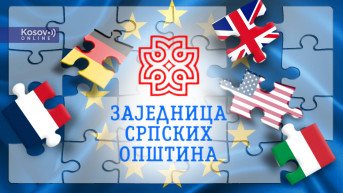
Ten years ago in Brussels, several documents were signed elaborating on the agreements reached in 2013. The most important of these laid out the general principles – the key elements for the establishment of the Community of Serb Municipalities (CSM). A decade later, progress has stalled at the very beginning. Experts interviewed by Kosovo Online warn that without stronger pressure on Pristina, no movement should be expected. They also highlight that a further problem for the Serbian community is that the Kosovo issue is no longer in focus in either Brussels or Washington.
Written by: Djordje Barovic
The agreement reached on 25 April 2015 included several documents: “Community/Association of Municipalities with a Serbian Majority in Kosovo – General Principles/Key Elements,” the “Action Plan in the Field of Telecommunications,” the “Conclusions of the EU Facilitator on the Implementation of the 2013 Energy Arrangement,” and the “Conclusions of the Working Group on Freedom of Movement/Bridge.”
In its “Progress Report on the Belgrade–Pristina Dialogue for the period April–October 2015,” the Serbian Government’s Office for Kosovo and Metohija noted that these were “arrangements elaborating on previously agreed commitments and principles, specifying deadlines and modalities for their implementation.”
The agreements were signed in Brussels by then-Prime Ministers of Serbia and Kosovo, Aleksandar Vucic and Isa Mustafa, in the presence of then EU High Representative Federica Mogherini.
Following the signing, Vucic stated that the CSM would have broad powers, its own president and vice president, decision-making authority in healthcare, education, urban and rural planning, and economic development, as well as the ability to receive funding from Serbia free of taxes, duties, and customs. Mogherini announced that agreement had been reached “on the general principles and key elements of the CSM, paving the way for its establishment,” while Isa Mustafa stressed that all agreements were consistent with Kosovo’s constitution and laws, and that the CSM would have government support and cooperation with Serbia, but no original powers.
Just two months later, Kosovo’s then-President Atifete Jahjaga requested a constitutional review of the agreement on the CSM and announced that all Brussels agreements relating to the CSM would be suspended in the meantime.
The Constitutional Court’s ruling followed on 23 December 2015, finding that some principles agreed in Brussels “were not fully aligned with the spirit of the Constitution.” While the Court explicitly ordered the CSM to be formed, this part of the ruling has since served as a pretext for Kosovo authorities to avoid doing so.
This has continued despite repeated warnings from the EU and Quint states that the CSM is the “condition of all conditions.” Most recently, the German Ambassador in Pristina, Jörn Rohde, stated in an interview with Klan Kosova:
“We said: as soon as this first step is taken—by sending the draft statute to your (Constitutional) Court for review—we will one hundred percent respect the Court’s decision. We will convene an extraordinary meeting in the Council of Europe and advocate for membership, and I am convinced that Kosovo will succeed.”
Pressure and Credibility
Slobodan Zecevic, Director of the Institute for European Studies in Belgrade, is convinced that without “serious EU pressure and threats” or a change in the political climate in Kosovo, the CSM will not be formed, and instead there will be continued “underground ethnic cleansing” of the Serbian community.
“Without serious EU pressure and threats, or a change in Kosovo’s political atmosphere, they will not manage to do it. Kurti clearly will not,” Zecevic told Kosovo Online.
Reflecting on the tenth anniversary of the second Brussels Agreement, Zecevic stated that the Serbian side has fulfilled all obligations agreed in 2013 and 2015, but the problem is that the second part of the agreement has never been implemented.
“All the compromise elements of the agreement, implemented by the Serbs to their own detriment—such as integrating the police and judiciary—in the hope that the second part would follow, namely the CSM, have not been realized,” Zecevic explained. He added that in the meantime, Serbs began to “lose faith,” ultimately withdrawing from Kosovo institutions.
“The process of implementation progressed only on our side, while on the Albanian side it was very weak,” he said.
Zecevic identified the key reason for non-implementation, particularly regarding the CSM, as the loss of EU credibility.
“The EU has lost credibility and is struggling even to return to negotiations between Russia and Ukraine, precisely because it also had such an agreement with Russia—the Minsk Agreement—which it likewise failed to implement. When you fail to enforce what you sign, your credibility collapses. This is one of the reasons, among others, why EU credibility in Serbian public opinion is ever lower,” Zecevic emphasized.
He believes that by failing to act, the EU is sending a message that it “tolerates ethnic cleansing” of Serbs in Kosovo.
“The message is that ethnic cleansing is tolerated—quiet, underground cleansing. Albin Kurti acts in the style of an old ‘Stalinist-Marxist.’ Stalin used to say: ‘No man—no problem.’ The idea here is: no Serbs—no problem. This is Kurti’s philosophy: he believes all problems will be resolved once there are no Serbs left,” Zecevic stated.
Between “Paper and Deadlock”
Pristina-based political analyst Shkëlzen Maliqi observed that while “on paper” many issues have been resolved, the formation of the CSM—like several other questions—remains at a “dead point.”
He noted that the CSM was from the outset linked to the “final settlement of the Kosovo issue.”
“It was always, in some way, conditioned on achieving a comprehensive agreement. Over the last ten years, both sides have obstructed parts or the entirety of the agreement whenever possible. The CSM was left with the requirement to ‘pass through’ the Constitutional Court. It essentially did once, but with some remarks, and since then everything has stalled,” Maliqi said.
He added that part of the reason the agreement has not been implemented is that “many developments outside the Serbia–Kosovo relationship” have taken place since 2015.
“In a way, ‘on paper,’ many things have been settled since then. This serves as the basis of all subsequent agreements, including the Ohrid Agreement and the Franco-German proposal. Everything is there, on paper,” he noted.
He said that even the issue of the main Ibar bridge remains unresolved.
“Pedestrians can cross, but not cars. There are political ‘games’ about whether Kurti might try to build pontoon bridges ahead of elections to show that his policy was right. But he cannot do that because NATO and KFOR guard it. So we are stuck at a ‘dead point,’” Maliqi explained.
He argued that the CSM will come onto the agenda only once an agreement on normalization is reached and Serbs return to Kosovo’s institutions.
“This issue is always alive, but both sides need to accept conditions that are more or less agreed. I have not had the chance to see the latest agreement, but for it to be realized, it presumes that Serbs return to Kosovo institutions, recognize Kosovo’s sovereignty, and then gain all the rights guaranteed to them,” Maliqi stated.
Asked how to interpret the statement of German Ambassador Rohde that Kosovo cannot join the Council of Europe because it failed to submit the CSM Statute to the Constitutional Court, Maliqi agreed.
“Not even a draft was submitted, which is the first step. It was once done, and the Constitutional Court did not ban it—it said 23 points need to be clearly formulated to prevent evasion and multiple interpretations. As we see today, there is evasion regarding Kosovo’s Constitution. Everyone has their own claims and wishes, but no one reads what is written. This should be resolved. Over a year ago, our government had the opportunity to send the draft CSM to the Constitutional Court and did not, and this was the condition for Council of Europe membership. And here we are—still in the same place,” Maliqi concluded.
“Diluting” the CSM
Dimitrije Milic, Program Director of the organization New Third Way, stated that without greater U.S. and EU pressure on institutions in Pristina, one should not expect the CSM to be formed, noting that all Kosovo governments so far have sought to “water down” the concept as much as possible.
Milic emphasized that the failure to implement agreed protections for the Serbian community is exacerbated by the fact that both the U.S. and the EU are currently preoccupied with more urgent matters.
“This issue has been pushed aside because the current international context imposes other priorities,” Milic explained.
He added that while the Western Balkans is “strategically important” for the EU, at present the burning issues are the war in Ukraine and the risk of escalation in Gaza, which could lead to a regional war with “unforeseeable consequences not only for Europe but for the global economy.”
“They are simply expending limited diplomatic and political capacities on these issues. In the 1990s, even when they had fewer distractions and were far stronger compared to other global actors, they still could not quickly resolve the Balkan crisis, which dragged on for a decade. Therefore, it is unrealistic to expect European states to resolve this now, given that they face even more internal and external problems than in the 1990s. And so it remains off the agenda,” Milic said.
He stressed the importance of constantly keeping the issue alive.
“It is always important to revisit this question, considering that various Kosovo governments have tried to dilute the concept of the CSM to align it with the Constitution. This was their form of ‘legalistic argumentation’ for why it could not be implemented in the format negotiated since 2013 and clearly defined in 2015,” he explained.
Milic expressed confidence that progress can only be achieved with the involvement of the U.S. and the EU.
“The obstacles and implementation directly depend on the degree of American and European pressure on Pristina. We have seen some pressure that has harmed the Kosovo government’s international reputation, but it still does not amount to implementing the CSM. There is no visible progress, especially at a time when global crises have escalated,” he underlined.
He warned that the basic concept of the CSM has been altered over the last decade “to the detriment of the Serbian community.”
“In recent years it has mostly changed to the detriment of the Serbian community in terms of the scope of autonomy. Through the ‘legalistic argument’ of aligning with Kosovo’s Constitution, powers have been reduced or, colloquially, ‘watered down’ to make them more acceptable to Kosovo public opinion,” Milic said.
He added that Pristina’s key argument remains the fear that the CSM could become a “Republika Srpska within Kosovo’s system.”
“From the perspective of the Albanian political elites, it is defined as a ‘destabilizing factor within society’ or a ‘disruptive political factor’ undermining the functionality of basic institutions. That has been the idea, but as long as there is no U.S. or EU pressure to implement it, it is unlikely Kosovo’s political elite will carry it out or suffer consequences for failing to do so—except possibly in the case of a very weak coalition government, which could come under greater pressure from minority communities,” Milic clarified.
He stressed that success in the upcoming local elections in majority-Serb municipalities is a precondition for the issue of the CSM to be placed before Kosovo’s institutions.
“In that case, you would have local self-governments representing the community and thus greater political leverage to negotiate. But the question remains how successfully you can impose this issue as a national priority for Kosovo’s government and parliament, rather than having them focus on other matters,” Milic observed.
He concluded that much will depend on when, and by whom, a future functional government in Kosovo is formed.
Principles and Enigmas
Milos Pavkovic, Strategic Director at the Centre for European Policy, told Kosovo Online that the 2015 agreement defined the key principles of the CSM, yet ten years later it remains an “enigma.”
He warned that Serbian victories in upcoming local elections are still “no guarantee” that Pristina will implement the arrangement.
“The 2015 agreement, which actually defined the key principles and elements of the CSM, was a follow-up to the 2013 Brussels Agreement, with clearly specified principles and structures the CSM should include—such as a president, vice president, assembly, council. It was a sort of elaboration of how the CSM should look in practice,” Pavkovic explained.
He identified two key reasons why the CSM has not been formed.
“The first is the Constitutional Court’s ruling on the 2015 agreement. In 2016, it ruled that parts of the agreement were inconsistent with the Constitution. This has been the excuse for successive Kosovo governments to shelve the entire matter, even though the Court never said that the CSM itself was unconstitutional—only parts of that particular agreement,” Pavkovic said.
The second reason, he added, is the broader political context.
“Relations between Belgrade and Pristina are at their lowest since 1999, coupled with Prime Minister Kurti’s complete disinterest in addressing the CSM issue, and on the other side, the EU’s lack of political will or ability—as guarantor of the 2013, 2015, and 2023 agreements—to enforce their implementation,” he said.
Pavkovic noted that much has changed over the past decade regarding the CSM. The most significant development is the European draft Statute of 2023.
“Since Belgrade and Pristina could not agree, the EU took a proactive role and presented a draft Statute intended to be adopted by Kosovo’s Assembly. However, that Statute was never made public and never brought forward for discussion or vote, leaving it, in a sense, an enigma,” Pavkovic emphasized.
What is not an enigma, he added, is that this European draft represents “a serious concretization of all previous agreements.”
“It clearly put on paper the functions and competences of the CSM, its relationship with central authorities, and the entire structure of its administration,” he explained.
Pavkovic expressed confidence that changes of power, particularly in the four northern municipalities, could place renewed pressure on the issue.
“Given that the Serbian community will participate in the elections—primarily the Serb List, but also others—I believe that if new local governments are formed, especially in the four northern municipalities, these authorities will insist on the formation of the CSM and pressure both Pristina and the international community,” he said.
However, he added, even this would be “no guarantee.”
“We can expect stronger insistence and lobbying, but that is no guarantee that the CSM will be formed, since it will ultimately depend on who forms the government at the central level and how willing that government is to move forward with the CSM process. And, of course, it depends on the readiness of the international community to exert pressure on Pristina,” Pavkovic concluded.

0 comments