
Three years since the indictments against Thaci and three leaders of the KLA: The key issue is witness protection; the verdicts will not reconcile Serbs and Albanians
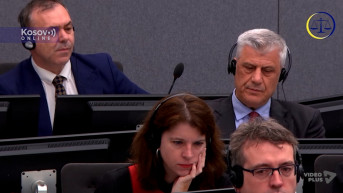
The trial against Hashim Thaci and three former KLA leaders at the Kosovo Specialist Chambers with headquarters in The Hague began in April of this year and has been marked by controversies regarding witness intimidation and protection. At the same time, legal experts warn that regardless of the outcome, the verdicts will not bring reconciliation among the peoples of Kosovo.
"The indictment is completely unfounded. I declare that I am not guilty of any point in the indictment", Hashim Thaci said on November 9, 2020, just four days after the indictment against him was made public on November 5, 2020, by the Specialist Prosecutor's Office of Kosovo, which is an integral part of this ad hoc institution based in The Hague.
Thaci resigned from the Presidency of Kosovo on the same day and was transferred to The Hague.
He reiterated his innocence on April 3 this year when the formal trial began in case "KSC-BC-2020-06", in which, along with him, former high-ranking KLA officers Kadri Veseli, Rexhep Selimi, and Jakup Krasniqi are also accused.
All of them face six counts of crimes against humanity and four counts of war crimes, including murder, torture, enforced disappearances, persecution, and cruel treatment committed in various locations in Kosovo, as well as in Kukes and Cahan in northern Albania, from March 1998 to September 1999.
In this trial, the prosecution plans to hear 33 witnesses, and a record number of victims, 143, will also participate.
In case of convictions, they will have the right to financial reparations.
The interlocutors of Kosovo Online have summarized the current proceedings of the most significant case before the Specialist Chambers in The Hague in different ways.
Tom Gashi, a lawyer from Kosovo, is confident that this trial will not conclude quickly and could last for an entire decade.
"The Special Court has stated that the prosecutor's examination of witnesses alone will take over two years, and in my opinion, the trial will last between five and ten years due to the three-tier system for reaching a final verdict. After the first-instance verdict, both the prosecution and the defense have the right to appeal, which is decided by the appellate panel, the second-instance court. And after that verdict, both sides have the right to appeal to the third-instance court", Gashi explains.
No one can predict the outcome of the trial, says the Pristina lawyer, but it is clear, he emphasizes, that in the end, when the court makes a final decision, either Serbs or Albanians will be dissatisfied.
"Perhaps the court should have been located in the territory of Kosovo or it should have been an international court that, after an investigation, would indict anyone who committed war crimes and other serious criminal offenses related to the war in Kosovo in 1998 and 1999, rather than being a mono-national court. Suppose members of the KLA are declared guilty. In that case, Albanians will not believe those judgments, and if they are acquitted, Serbs will not believe those judgments, so it absolutely does not help anyone because not everyone in Kosovo will believe the judgments that this court will make", Gashi says.
Belgrade lawyer Branko Lukic, who defended the commander of the Army of the Republika Srpska, General Ratko Mladic before the ICTY, points out that it is least important how long the process against Thaci will last, as this court is already facing a far more serious problem of protecting witnesses, and the intention is to apply the "monstrous theory" of a joint criminal enterprise, not only over Serbs but also over Albanians.
"We should give this court a chance to see what and how it will work. The length of the proceedings is usual for the work of international tribunals, so I would not object on that basis. However, as a problem, I see, and we saw it before the Tribunal that tried crimes committed in the former Yugoslavia, in the Haradinaj case, the Prosecution was prevented from presenting evidence, as more than 40 witnesses were eliminated. We know that a proceeding was also conducted before this Tribunal against Hysni Gucati, who was sentenced to more than four years and was released on parole on October 18. He provided information about protected witnesses and protected documents. So, this court failed to protect witnesses. Given the fact that witnesses were previously killed, this is a great threat to all the witnesses who are supposed to participate in the Thaci trial. Not only is the court's control fully established by the US Prosecution, but we also have the fact that the Albanians from Kosovo themselves control witnesses, eliminate them, or intimidate them. People are afraid to testify. I think there will be big problems in the Thaci trial itself", Lukic believes and as evidence of this claim, he points out that at the beginning of the month, on the orders of the Special Prosecutor's Office, the former Mayor of Malisheva, Isni Kilaj, was arrested and charged with "obstructing an official in the performance of official duties" and "violation of the secrecy of the proceedings".
"So, the same practice continues. How will the prosecution be able to present evidence, to prove guilt if they are unable to present witnesses because they have been eliminated or are unwilling to testify for fear of their families? I see this as the biggest problem in the work of this Special Court for Kosovo," Lukic says and specifies that this is precisely why Thaci's lawyer, Gregory Kehoe, stated a few days ago that he intended to release his client as soon as the Prosecution completed the evidentiary proceedings.
Most witnesses who have been heard in the trial against Thaci and the three former KLA officers were granted maximum protection measures, including concealing their identities, blurring their faces, and altering their voices. Among those who did not agree to this was Nebojsa Radosevic, a former Tanjug journalist who was abducted by KLA members in 1998 and held in captivity for 41 days, about which he recently testified in The Hague.
Unlike Gashi and Lukic, Radosevic told Kosovo Online that the work of this institution instilled confidence in him, and he expected that it would result in appropriate judgments and put an end to all the events that had taken place on the territory of the former Yugoslavia.
"I went there, and they offered me blurring my face and changing my voice. However, everyone knows me and knows how I look, and I've given interviews, so I had no problem with that. My demand was either to have complete protection without any television appearances, or I'll go public, and kindly ask. After all, I have nothing to hide", Radosevic says, adding that the work of the Special Court appears serious to him.
"Since I came into contact with that court, it all seemed quite serious to me. I had been in contact with some other prosecutors and courts before, but this is on a much higher level, more serious. I spent nine days in The Hague, and I saw that people are dedicated to their work, both prosecutors and defense. I see that the prosecutors are very studious in collecting evidence, wanting to do their job properly. Of course, the defense is also doing its job, trying to free the people they represent. The judicial panel was very interesting to me because it seems, based on my experience, that they absolutely do not favor anyone's side", Radosevic says.
Commenting on the work of the Kosovo Specialist Chambers and what has made the strongest impression on him so far, Radosevic points out that it is primarily the fact that the leaders of the KLA are on trial.
"For me personally and, of course, the entire Serbian public, the biggest surprise is that Thaci and company ended up in The Hague. This is what may indicate that something is happening there after all and that it will be more serious than before. I think it's a big step that these people are there", Radosevic emphasizes, adding that he expects that the trials before the Special Court in The Hague could mark the end of a historical chapter.
"I don't want to comment on the work of the Hague Tribunal, but the two cannot be separated. I consider this to be the end of everything related to the prosecution of war crimes on the territory of the former Yugoslavia. What I expect are verdicts. I don't know how many or what they will be like, but I really believe there will be some. And what is happening and all the evidence of command responsibility and any other responsibilities still stand, and I expect that the work of this court will finally put an end to everything that has happened since the 1990s in the former Yugoslavia", Radosevic concludes.
Tom Gashi does not share the same view.
He points out that the International Criminal Tribunal for the Former Yugoslavia (ICTY) prosecuted everyone from the territory of the former Yugoslavia who committed crimes, and people believed in that tribunal, which, he says, is not the case with the Special Court, which, in his opinion, is mono-national.
"I think it should be entirely different; there was the possibility of extending the term of the court in The Hague for the former Yugoslavia or creating another international court that would deal with all those who committed war crimes during the Kosovo war, not just one nation. This is the biggest mistake that has been made, and I don't think it will contribute to any kind of peace in Kosovo, given that there are still tensions between the Serbs and the Albanians, even though 25 years have passed since the war. I think the situation is quite clear, that the Assembly of Kosovo should not have created a mono-national court", Gashi concluded.
For Branko Lukic, the problem is much deeper and more serious because both the ICTY and the Special Court, he claims, are linked by the dangerous intention to legally strengthen the criminal act of a joint criminal enterprise, for which the entire state and military leadership of the Republika Srpska has already been convicted.
"The similarity is that they are trying to strengthen that monstrous theory under which all Serbs were tried in the Tribunal, the theory of a joint criminal enterprise. It's a truly monstrous theory, and they are trying to strengthen that theory through the Kosovo Court because no other court established after the Tribunal for the former Yugoslavia, such as the International Criminal Court, the Special Tribunal for Lebanon, or the Extraordinary Chambers in the Courts of Cambodia, has accepted that practice. That's why the Hague Tribunal is the blind spot of international justice because its case law cannot, and should not, be applied before any other tribunal," Branko Lukic concludes.
Before the Special Court in The Hague, ten Albanians have been charged in five legal proceedings so far.
Two cases were conducted due to witness intimidation and disclosure of official secrets.
Hysni Gucati and Nasim Haradinaj were finally convicted in February of this year to 4 and 3 years in prison for intimidating "during criminal proceedings" and for revealing information protected by the Law on Specialist Chambers, including information about potential witnesses. In addition to prison sentences, they were also fined 100 euros each.
The trial against Salih Mustafa, who was sentenced to 26 years in prison and reparations to victims amounting to 207,000 euros for war crimes in the first instance in 2022, is currently in the appeals phase.
In the proceedings before the Special Court, it is planned to hear a total of 86 prosecution witnesses and 159 victims who are participating in the proceedings according to the Statute of this Court.


comments