
Trials of Serbs before the Specialized chambers in The Hague – Reality or Kurti’s pre-election Spectacle?
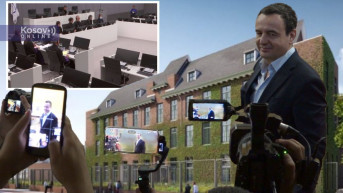
Kosovo’s caretaker Prime Minister Albin Kurti has raised the possibility that the Kosovo Specialist Chambers in The Hague could also conduct proceedings for alleged war crimes committed by Serbs. However, the international court told Kosovo Online that its mandate is clearly defined by the report of Dick Marty, while legal experts from Belgrade and Pristina assess Kurti’s claims as politically motivated and lacking any legal foundation, noting that, rather than new trials, a gradual winding down of the court is more likely.
Written by: Petar Rosic
The mandate of the Specialist Chambers is based on the 2011 report of the Council of Europe, prepared by special rapporteur Dick Marty, which investigated crimes committed by the KLA and allegations of human organ trafficking in Kosovo and Albania.
The report significantly contributed to the investigation of the wartime role of Hashim Thaçi as a commander, both during and immediately after the war, which is why proceedings against him are currently under way in The Hague.
To date, a total of 15 indictments have been issued before the Specialist Chambers in The Hague. The largest and most prominent case involves charges against Thaçi, Kadri Veseli, Rexhep Selimi and Jakup Krasniqi for war crimes and crimes against humanity.
A letter to Trendafilova
On the fifth anniversary of the indictment, in mid-November, Kurti revealed the contents of a letter he had sent in September 2022 to the President of the Specialist Chambers, Ekaterina Trendafilova. In the letter, he requested the release of former KLA leaders, offering guarantees from Kosovo’s security institutions. At the time, analysts told Kosovo Online that this move was a public spectacle and an attempt to secure the support of KLA sympathizers ahead of increasingly likely early parliamentary elections.
Last week, ahead of the start of the election campaign, Kurti made another claim regarding the same letter, stating that he had also asked Trendafilova whether it would be possible for the Specialist Chambers to consider cases involving crimes allegedly committed by Serbia during the Kosovo war.
“For the first question, the President of the Court said, more or less, that their return to Kosovo was not possible, while for the second question the answer was more ‘yes’ than ‘no’. I believe they should publish their response,” Kurti said.
The mandate of the Specialist Chambers is clear
The claims made by Kosovo’s caretaker prime minister were not commented on by the Specialist Chambers.
“It is not for the Specialist Chambers to interpret Mr Kurti’s words,” spokesperson Michael Doyle told Kosovo Online.
He stressed that the mandate of the Specialist Chambers is clear and linked to the 2011 Council of Europe report.
“The Specialist Chambers have jurisdiction over war crimes and crimes against humanity committed between January 1998 and December 2000 that were initiated or committed in Kosovo, or where the perpetrator or victim was from Kosovo or from the former Federal Republic of Yugoslavia. Therefore, the legal framework does not limit the court’s jurisdiction to a particular nationality, except to nationals of Kosovo or the Federal Republic of Yugoslavia. In addition, the legal framework requires that the alleged crimes be connected to the report of the Parliamentary Assembly of the Council of Europe,” Doyle said.
He added that the Specialist Chambers also have jurisdiction over other criminal offences, but only insofar as they relate to proceedings before the Specialist Chambers.
“The Specialist Chambers also have a mandate to try individuals who commit offences against the administration of justice, such as witness intimidation or evidence tampering, but only to the extent that these relate to proceedings before the Specialist Chambers,” he emphasized.
Serbian generals already tried in The Hague
Lawyer and former military prosecutor Dragan Pasic also points out that the jurisdiction of the Specialist Chambers is defined by Dick Marty’s report, while reminding that certain Serbian military and police generals and senior officials have already been held accountable before the International Criminal Tribunal for the former Yugoslavia for crimes committed on the territory of Kosovo. Bearing this in mind, he adds, it cannot be expected that members of the Serbian nationality who have already been convicted would be tried again in The Hague.
“That fact is indisputable,” Pasic told Kosovo Online.
Asked which cases Kurti might have been referring to when he said they could be transferred to The Hague, Pasic suggested that this might concern already-issued indictments against senior Serbian military officers.
“Above all, I am thinking of the former head of military security of the then Pristina Corps, General Momir Stojanovic, as well as police officials, but the indictment has already entered into legal force, and jurisdiction lies with the regular courts on the territory of Kosovo and Metohija. For that reason, it is not expected that this case will be transferred to The Hague or any other international institution,” the lawyer explained.
A political motive without legal basis
Commenting on Kurti’s statement, Pasic assesses that Kurti is attempting, in public discourse, to portray the leading KLA figures on trial in The Hague as victims of so-called mono-national justice, in order to secure voter support ahead of the elections.
“He emphasizes that only Albanians are being tried. It should be borne in mind that elections are scheduled for 28 December this year and that he wants to secure his electorate. It is obvious that in this way he is trying to win over his voters, primarily veterans of the so-called Kosovo Liberation Army, presenting himself as someone who allegedly cares about the national interests of the so-called Republic of Kosovo. This is a political motive that has no basis in law,” our interlocutor says.
He adds that Kurti is well aware that the Specialist Chambers were established because Kosovo’s judicial institutions were unable or unwilling to prosecute war criminals.
“The so-called Republic of Kosovo committed to this back in 2014, when it signed an international agreement establishing the Specialist Chambers. Therefore, it is not expected that individuals who have already been convicted will be tried again, and by now the public would certainly be aware of any potential perpetrators of these criminal offences sanctioned by international humanitarian law. We have no such information, and therefore no new trials are expected,” Pasic concludes.
The court’s mandate strictly limited
That the mandate of the court in The Hague is strictly limited to the allegations set out in Dick Marty’s report—relating to crimes committed by certain members of the KLA—is also pointed out by Pristina-based lawyer Amer Alija.
“If we look at the law on the Specialist Chambers, it is clear that the jurisdiction of this court and the Prosecutor’s Office is limited to crimes committed between 1998 and 2000 by nationals of the Republic of Kosovo or the former Federal Republic of Yugoslavia. If we also consider who, over the years, has been summoned to give statements as witnesses or suspects before these institutions, it can be concluded that the court deals exclusively with the allegations from Dick Marty’s report and the resolution of the Council of Europe, which concern the actions of individuals from the ranks of the KLA,” Alija told Kosovo Online.
He stressed that, although the court was established more than ten years ago, no member of Serbian military or police structures has so far been summoned in the capacity of a suspect.
“For that reason, it can be concluded that indictments will not be brought against Serbian leaders accused of having committed crimes during the Kosovo war,” our interlocutor said.
In his assessment, once the current proceedings—above all the case against former KLA leaders—are concluded, the Specialist Chambers will have fulfilled their primary purpose.
“I believe that this court will gradually begin to close after the completion of the major case against Hashim Thaçi and the others,” Alija stated.



0 comments