
Vjosa Osmani and the election campaign: Neutral or aligned with Self-Determination?
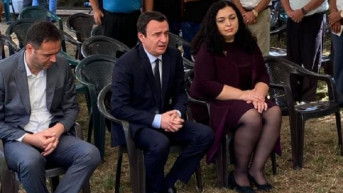
From the moment she set the date for the snap parliamentary elections, Kosovo President Vjosa Osmani faced accusations that she was following the wishes of Albin Kurti. As the campaign has progressed, some of her actions have been interpreted by the opposition as undisguised support for Vetëvendosje (Self-Determination). Interviewees for Kosovo Online assess that certain moves by Osmani could steer part of the electorate toward Kurti’s party, and see her motive for indirectly helping the party in her desire to secure another term as president.
Written by: Dusica Radeka Djordjevic
The Constitution of Kosovo stipulates that after elections the President of Kosovo may not hold any party function. Osmani complied with this requirement and, upon taking office in 2021, stepped down from the leadership of the Guxo list, which she herself founded.
Now, less than three months before the end of her term, members of opposition parties are describing her as an extended arm of the caretaker prime minister of Kosovo and leader of Self-Determination, Albin Kurti—indeed, as a tool in his hands.
The latest move by Osmani that has been interpreted as participation in the campaign is the announced reception for members of the diaspora on 26 December, two days before the elections.
According to Xhavit Haliti of the Democratic Party of Kosovo, this calls into question respect for her constitutional role.
“It raises the question of why such meetings are being organized precisely now, during the election campaign, practically on the eve of the elections. Madam President, play your constitutional role,” Haliti said.
An official of the Democratic League of Kosovo, Bajram Gecaj, also criticized the timing of the event, noting that its true purpose is “clear even to the sparrows on the branches,” and arguing that it should have been organized either earlier or after the elections.
In his view, Self-Determination leader Albin Kurti has, in addition to the judiciary, managed to place the other pillars of government under complete control.
“Institutions that should serve citizens and democracy have become tools in his hands,” Gecaj said, also criticizing Osmani for visiting the newly elected mayor of South Mitrovica, Faton Peci, who was a Self-Determination candidate.
Osmani also received criticism for visiting Peci from analyst Shenoll Muharremi, who believes that by this gesture she demonstrated bias.
However, the President’s office considers such claims tendentious, noting that Osmani has also visited municipalities governed by other parties.
Political analyst Artan Muhaxhiri told Kosovo Online that President Vjosa Osmani sides with Self-Determination in 99.9 percent of decisions—understandably so, he says, because she is aiming for another term and knows that without the support of Prime Minister Albin Kurti she has no chance.
Regarding the message Osmani sent by visiting South Mitrovica and Mayor Faton Peci immediately after he took office, Muhaxhiri says this is fully consistent with what happened during the elections, as Kurti was 100 percent focused on Peci’s campaign and victory in South Mitrovica.
“I think it was strong support both for Mr. Peci and for Mr. Kurti, and more broadly for the entire idea of the government’s and Kurti’s focus on Mitrovica, both north and south,” Muhaxhiri assesses.
“Osmani is losing allies”
According to this analyst, Osmani has charted her political positions and ideas alongside Self-Determination, and the latest decision that supports the view that she sides with Self-Determination was, he says, setting the election date.
All other parties, Muhaxhiri recalls, opposed 28 December as the election date, considering it illogical, while only Self-Determination supported that date—and Osmani decided that the elections would be held then.
“But that is understandable, because she wants a new mandate and knows she cannot even dream of securing another presidential term without Mr. Kurti’s support. The problem, however, is that the situation has changed since 2021, when Mr. Kurti had 50 percent of the vote. Back then it was much easier because they could do it on their own. Now it is unlikely that she will so easily become president again, and she needs a coalition with other parties. But with this approach she is losing allies, because I do not think the LDK or the PDK will so readily vote for a new mandate for President Osmani,” our interlocutor says.
He adds that this means another major crisis on Kosovo’s political scene is likely in April, and that new elections will probably follow. The gap between the parties, he says, is enormous, which is why he does not believe there will be an agreement on electing a president.
“For militant voters, Kurti and Osmani are one team”
Asked whether voters will interpret the EU’s lifting of sanctions on Kosovo—about which Osmani informed the public—as a success of Self-Determination, Muhaxhiri says it depends on the category of voters.
“Militant voters will present this as a joint success because they see Kurti and Osmani as one team. However, rational voters will know that this was merely the fulfillment of the European Union’s requirement to carry out a democratic voting procedure in the north, with the return of Serbian mayors to four Serb-majority municipalities in the north. That is very clear, but now we will enter a war of reinterpretations and everyone will reinterpret it as they wish,” he notes.
The Director of Strategy at the Center for European Policy in Belgrade, Miloš Pavković, told Kosovo Online that Vjosa Osmani, as President of Kosovo, formally should not participate in the pre-election campaign for parliamentary elections, but that some of her actions represent a form of indirect assistance to Self-Determination, which is not necessarily illegal.
Assistance from the gray zone
Osmani, Pavković adds, has not directly endorsed Self-Determination; however, the popularity of the moves she makes spills over to Self-Determination and provides a certain level of support to that party—especially given that Osmani and Albin Kurti have, as he says, been seen over the past five years as a duo governing Kosovo together.
“Actions such as securing recognition of Kosovo from the Bahamas are something that enjoys the trust of the entire nation. When we add to that the meeting in South Mitrovica and the announced meeting with the diaspora on the eve of the elections, this definitely has an impact—especially on undecided voters or those leaning toward Self-Determination—and she can push them in that direction. This is more a type of indirect assistance to Self-Determination, a kind of gray zone, but not necessarily illegal,” Pavković emphasizes.
Speaking about the extent of Vjosa Osmani’s influence on voters at this moment, our interlocutor says that she holds a very high position—the most important in Kosovo after the prime minister—while on the other hand, through her education and contacts primarily from the West, she brings a kind of balance between herself and Kurti, who is often a rigid political actor.
He also notes that Osmani has good relations in Washington and Brussels and that she has made numerous visits to both the EU and the United States over the past year.
“One of her most recent visits to Brussels resulted in the lifting of sanctions following her meetings with Ursula von der Leyen, President of the European Commission, and Kaja Kallas, the EU High Representative for Foreign Affairs and Security Policy. Through the presidential role and by securing significant political decisions—such as recognition by the Bahamas or the lifting of sanctions—she undoubtedly contributes to a more positive image of Kosovo, which is indirectly also viewed as a result of Self-Determination, which remains formally in power,” Pavković assesses.
The campaign for the snap parliamentary elections will last until polling stations open on 28 December.

0 comments