
War archives, selective memory, and hidden agendas: What lies behind the Kosovo-Montenegro Agreement?
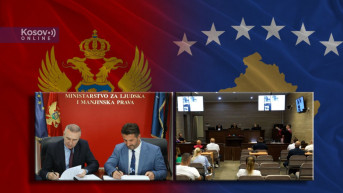
The agreement recently signed between the Kosovo Institute for War Crimes and the Montenegrin Ministry for Human and Minority Rights on the exchange of archival materials went largely unnoticed by the Montenegrin public. However, in Belgrade and Pristina, it has raised numerous questions about its true purpose and political background. While one side claims it is an important step toward clarifying war crimes, others warn that the cooperation is more symbolic than substantive—and potentially dangerous if it remains one-sided.
Written by: Petar Rosic
News of the cooperation agreement between Kosovo and Montenegro, signed in Podgorica, appeared almost simultaneously in nearly all Pristina-based media outlets. The agreement on transferring archival materials to the Kosovo Institute for War Crimes was signed by the Institute’s Executive Director, Adem Hetemi, and Montenegro’s Minister for Human and Minority Rights, Fatmir Gjeka, in the presence of two other members of the Montenegrin government.
The agreement was also supported by Montenegro’s public broadcaster (RTV Crna Gora), local media in Ulcinj, and activist organizations.
“This visit marks another important step in strengthening inter-institutional and regional cooperation for the preservation of historical memory and documentation of crimes committed during the war in Kosovo,” the Institute stated.
Amer Alija, a lawyer from Pristina affiliated with the Humanitarian Law Fund, says that the Institute’s goal is to collect evidence of war crimes in Kosovo from across the region. He told Kosovo Online that cooperation has already been established with Albania and North Macedonia, and that the most recent development is the agreement with Montenegro’s Ministry for Human and Minority Rights.
“The Institute for War Crimes, headquartered in Pristina, was founded in mid-2023. Its goal is to gather all available material evidence about war crimes committed during the war in Kosovo—from state institutions as well as sources like the media, NGOs, and individuals,” says Alija.
He explains that the agreement with Montenegro includes the exchange of information and potentially obtaining evidence related to war events.
“It is quite certain that Montenegro possesses certain data about refugees, events, and crimes that occurred during the war in Kosovo. At that time, the Yugoslav Army consisted of units from both Serbia and Montenegro, and any document, recording, or testimony that can be obtained from that country has value,” he notes.
According to him, the Institute has been working for several months on establishing contacts with Albania and North Macedonia with the aim of gathering all relevant regional evidence at an archival center in Pristina.
Since Kosovo has no official cooperation with Bosnia and Herzegovina, an agreement has instead been signed with the Srebrenica Memorial Center.
“That’s why the Institute is trying to establish ties with specific organizations. The goal is to gather evidence from all possible institutions related to crimes committed during the war in Kosovo,” he adds.
Alija emphasizes that reconciliation would require the entire region—including Serbia—to participate in the exchange of evidence.
“It would be good to establish normal regional cooperation, enable the exchange of information and evidence, and ensure that those who committed crimes are prosecuted. If nothing else, at least the facts should be established based on evidence, including the number of victims—whether they were Albanian, Serb, or of other backgrounds. Every individual case and crime that occurred in the former Yugoslavia should be documented,” he stresses.
In contrast to Pristina, the news of the agreement has gone virtually unnoticed in Montenegro, notes Montenegrin commentator and publicist Perica Djakovic. Speaking to Kosovo Online, he explains that Minister Fatmir Gjeka signed the agreement on behalf of Montenegro with the support of two other government officials—Minister of Public Administration Maraš Dukaj and State Secretary Astrid Hoxha.
However, he adds, what is concerning is the complete lack of transparency surrounding the agreement.
“I tried to contact media colleagues and people from political circles, and everyone was surprised. No one knew this had taken place. No one knows what the agreement entails or what archival materials are involved. It’s as if the whole thing is shrouded in secrecy,” he says.
Djakovic recalls that during the Kosovo war, Montenegro opened its borders to people from Kosovo—both Albanians and Serbs. In that context, he points to rumors that some Kosovo residents in Montenegro were pressured last year, especially those refusing to sell their property in Kosovo.
“A year ago, some people from Kosovo were warned to be careful about their movements, as there was a risk that Pristina authorities—specifically Mr. Albin Kurti—could declare certain individuals war criminals, allegedly because they refused to sell their family land in Kosovo and Metohija. I can’t say for certain that this is happening again now, but those rumors caused fear among people,” he says, noting that these are only rumors.
He hopes someone in the Montenegrin Parliament will raise the issue of the agreement, as no senior official has commented on it, nor has the media reported on it.
“If this is an official agreement, the public broadcaster should have reported on it. The statement mentions Montenegrin TV offering archival material to the Institute, as well as Teuta TV, a local media outlet from Ulcinj. I hope someone Djakovic concludes.
While Pristina emphasizes the cooperation, and Podgorica keeps it “under the radar,” the Serbian side sees this agreement more as a symbolic gesture than a meaningful step toward investigating war crimes.
“Based on available information, we don’t know what kind of material is actually involved. The only thing mentioned is content from Montenegrin state television (RTCG), and it’s hard to imagine how that would be significant for investigating war crimes. That’s why I believe this is more a symbolic gesture than something that will yield substantial results,” says Petar Ristanovic, a research associate at the Institute for Serbian Culture in Leposavic.
He adds that the cooperation is primarily political and sends a message of “closeness between Albanians from Montenegro and Kosovo.”
“We see that Albanian representatives in the Montenegrin government attended the signing, which took place at a lower institutional level, aiming to emphasize ties between Albanians from Montenegro and those from Kosovo. It’s questionable whether there is anything significant in Podgorica that could aid Albanian institutions investigating war crimes. I honestly doubt it—perhaps something from security service records, but I really don’t believe such materials will ever be exchanged,” he states.
Comparing Kosovo’s cooperation with the Srebrenica Memorial Center, he points out the selective approach.
“The Srebrenica Memorial Center focuses exclusively on crimes committed by Serbian forces, and the Albanian side focuses only on crimes committed by Serbs in Kosovo. Based on their work so far, it’s evident they are not at all interested in undeniable crimes committed by the Albanian side. There is a shared historical narrative and understanding of what should be studied. Hence the cooperation,” he explains.
Commenting on Kosovo Albanians’ calls for a genocide lawsuit against Serbia, Ristanovic says the issue is constantly recycled in local discourse but lacks real substance.
“To me, it seems more like a topic used for scoring political points in their domestic public. The fact is, such a charge wouldn’t stand in any international court—especially today, when the Hague Tribunal is losing credibility due to what’s happening with Palestine,” he states.
Ristanovic believes Serbia should take a more proactive approach to its own archives and the investigation of post-1990 events in Kosovo.
“Serbia should encourage researchers and allocate significantly more resources to the topic of Kosovo and Metohija, especially events after 1990, which remain largely unexplored. It is also necessary, even crucial, that Serbia opens up its archival records—particularly those of the military, police, and security services. Many influential figures in the KLA today hold a cult status in Kosovo. Our security services undoubtedly have extensive documentation on these individuals, but it is inaccessible to researchers, making it nearly impossible to write serious biographies,” Ristanovic concludes.


0 comments