
Washington Agreement six years later: What remains of the White House deal?
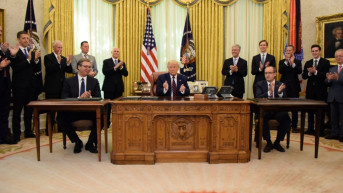
The anniversary of the Washington Agreement, signed at the White House on September 4, 2020, is being marked amid an uneven implementation of its provisions, as well as fundamental changes in Washington's relations with Belgrade and Pristina. The document, conceived as a framework for economic normalization and regional connectivity, has produced mixed results over the years. Some provisions have been fully implemented, while key economic and infrastructure projects have been left aside, directly affecting the subsequent course of US policy in the region.
On this day in 2020, in the presence of US President Donald Trump, Serbian President Aleksandar Vucic and then-Kosovo Prime Minister Avdullah Hoti signed separate agreements at the White House on the economic normalization of relations between Belgrade and Pristina.
The agreement was presented at the time as a new opportunity to bring Belgrade and Pristina closer, primarily through economic cooperation and major infrastructure projects.
One of the agreement's key political provisions was Pristina's commitment not to apply for membership in international organizations for one year, while Serbia was expected to suspend its campaign for the withdrawal of recognition of Kosovo. The moratorium was subsequently extended, but its implementation ended when Pristina applied for membership in the Council of Europe.
The Washington Agreement also provided for the implementation of the agreement on the Belgrade–Pristina highway and the railway agreement, as well as the preparation of a feasibility study on the possibility of connecting the Belgrade–Pristina railway infrastructure with a port on the Adriatic.
The document also mentions cooperation with the US International Development Finance Corporation on the "Peace Highway", the Pristina–Merdare railway and the Nis–Pristina railway.
One of the provisions concerned joining the "mini-Schengen", which was later renamed the "Open Balkan", but Kosovo did not become part of the initiative.
It was also agreed that Belgrade and Pristina would cooperate with the US Department of Energy on a feasibility study on the joint use of Gazivode Lake, as well as on diversifying energy sources.
The agreement also covered the protection and promotion of religious freedoms, the protection of religious sites and the implementation of court decisions concerning the Serbian Orthodox Church, as well as continuing the return of property that had been taken away.
Belgrade and Pristina also committed to accelerating efforts to locate and identify the remains of missing persons, as well as to working on long-term solutions for refugees and internally displaced persons.
Kosovo committed to opening an embassy in Jerusalem, after which Israel recognized Kosovo. According to Serbia's version of the document, Serbia was expected to move its embassy from Tel Aviv to Jerusalem, but this did not happen.
Six years after it was signed, the Washington Agreement remains a document whose individual elements have been implemented, while a significant portion of its provisions remains only partially implemented.
From the moratorium on international organizations, infrastructure projects and cooperation over Gazivode to the "mini-Schengen", railway connectivity and other economic issues, a large part of what was agreed at the White House remains an open question.
One of the agreement's most concrete outcomes was the establishment of diplomatic relations between Kosovo and Israel and the opening of Kosovo's embassy in Jerusalem.
As for Kosovo-US relations over the six-year period, Washington suspended the strategic dialogue process in September 2025, after announcing its launch earlier that year.
Diplomatic pressure on Pristina and the suspension of the dialogue followed Washington's concerns over unilateral actions and statements by Kosovo Prime Minister Albin Kurti, which were assessed as destabilizing for northern Kosovo and relations with allies.
On the other hand, the United States launched a strategic dialogue with Serbia in August 2025, following a meeting between US Secretary of State Marco Rubio and Serbian Foreign Minister Marko Djuric in Washington.
The dialogue is focused on cooperation in the energy sector, including reducing dependence on Russian gas, military-technical cooperation, and attracting US investment in the technology sector.
While the Washington Agreement laid the foundations for economic connectivity, subsequent political deadlocks and changes on the ground have shown that full implementation of the agreed measures requires continuous coordination and the political will of all sides.
0 comments