
Five years since the Washington Agreement: How likely is its revival?
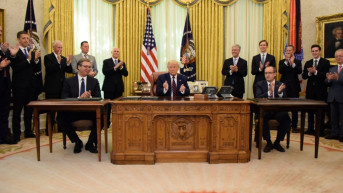
Although the Washington Agreement was supposed to position the economy at the heart of relations between Belgrade and Pristina, politics—meant to be “on hold”—ultimately disrupted that plan. Five years on, interlocutors for Kosovo Online assess that the Washington Agreement, signed in the White House on this day, has been implemented only in fragments, yet they do not entirely dismiss the possibility that the U.S. administration might at some point turn its attention back to it.
Written by: Dusica Radeka Djordjevic
The signatories of the Washington Agreement, Serbian President Aleksandar Vucic and former Kosovan Prime Minister Avdullah Hoti, using different terminology, essentially sent the same message today: the brakes on implementing the agreement were pulled in Pristina.
The Serbian President stated that the agreement was primarily economic, but that Pristina had refused to implement it, just as it refuses to implement any agreement.
He reminded that Joseph Biden, who replaced Donald Trump as U.S. President shortly after the Washington Agreement was signed, wanted the agreement to be forgotten and replaced with new ones.
“We had, above all, an agreement on the economy. They pushed part of their political agenda that had nothing to do with that—whether we recognize or not. They tried, I refused. It was primarily an economic agreement they did not want to implement. And it’s not them that’s my problem… Trump then lost power, Biden came, who wanted the Washington Agreement set aside, to apply some new one, and for the Brussels Agreement to be forgotten,” Vucic said, stressing that the Brussels Agreement will nevertheless have to be implemented and the Association of Serb Municipalities formed.
Avdullah Hoti, the signatory of the agreement on behalf of Pristina, concluded today, as he has many times before, that the agreement was neglected by Kosovo’s institutions that emerged from the 2021 elections.
He views the agreement he signed in the Oval Office as a “missed opportunity for Kosovo,” but also as a historic achievement that created unique opportunities to strengthen the strategic partnership between Kosovo and the United States and to place Kosovo at the center of regional economic development through large infrastructure projects.
“Had the major infrastructure projects included in this agreement been implemented, Kosovo would today have assumed its role as a passenger, railway, and energy hub in the region and beyond. In political terms, the agreement brought recognition from Israel, breaking a years-long blockade of non-recognition and enhancing Kosovo’s international subjectivity,” Hoti said.
The last point of the agreement, it should be recalled, was worded differently in the document signed by Vucic with the U.S. administration than in the one signed by Hoti. In Pristina’s version, it states that Kosovo and Israel agreed to mutually recognize each other.
According to Charles Kupchan, senior fellow at the Council on Foreign Relations and professor of international affairs at Georgetown University, the most important outcome of the Washington Agreement was its symbolism rather than its practical effects.
Symbolism number one, Kupchan told Kosovo Online, was that the U.S. was ready to engage in the long-standing conflict between Kosovo and Serbia.
“Number two is that progress can be made—that Pristina and Belgrade can actually agree on something, even if it is economic in nature, and not on broader political issues. But the problem is that nothing has really happened since then. In fact, I would say the process has moved backward, despite the agreement that the European Union put on the table. Neither Belgrade nor Pristina has been in a position to move the ball forward in the normalization process,” Kupchan said.
The Washington Agreement was largely about trade relations, the professor reminded, but he also said that he does not believe trade can really make a difference.
“You have to get the politics right, and then economic integration can help achieve an agreement. But if you don’t get the politics right, trade and investment won’t help. And the problem is that politics was wrong under Prime Minister Kurti’s leadership. Kosovo, in a way, pursued a very nationalist policy. Kurti made some decisions on license plates, on mayors in the north that did not advance towards the Association of Serb Municipalities, which in many ways set Kosovo back in the eyes of Europe and the U.S. People began to blame Pristina for the problem, whereas in many respects it was Belgrade that was dragging its feet,” Kupchan assessed. From a political perspective, he added, neither Pristina nor Belgrade was in a position to move forward with the agreement.
“As a consequence, I think renewed engagement by the Trump administration will be needed to get the process moving,” he said.
Considering that Trump, as he put it, is keen to be a peacemaker and to reach agreements, he could re-engage now, though much also depends on whether Trump feels he has enough “breathing space.”
“He has a lot on his plate with Russia and Ukraine, with Israel, Gaza, the wider Middle East, and Iran trying to reach a new nuclear deal. He’s dealing with the rise of China and, as a result, Kosovo and Serbia don’t immediately reach the level of presidential attention, but they are clearly on Trump’s radar. He may see Kosovo and Serbia as ‘low-hanging fruit,’ an intractable conflict in which he could make significant progress. And so he may return to Ric Grenell, or other members of his team, like Steven Witkoff, and see if he can make some progress in the Balkans,” Kupchan reasoned.
According to Afrim Hoti, professor of international relations in Pristina, the U.S. political leadership is currently more focused on other crises, but he believes that once the Russia-Ukraine conflict is resolved, American attention will return to the Washington Agreement.
“It can definitely serve as a reference for normalizing relations between the two countries,” Hoti opined, adding that he sees the agreement as one of the best to date.
“We weren’t lucky because President Trump was no longer in office after the signing of the agreement. There was a change in the White House, and it seems that for Joe Biden’s Democrats this agreement was neither a goal nor a reference point for relations between the Republic of Kosovo and the Republic of Serbia. Now that President Trump is in his second term, I think the Washington Agreement can easily become one of the points—or the main point—of the political agenda, since it primarily relates to the economic perspective,” Hoti told Kosovo Online.
The situation is viewed somewhat differently by Igor Novakovic, senior fellow at the Center for International and Security Affairs in Belgrade, who says he is not sure whether relations between Belgrade and Pristina would have been normalized even if the agreement reached five years ago had been implemented.
“Normalization of relations has two dimensions. The first is technical, which implies that Belgrade and Pristina can coexist normally, and the second is narrative. The biggest problem is that this narrative normalization does not exist; on the contrary, I feel that we are in a bigger problem now than ever. What that agreement would likely have contributed to is the technical aspect of normalization,” Novakovic told Kosovo Online.
He also noted that U.S. policy toward the region is quite disinterested, which is why he believes there should be no illusions about implementing the Washington Agreement at this moment.
“Without the key figure who led it—and at that time it was Mr. (Richard) Grenell—there should be no illusions that the Washington Agreement will be implemented now,” Novakovic assessed.
Speaking about the scope of the White House deal, he observed that little has been implemented aside from Israel’s recognition of Kosovo.
“Some infrastructure elements of the Washington Agreement will be fulfilled regardless of the agreement itself, such as the construction of the highway, as it is currently financed with European Union funds. For other issues, such as railways, we will see, since after signing the agreement financing for such projects must be secured, and that has not happened,” he noted.
Still, when asked whether a “Washington Agreement II” is possible, Novakovic said it is theoretically possible, but reiterated that one must bear in mind that the Washington administration is not particularly interested in this region at the moment.
“Perhaps in the second half of Trump’s term that interest might return, or possibly with Richard Grenell’s return to a function of importance for the region. At this moment, that interest does not exist,” he said.
Bojan Stanic, assistant director of the Sector for Strategic Analyses, Services, and Internationalization at the Serbian Chamber of Commerce, said that the idea behind the Washington Agreement was that political disagreements in negotiations between Belgrade and Pristina would be resolved through economic cooperation. Yet, after five years, he concluded that politics was the “culprit” for the agreement on economic normalization not being fully implemented as envisioned.
Given that the agreement envisaged both sides joining the “Mini-Schengen Zone,” later renamed the Open Balkan, Stanic said the idea was to establish a common market based on the free flow of goods, services, people, and capital.
“But since 2020, there have been blockades of Serbian goods entering the market of Kosovo and Metohija, and that was absolutely a unilateral decision by the Pristina authorities. It not only violated the CEFTA agreement but also harmed the needs of the population in Kosovo, who were unnecessarily exposed to price increases because they had to import goods from other markets less competitive than Serbia’s,” Stanic told Kosovo Online.
“After the pandemic, however, a geopolitical crisis emerged, most notably the war in Ukraine, which pushed the priorities of all, conditionally speaking, sponsors of economic cooperation initiatives and their attention to this region to the fifth or sixth tier. Consequently, local politicians reemerged as more influential actors who simply halted that process,” he stressed.
He recalled that the Washington Agreement envisaged America supporting the region with its investments and noted that in Serbia, U.S. investments, for example, have exceeded German ones over the past year and a half.
“But from that story of forming an investment center here, only words remain, while in terms of realization, practically nothing or very little has been done,” Stanic said.
Commenting on the points of the agreement concerning infrastructure projects, such as the highway and the railway that was supposed to link Belgrade and Pristina, he emphasized that their realization would primarily benefit Pristina.
“The territory of Kosovo cannot achieve sustainable economic development without cooperation with Serbia or Albania and other regional countries, because it has no access to the sea and is geographically positioned in such a way that none of the pan-European routes go through it, and it can practically be bypassed,” he pointed out.
Agreed / (Un)fulfilled
The agreement envisaged both sides joining the “Mini-Schengen Zone,” proclaimed by Serbia, Albania, and North Macedonia in October 2019, but Kosovo never became part of this initiative.
The U.S. Department of Energy and the Pacific Northwest National Laboratory submitted in June 2021 a report to the governments of Serbia and Kosovo on the management of Lake Gazivode, which was one of the points of the agreement, suggesting that arrangements be considered in line with the U.S.-Canadian treaty on the Columbia River.
It can be said that the provision obliging Pristina to a one-year moratorium on seeking new memberships in international organizations, and Belgrade to pause its campaign for Kosovo’s de-recognition, was fulfilled.
The agreement also obligated both sides to accelerate efforts to locate and identify the remains of missing persons.
Israel recognized Kosovo, and Pristina opened an embassy in Jerusalem. It was also envisaged that Serbia would move its embassy from Tel Aviv to Jerusalem by July 1, 2021, but this did not happen due to Israel’s recognition of Kosovo.

0 comments