
Washington’s solution for Kosovo: What could be Trump’s “offer that can’t be refused”?
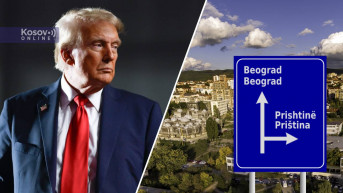
The Trump administration continues to demonstrate that U.S. foreign policy in the next four years will be anything but predictable. Ukrainian President Volodymyr Zelensky has already experienced this firsthand, facing a rough time in the Oval Office. Because of this, political science professor Basri Muja fears that Trump could simply "wake up one morning" and present Belgrade and Pristina with a fait accompli to resolve the Kosovo issue. Most sources interviewed by Kosovo Online believe that such a scenario is possible and that Trump’s proposal would likely come in the form of an ultimatum. The only question is whether Kosovo is marked in red on Trump’s map of "quick diplomatic victories."
Written by Arsenije Vuckovic
"I hope Trump doesn’t wake up one morning and try to push through a quick agreement between Kosovo and Serbia. Given his approach to other global issues, he could place both sides before a fait accompli," Muja warned.
Albanian politician Gino Maliqi, a representative from Wylie, Texas, also expects a stronger engagement from the Trump administration in the dialogue.
"I would be happy if Trump’s administration takes the lead in the Kosovo-Serbia dialogue, just as it has in Ukraine. The U.S. involvement in Ukraine is a good signal that there will be a more serious approach to Kosovo-Serbia talks," Maliqi stated.
"The Chinese model"
Historian Stefan Radojkovic told Kosovo Online that Trump could indeed put an end to the prolonged normalization process—a scenario that both Belgrade and Pristina fear equally.
"What worries Pristina—especially those who understand international relations better—is the fact that the U.S. is trying to disengage from conflicts, crisis zones, and unstable regions in Europe, shifting its focus toward China and the Pacific. These are the main geopolitical challengers to the U.S., and that’s where Washington will direct its attention. Given that Pristina’s administration heavily relies on the U.S. for security and diplomacy, it’s clear why there’s so much panic," Radojkovic explained.
On that list, he emphasizes, are also the actions of the current Prime Minister Albin Kurti over the past four years.
"They have not contributed to giving the U.S. any reason to support the Pristina administration in the way it has done so far. That is why they fear any quick resolution, just as Belgrade fears a quick resolution. The only conceivable 'bold offer,' in my opinion, might be one that Belgrade would accept, but Pristina would not. So, more or less, we remain in this tense relationship, and no quick agreement between Belgrade and Pristina can take place under the Trump administration," explains Radojkovic.
As a possible offer for Kosovo, he envisions the "Chinese model" of U.S.-Taiwan diplomatic relations.
"The bold offer that Trump might put forward, which could at least be acceptable from Serbia’s side, is the 'Chinese model.' By that, I mean Washington’s and Beijing’s stance on Taiwan. They maintained a One China policy, where the U.S. has certain relations with Taiwan but does not recognize it as an independent state, instead treating it as a legal entity with which it has relations. However, they formally recognize the unified People's Republic of China, which includes Taiwan. That is something Belgrade could accept. However, all of this remains speculation," says Radojkovic.
No "quick solutions"
On the other hand, political analyst and university professor Nexhmedin Spahiu doubts the likelihood of "quick solutions" from Washington.
He is convinced that Trump will follow the existing U.S. policy toward Kosovo and supports this argument by referencing his congratulatory message on the 17th anniversary of Kosovo’s declaration of independence.
"If we look at the message Trump sent to President Vjosa Osmani on the 17th anniversary of Kosovo's independence, it was a strong message of support. He referred to Kosovo as a determined and persistent nation, which even Kosovo’s own leaders do not say about Kosovo," Spahiu told Kosovo Online.
He recalls that former U.S. envoy Richard Grenell shares similar views but differs from Trump only in his stance toward Kosovo’s Prime Minister Albin Kurti.
"He made some provocative remarks about Albin Kurti, although he did not mention him directly but instead praised Hashim Thaçi, which effectively means a direct attack on Kurti. However, it was still a show of support for Kosovo as a state," Spahiu believes.
"Checkmark diplomacy"
For Marko Miskeljin, an associate of the Center for Social Stability, the key word in the future U.S. approach to Kosovo is "checkmark diplomacy."
Donald Trump’s intention is to secure as many diplomatic victories as possible worldwide.
Therefore, he warns, it is not impossible that the future solution for Kosovo will be imposed as a form of ultimatum on both Belgrade and Pristina.
"At some point, talks will take place, and the first offer will be exactly that. Because that is the way Donald Trump negotiates. It is very important to respond to such offers and negotiation tactics diplomatically and calmly, especially in light of what we saw in the Oval Office a few days ago. Learning from that experience, we must understand that this is primarily Trump’s negotiation tactic, as he is eager to check off as many achievements as possible, particularly in his second term, when he will be more concerned with his legacy than in the first. It is important for him to be seen as a peacemaker in as many places as possible," Miskeljin told Kosovo Online.
He emphasizes that if there is a willingness for a pragmatic solution and mutual interest, Trump’s offer should not be interpreted as an ultimatum but as "the next offer in negotiations."
"If his side senses that one party or the other is unwilling to engage in negotiations, that is when an ultimatum might come—after which there will be no further offers. I fear that Zelensky has already felt that firsthand," Miskeljin says.
For this reason, he stresses, it is important not to take rigid positions in those negotiations.
"The Serbian leadership must continue what has been done so far. A calm and wise policy toward the U.S. should be the way forward because that is simply how this new administration operates," Miskeljin believes.
He adds that for Pristina, much will depend on who forms the next government.
"We have seen from Kurti and his administration—both this one and the previous one—something that was not typical for the Albanian side, and that is a rather harsh stance toward one segment of the U.S. political spectrum, which is currently in power. However, they have been wise enough not to handle it the way Volodymyr Zelensky did," explains the analyst.
He is convinced that in these negotiations, the Washington Agreement would be utilized.
"The Trump administration would certainly make use of the Washington Agreement because, at the end of the day, they consider it another diplomatic victory. It was reached just before the elections, and some aspects—especially those related to the economy—were quite important and emphasized by both Donald Trump and other key figures," Miskeljin notes.
He concludes that in such a case, Trump would also rely on trusted individuals familiar with the issue, highlighting John Jovanovic, who previously led the U.S. National Agency in Belgrade and is now the director of the U.S. Export-Import Bank, as well as former envoy Richard Grenell, who now serves as a special missions envoy.


0 comments