
The Western Balkans and the European Football Championship: War Trumpets from the Stands
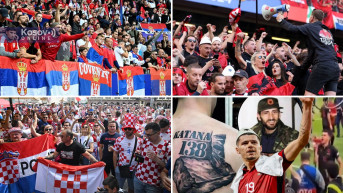
Fan passions from the Western Balkans have moved to stadiums in Germany for the European Football Championship. According to sources from Kosovo Online, from Skopje to Vukovar, the unsavory scenes at the matches of Croatia, Albania, and Serbia are much more than mere "choreography". They warn that the "shadows of the past" are still the future of the Balkans.
It started almost naively when the former Prime Minister of Montenegro, Dritan Abazovic, joined the RTS program live from Essen and said he was there privately to watch football and support neighbors from the region.
"I came privately to support neighbors from the region a bit. Tonight was the Albania - Italy match, and on Sunday evening I will be at the stadium to support Serbia against England, hoping for a big surprise. Let it be brave, even a draw would be a great result, but why not believe that England can fall tomorrow?" said Abazovic.
However, everyone heard what they wanted, and he was declared a traitor the very next day.
Then, it escalated into a brawl involving Serbs, English, and Albanians, moving the "atmosphere" from the streets to the stadiums.
The epilogue is more than 200,000 euros in fines that the football federations of Croatia, Albania, and Kosovo had to pay UEFA for the behavior of fans during the matches, and the account has not yet been settled.
So far, the UEFA Ethical-Disciplinary Commission has fined the Albanian Football Federation almost 100,000 euros for a series of incidents during matches against Croatia and previously Italy.
The Football Federation of Serbia was also fined a total of 14,500 euros for events during the match against England.
The Croatian Football Federation has paid 87,875 euros so far for the hooliganism of fans during the match against Spain, and the invoice from the Fare organization - Football Against Racism in Europe for chanting: "Kill the Serb" and "Serbs on willows" is yet to be issued.
The Croatian federation distanced itself from that incident, claiming that the slogans, in clear Croatian, were shouted by Albanians.
"They expected Croatian fans to join in since they chanted in our language, but that did not happen," writes the Zagreb-based Jutarnji List, noting that "only a small part of Croatians joined in," on which the HNS will base its defense.
There is no doubt about who chanted what thanks to Albanian player Mirlind Daku, who after the Croatia-Albania match, which ended in a 2:2 draw, used a megaphone to chant insults at Macedonians and Serbs with fans.
Daku later explained that he was carried away by emotions. He was punished with a two-match suspension.
Emotions apparently also carried away Albanian journalist Arlind Sadiku, who had his UEFA accreditation revoked because, before the England-Serbia match, in front of a stand with Serbian fans, he crossed his arms symbolizing the double-headed eagle.
Before the Croatia-Albania match, a German police officer reacted emotionally with identical hand movements...
However, the "fan fever" of the Western Balkans spread beyond the region, as shown by the Albania-Spain match.
"We ask Spain, recognize the independence of Kosovo. You will lose nothing, on the contrary, you will gain a sincere friend," a banner read alongside flags of Kosovo, Albania, and Spain.
The Albanian team bid farewell to the European Championship with a defeat, accompanied by Spanish fans chanting: "Kosovo-Serbia."
Flags and choreographies glorifying "Greater Albania," and symbols of the KLA at every turn, are not just a warning for UEFA, but also for the Swiss Football Federation, according to the Swiss magazine "Weltwoche".
This publication points out that the team of this country "has become a platform for foreign extremists."
Serbian fans were not spared either.
The Football Federation of Kosovo has prepared a complaint to UEFA due to behavior during the match against Slovenia in Munich.
"The Football Federation of Kosovo strongly condemns the nationalist calls and the display of the Serbian flag with the map of Kosovo and the inscription 'No Surrender'. Repeating such behavior at football stadiums, even after previous UEFA penalties, is unacceptable and demands stricter enforcement by UEFA's decision-making bodies," the statement said.
Wars and Consequences
Historian Stefan Radojkovic evaluates in a conversation for Kosovo Online that the events in Germany during the European Football Championship are a kind of public opinion poll that shows that the Western Balkans region is still far from reconciliation.
“The fan passions we see during the European Championship in stadiums in Germany are a kind of public opinion research and testing the pulse of public sentiment. It can be said that the diasporas are still embroiled in the wars of the 90s, and probably a good portion of the local population that came from the Balkans region to Germany for the European Championship. We must be very careful because it is obvious that the passions have not yet fully calmed down and probably won't be the case anytime soon," says Radojkovic.
The scenes from the EC are an indicator, he adds, that more time is needed for the region to be able to look at the issues from the 90s with a cool head.
"It won't be quick. Work is needed over several generations. It's accepted that about three generations are needed for passions to calm down. And if approached in an institutional and responsible manner to the issues of the 90s, then we can hope for some results that would resemble what we call reconciliation today. But, so we are. Much water needs to flow under the Branko's Bridge before we can say that something like that will be," believes Radojkovic.
Folklore and Stands
Director Danilo Beckovic emphasizes that the incidents at the European Football Championship are a "concentrate" of everything happening in the region and that the peoples of the Western Balkans are in a "limbo" due to constant stoking of tensions.
"Essentially, we didn't need the European Championship to show that passions have not calmed down at all. It's a folklore that is present, but the bigger problem is that our reactions to these kinds of provocations are always excessive and a bit immature. I think it would be much better if such things were not given attention in that way," highlights Beckovic for Kosovo Online.
Commenting on numerous incidents during the performances of teams from the region, Beckovic says it is a "concentrate" of events in those countries.
"What you see in the stadium is actually just a concentrate of what is happening in those countries. And not only there. It is actually a consequence of a constant stoking of the political situation in the territory of the former Yugoslavia, which we had with the resolution in the UN, various statements, and events in BiH, Kosovo and Metohija, and ultimately in Serbia and Croatia. You constantly have pressure that comes not only from within but also from outside and which stirs up the atmosphere in all those countries. Then it is most clearly seen in the stadium," says Beckovic.
Asked if the region could get out of this kind of matrix, he emphasizes that it is possible only if the "peoples of the Balkans grasp some kind of independence."
"The region could come out of that limbo when it turns to itself. There's this old cliché 'The Balkans to the Balkan peoples' which was accepted as a policy at one point. Now, no one even thinks about it. Simply, the Balkan peoples have accepted various patronages from abroad, and nobody from abroad is actually dealing with ensuring peace in the Balkans. Simply, that, that's not their job, it wasn't expected of them. Therefore, the only way to get out of it is for the Balkan peoples to grasp some kind of independence again," concludes Beckovic.
Cause and Effect Connection
Analyst from Skopje, Blagojce Atanasovski, believes that the unpleasant scenes at the European Football Championship show that the Western Balkans region, instead of building bridges of coexistence, still lives in the nineties and that it is a causal-consequential dependency and intertwining of political relations in the region.
“I don’t think it’s coincidental, it's simply a causal-consequential dependency and intertwining of political relations in the region, namely these outbursts of fans are an absolute continuation of some policy of the official authorities of the countries from the region. Otherwise, heads of state do not speak in the way that fans chant. Fans speak openly and without diplomatic gloves in stadiums,” says Atanasovski in a conversation for Kosovo Online.

0 comments