
The Western Balkans and the new priorities of the European Commission: What is Von der Leyen serving alongside the Growth Plan?
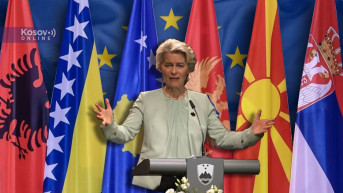
The President of the European Commission, Ursula von der Leyen, will host a working lunch tomorrow with regional leaders, where the main topic is expected to be the disbursement of the first tranches from the Reform and Growth Fund for the Western Balkans. Analysts from Pristina and Belgrade, speaking to Kosovo Online, suggest that this could indicate the region will be among the foreign policy priorities of the new European administration.
By Arsenije Vuckovic
"Prosperity, security, and democracy are the overarching themes defined by six priorities," Von der Leyen said on Wednesday, introducing the candidates for the new European Commission commissioners.
Is the Brussels lunch with her, just two days later, good or bad news for the leaders of the Western Balkans, and what will be on the menu?
According to announcements, the discussion will revolve around the first installments of the largest financial package the EU has allocated to the region. The six-billion-euro package aims to double the economies of the regional countries within a decade. The first installments were supposed to be disbursed this month, but the process was postponed until October.
Countries were required to submit reform plans to Brussels as a condition for receiving the funds, and the content of these plans is expected to be the main topic of Von der Leyen's discussions with regional leaders.
The European Council gave the green light on May 7 this year for the creation of the Reform and Growth Fund for the Western Balkans, a financial instrument to support reforms and economic growth in the region, as part of the Growth Plan for the Western Balkans from 2024 to 2027.
Kosovo and Serbia have an additional condition for accessing the financial package: they must demonstrate a constructive approach to the dialogue process.
Mechanisms and Priorities
Igor Novakovic, Senior Fellow at the Center for International and Security Affairs (ISAC Fund), notes that the impasse in the dialogue between Belgrade and Pristina will undoubtedly be discussed, though likely on the sidelines of the meeting. One of the key topics will be the pace of project submissions and issues with implementing the Growth Plan for the Western Balkans.
"In some cases, there's a complete stalemate, such as in Bosnia and Herzegovina, where there is no real national consensus on the Growth Plan. This is because not only the central government but also the governments of the entities, cantons, and the Brcko District need to agree. This shows that internal political processes in all the Western Balkans Six need to be pushed forward to maximize the impact that the Growth Plan is intended to have," Novakovic said in an interview with Kosovo Online.
As a positive example, Igor Novakovic highlights the announcement by Serbia and Montenegro to use these funds to renovate the Belgrade-Bar railway.
Novakovic emphasizes that the meeting between European Commission President Ursula von der Leyen and the leaders of the Western Balkans also signals that the region will receive greater attention from the new composition of the European Commission, with the Growth Plan serving as one of the key mechanisms for the EU accession process.
"There are two elements here. The first is that Ursula von der Leyen, or rather the previous iteration of the European Commission, already announced earlier this year a greater focus on the Western Balkans with the Growth Plan, which has often been described as the first step in bringing the Western Balkans closer to the EU. This means accession not only through the formal enlargement process, or negotiations between the EU and Western Balkan countries, but also through a special plan that would enable greater financial assistance, primarily for infrastructure projects," Novakovic explains.
He has no doubt that the new European administration's focus on the region will also include addressing old challenges, such as preventing potential spillover of conflicts from Eastern Europe into the Balkans.
"The new High Representative for Foreign Affairs and Security Policy and Vice-President of the European Commission, Kaja Kallas, has already informally announced that the Western Balkans will be one of the priorities, especially in terms of security, in the context of everything happening in Eastern Europe and the danger of some possible conflict spillover into this region," Novakovic emphasizes.
Tensions, as well as the stalemate in the dialogue between Belgrade and Pristina, will undoubtedly be one of the topics, but likely on the sidelines of this gathering.
"I don't expect this to be a central topic of the meeting, but there will certainly be separate meetings with leaders on the margins to assess the situation. We saw that Lajcak was in Belgrade and Pristina last week and the week before, and the question is whether something can be achieved through the official dialogue. My impression is that everything needs to be reformulated. We've already heard that Kaja Kallas herself is very interested in the issues related to the dialogue," Novakovic points out.
The 'Three C' Principle
Avni Mazreku, a professor of European law from Pristina, is convinced that the meeting between the European Commission President and the leaders of the Western Balkans is a positive signal for the region, and that the new European administration will continue the policy of the "Three Cs" — conditions, communication, and consolidation — both in terms of EU membership and accessing funds from the Growth Plan.
"I think that the new European Union policy, like the previous one, will function based on the 'Three Cs' (fulfilling obligations, conditionality, and communication). It will be a 'conditional policy' carried out through continuous communication between the EU, the European Commission, and the countries aspiring to join the Union. Similarly, there will be a 'conditional policy' toward these countries, requiring them to take certain actions or meet certain criteria in order to reach the third level, the 'third C' — state consolidation. This means that everything will be done through constant communication, conditioning the candidate country with the goal of consolidating its institutions. I believe this 'Three Cs' policy will also apply to the new EU funds for the Western Balkans," Mazreku said in an interview with Kosovo Online.
Commenting on the selection of new commissioners and the upcoming meeting between Western Balkan leaders and European Commission President Ursula von der Leyen, Avni Mazreku emphasized that this is a positive signal.
"She will continue leading the European Commission for the next five years, which is positive for the Western Balkans because she is familiar with the region's specificities and problems, as well as other global challenges affecting the functioning of the European Union. In this context, I believe this is a positive development," Mazreku concluded.
Geopolitics and Economics
Dimitrije Milic, Program Director of the "New Third Way" organization, stated in an interview with Kosovo Online that the new European Commission will focus on a more effective foreign policy in the EU's geopolitical positioning, which will involve strengthening its influence "in its backyard," specifically in the Western Balkans.
"Ursula von der Leyen had already announced during the previous European Commission that this would be a geopolitical commission, meaning that it would not only deal with technical and bureaucratic issues but also a more effective foreign policy in positioning the EU on the global stage. It is difficult to expect the EU to be more influential outside its immediate region if its internal backyard, represented by the Western Balkans, is not fully pacified, relationships are not fully normalized, and those states do not become EU allies, if not members," Milic told Kosovo Online.
Milic assessed that the EU's increased focus on the Western Balkans has been highlighted by the war in Ukraine, but the region's importance was also emphasized by the migrant crisis.
"Certainly, the war in Ukraine has brought the EU's foreign and security policy into focus, including towards our region. However, I would say that migration is the issue that has most highlighted the importance of our region," Milic emphasized.
He recalled that the migrant crisis, which began in 2014 and peaked in 2018, continues to this day.
"If our regional states hadn't cooperated in this area, it would have appeared much more chaotic and problematic for the EU. In terms of migration and security, the Western Balkans are very important to the European Union," Milic stressed.
He added that the economy will remain at the top of the cooperation agenda because the EU is the largest economic partner for all Western Balkan countries.
"In all the countries of our region, the EU is the main economic partner. Due to the geographic proximity, they are naturally oriented toward the EU, which is why it is difficult to politically ignore the Union if you are economically bound to it by nature and geography," he said.
Milic also pointed out that the question of EU assistance to the Western Balkans is simultaneously a matter of political communication between regional leaders and EU officials.
He is confident that, despite negative opinions about the re-elected President of the European Commission, the region's leaders will find a way to establish good cooperation with her and all members of the new European administration.
"Even if there are negative views about Ursula von der Leyen, they will have to find a way to work with her and other members of the European Commission, who will be in office for the next five years," Milic concluded.

0 comments