
Western Balkans under pressure due to the EES system – can transport operators break through the EU barriers?
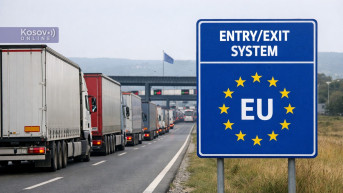
Road transport is the lifeblood of every country’s economy, experts and representatives of transport operators from the region told Kosovo Online, warning that the implementation of the European Entry/Exit System (EES) could seriously jeopardize the Western Balkans. While the EU insists that the rules are clear and unchanged, drivers say that in practice the doors of Schengen are being closed to them and, in response, have announced a blockade of borders starting on 26 January.
Written by: Petar Rosic
The new digital border management system (EES) for entry and exit began to be applied in 29 European countries on 12 October last year and is expected to become fully operational on 10 April.
It was announced as a system that would improve the security of the Schengen area, help prevent illegal migration, and increase efficiency for travelers. However, for transport operators from the Western Balkans it has brought numerous problems.
Representatives of transport associations from Serbia, Bosnia and Herzegovina, and Montenegro announced that from 26 January they would block freight border crossings with Schengen countries, with support for this action also coming from colleagues in North Macedonia.
At a press conference in Belgrade, they emphasized that the full implementation of the EES system would effectively limit the stay of drivers from the Western Balkans in Schengen countries during their daily work activities, which is why they are demanding equal status with European companies and drivers.
Serbian Prime Minister Djuro Macut also reacted, telling the Head of the EU Delegation to Serbia, Andreas von Beckerath, that this problem threatens to completely paralyze the operations of Serbia’s transport community, as well as the economies of the rest of the Western Balkans.
The Prime Minister noted that flight crews and railway personnel are already exempt from this rule and added that Serbia is offering concrete solutions that do not require amendments to the Schengen Borders Code, which he presented to his interlocutor.
Meanwhile, a response has arrived from the European Commission, but without a concrete answer. European Commission spokesperson Markus Lammert stated that the rules of the Schengen states are clear and have not changed.
Increasing deportations of drivers
Last week, the International Transport business association “Pumedtrans” also spoke out, announcing that eight Serbian citizens—professional truck drivers—have been arrested in the port of Rostock, Germany, since 15 January for exceeding the permitted number of days of stay in the Schengen area.
On the same day, the “Logistics BiH” consortium announced that in the past 365 days, 100 professional drivers from Bosnia and Herzegovina had been deported from Germany alone “solely because they work.”
The President of the Serbian Transporters’ Association, Nedjo Mandic, on Friday also sent an open letter to representatives of the Schengen countries and the European Commission, proposing two solutions.
In the letter, which he signed as a European citizen, Mandic proposed either temporarily suspending the application of the 90/180 rule for professional drivers or finding provisions within the agreement that would allow an exemption for the professional group of drivers in international transport, “which represents the lifeblood of the economy.”
Companies facing shutdown
Speaking to Kosovo Online, Mandic said that the implementation of the EES system in practice does not make the work of professional drivers from the Western Balkans more difficult, but actually makes it impossible, and that its consequences could be catastrophic for both the economy and citizens.
“This is collapse—neither will the driver earn a salary that allows for a decent life, nor will the employer be able to meet their obligations, including paying that salary. We either have to work at full capacity or stop altogether. There are a huge number of other costs that are so high that without serious work there can be no positive business results, and without positive results a company must shut down,” Mandic said.
He pointed to lengthy delays at border crossings.
“When we set off, we wait in queues—sometimes 24 hours, sometimes 48, even 72 hours. The same happens on the return journey, and this prevents us from covering a sufficient number of kilometers and completing operations,” he said.
He added that the introduction of the electronic system would further restrict work.
“Previously we were not checked, but this is a system of electronic registration. Once you reach 90 days, there is no entry, and that limit is reached in just three to four months, which means that for the following two months there is no work,” he emphasized.
No answers forthcoming
Commenting on messages from the European Union, Mandic said that responses are lacking.
“It is the same response we have been receiving for two years. That response is meaningless. They say there will be no change, yet the Schengen Agreement states that it can be amended and supplemented,” our interlocutor said, adding that a solution does exist.
“There are a hundred solutions, starting with the simplest: reintroduce a driver visa for professional drivers—a long-term visa, for three or five years—that would allow an unlimited number of entries and exits, and then there would be no problem. We have proposals, but it is best to talk and for each side to propose what suits it best, so that in the end we find a compromise solution, resolve the problem, and eliminate the need for protests,” he stressed.
He emphasized that blockades are not the goal, but that they will not abandon them.
“At a meeting with von Beckerath, I said there would be no blockades—just send us a letter and invite us to a meeting, with a joint commitment to reach a compromise and find a solution within 60 days,” Mandic said.
Macedonian transport operators supported the protest. The Secretary General of the Association of Employers of Transport Companies of North Macedonia “Makam-Trans,” Biljana Muratovska, told Kosovo Online that counting days of stay is economically unsustainable for professional drivers.
“Because within those 180 days, the 90 days spread across the months allow drivers to operate for only 10 to 15 days, depending on whether they have shorter or longer routes. That means that, if we know that with all mandatory rest periods—weekly and daily—their effective working time is 20 days, then these 10 or 15 days are economically unjustified. In short, we are being stopped and cannot serve clients normally, which means that we will gradually lose our entire business,” she said.
Speaking about possible economic consequences, Muratovska emphasized that road transport is the lifeblood of every state.
“We connect importers, exporters, and product distribution. Given that across the region, with the exception of Montenegro, we are connected exclusively by road transport and are import-dependent, this means that if road transport does not function, we will face serious problems, including shortages of raw materials, consumer goods, and even medicines and other essential items,” Muratovska said.
An attack on the entire economy
She added that this would have consequences for the entire regional economy.
“This represents an attack on the overall economy of all these Western Balkan countries, that is, those outside the European Union,” she said.
Speaking about the demands of transport operators, Muratovska noted that discussions with European institutions have been ongoing for two years.
“For two years now, together with Serbia, Bosnia and Herzegovina, Montenegro, Albania, and Türkiye, we have been fighting this issue, but so far we have received no response other than promises that some form of visas should be considered. If it is some form of visas, we say: introduce them, but without bans. However, even Switzerland applies the 90 in 180 days rule. This means that even with a visa the problem is not solved—we would only be paying fees to the state to obtain the visa,” she said.
The President of the Business Alliance from Pristina, Agim Shahini, told Kosovo Online that the EES system poses a problem not only for truck drivers, but for all citizens of the Western Balkans.
“Drivers truly have the right to complain and to block roads, because we in the Balkans are still treated as citizens outside Europe. And that is not good, because it undermines freedom of movement and human rights, because regardless of whether we live in Kosovo or in Brussels, we are people. Everyone—whether a worker or an artist, whether a businessperson or a politician—wants to live well and peacefully and to have their own views, yet the European Union applies different standards to us,” Shahini said.
Speaking about the economic consequences, he noted that blockades have a direct impact on the economy and create significant losses. At the same time, he pointed out that the EU has a strict policy toward the Western Balkans.
“However, when it comes to the Western Balkans, the European Union applies strict policies, and I believe this is contrary to European standards and human rights, regardless of which country it concerns,” Shahini said.
He is joined in this view by Granit Sokolaj from the “Alert” Consumer Center in Tirana. He told Kosovo Online that the EES system should not apply to passenger and freight drivers.
“When it comes to border security and preventing illegal immigration, I believe that this system should not be applied to passenger or freight transport drivers, because they are not part of the group of people who emigrate. These are people who go to work and stay three days, five days, or ten days in places where they deliver or collect goods, or who transport people if they are bus drivers,” Sokolaj said.
Speaking about possible reactions in Albania, he noted that he does not expect protests.
“Unlike Serbia or North Macedonia, unfortunately in Albania we do not know how to protest. Business associations are organizations that, from time to time, protect the interests of governments alongside their own interests, do not oppose the government for their own reasons, and such a protest would probably be considered an action against the government, so they remain silent,” he said.
He believes that the European Commission will not adopt a special decision to exempt freight drivers from the system, but he stresses that such a decision would be justified.
“I think it would be right for such a decision to be adopted. A driver working in Tirana, Belgrade, Skopje, Pristina, Podgorica, or anywhere else is an employee who is not emigrating, not going to the EU to violate the legal 90-day stay limit. Their trips last three days, one week, ten days, two weeks—at most one month in special cases, but no longer,” Sokolaj concluded.



comments