
Muratovska: Implementation of the EES system could endanger the Western Balkans economy
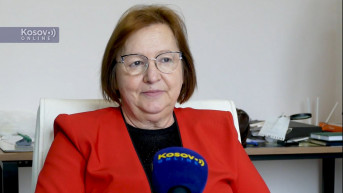
The Secretary General of the Association of Employers of Transport Companies of North Macedonia “Makam-Trans,” Biljana Muratovska, has warned that the implementation of the EES system in Schengen countries could seriously hamper the work of professional drivers from the Western Balkans and have negative consequences for the economy of the entire region.
“At the beginning there were only five countries in the Schengen Area, and the agreement we signed on visa liberalization, under which the 90 days in 180 days rule applies, is 16 years old. In the meantime, however, from five countries we have expanded to 29—27 EU Member States plus Norway and Switzerland—and we are now so surrounded by Schengen countries that the moment we leave our country we already enter Schengen territory,” Muratovska explained.
She notes that counting days of stay is economically unsustainable for professional drivers.
“Within those 180 days, the 90 days that are spread across the months allow drivers to operate for only 10 to 15 days, depending on whether they have shorter or longer routes. If we know that, with all mandatory rest periods—weekly and daily—their effective working time is 20 days, then these 10 or 15 days are economically unjustified. In short, we are being stopped and cannot serve clients normally, which means that we will gradually lose our entire business,” she stressed.
Speaking about possible economic consequences, Muratovska emphasized that road transport is the lifeblood of every country.
“We connect importers, exporters, and product distribution. Given that across the region, with the exception of Montenegro, we are connected exclusively by road transport and are import-dependent, this means that if road transport does not function, we will face serious problems, including shortages of raw materials, consumer goods, as well as medicines and other essential items,” Muratovska said.
She added that this would affect the economy of the entire region.
“This represents an attack on the overall economy of all these Western Balkan countries, that is, those outside the European Union,” she noted.
Commenting on the demands of transport operators, Muratovska said that discussions with European institutions have been ongoing for two years.
“For two years now, together with Serbia, Bosnia and Herzegovina, Montenegro, Albania, and Türkiye, we have been fighting this issue, but so far we have received no response other than promises that some form of visas should be considered. If it is some form of visas, we say: introduce them, but without bans. However, even Switzerland applies the 90 in 180 days rule. This means that even with a visa the problem is not solved—we would only be paying additional fees to obtain it,” she said.
She warned that the introduction of the electronic system would further complicate the situation.
“When the electronic system becomes fully operational from 10 April, we will no longer be able to work. You would need at least three drivers, constantly rotating. However, there is no economic possibility for anyone to sustain employing three drivers as reserves,” she said.
Muratovska stated that through the blockade they want to send a message and demonstrate what would happen if transport were to come to a standstill.
“More than one million tons of goods would be stopped, which would lead to shortages of products in stores and raw materials in factories. We would allow the transport of medicines, live animals, explosives, and ammunition. We would also allow trucks transporting coal for REK Bitola, as this concerns electricity generation, but everything else would come to a halt,” our interlocutor concluded.



0 comments