
What are the ambassadors saying about the conclusion of the dialogue - diplomatic etiquette or discordant voices?
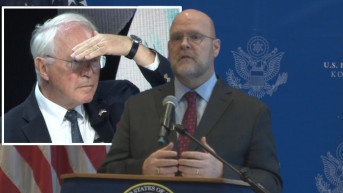
Countless times, U.S. officials have encouraged Serbia to achieve comprehensive normalization of relations with Kosovo, aimed at mutual recognition. This makes the statement by U.S. Ambassador to Belgrade Christopher Hill that "he believes de jure recognition of Kosovo will not be a condition for Serbia's entry into the European Union" seem, at first glance, to diverge from the rhetoric we are accustomed to. Especially since just a day earlier, the U.S. Ambassador to Pristina emphasized that the dialogue must end in mutual recognition.
As usual, in both cases, what was not said is more important than what was said. Hill did not "elaborate" on whether, if de jure recognition of Kosovo is not a condition for Serbia's EU entry, the condition will be that Belgrade does not obstruct Kosovo's entry into the United Nations. Similarly, Jeffrey Hovenier did not specify whether, if the dialogue must end in mutual recognition, this conclusion must come before Serbia's EU accession.
The statements of the two diplomats were, by all accounts, carefully chosen music to the ears of Belgrade and Pristina, respectively. To ensure the credulous are not misled, the German Ambassador to Pristina, Jörn Rohde, promptly reminded that the statement of German Chancellor Olaf Scholz from June 2022 still stands—that normalization of relations includes mutual recognition.
Former OSCE ambassador Branka Latinovic told Kosovo Online that America's goal is for the dialogue between Belgrade and Pristina to conclude with Kosovo's recognition, which, as she notes, Belgrade is aware of because this stance is consistent within the U.S. administration. She states that there are no significant differences between the statements made by the U.S. ambassadors in Belgrade and Pristina, Christopher Hill and Jeffrey Hovenier. It's a matter of nuances and interpretation.
"What Ambassador Hill said should be read between the lines, keeping in mind that he has good relations with all officials in his country of accreditation. He said it in the context of Serbia's path towards the European Union, indicating that it will not be a condition. This is a fact as long as five EU member states do not recognize Kosovo. It cannot be a formal or de jure condition for membership, and the entire process led by the EU is about normalization. Nowhere does it state recognition," Latinovic emphasizes.
All agreements since the Brussels Agreement of 2013 are agreements on the normalization of relations aimed at regulating relations between Belgrade and Pristina.
"The agreements from last year, what I colloquially call Brussels 2 and the Ohrid Agreement, or the roadmap for implementing these obligations, also speak about normalization of relations. Therefore, there is no significant difference in the positions between the U.S. ambassadors in Belgrade and Pristina, Christopher Hill and Jeffrey Hovenier. It is a matter of nuances and interpretation," says Latinovic.
"What Ambassador Hill said should be read between the lines, keeping in mind that he has good relations with all officials in his country of accreditation. He mentioned this in the context of Serbia's path toward the European Union, indicating that it will not be a condition. This is a fact as long as five EU member states do not recognize Kosovo. It cannot be a formal or de jure condition for membership, and the entire process led by the EU is about normalization. Nowhere does it state recognition," Latinovic emphasizes.
She adds that the dialogue between Belgrade and Pristina, as envisioned, has two phases: the first phase is the process of normalization, which means full implementation of the Brussels Agreements 1 and 2, from 2013 and 2023, respectively, which should be the framework for Serbia's EU membership and is reflected in Negotiation Chapter 35, which contains the conditions to be met.
"It is envisioned that negotiations about the overall regulation of relations would follow. Whether and when this will happen is now a hypothetical question," Latinovic says.
Aleksandra Joksimovic, Director of the Center for Foreign Policy and former Serbian ambassador to the UK, tells Kosovo Online that there are not two different U.S. policies toward the region and that the mentioned statements by Christopher Hill and Jeffrey Hovenier are not contradictory.
"The State Department strategically believes that recognition is necessary in the long term, but this has nothing to do with Serbia's EU membership at this moment," says Joksimovic.
She also reminds that in Serbia's negotiating process with the EU, last year's Brussels Agreement and its implementation annex have been included in Chapter 35, and those documents do not explicitly require recognition.
"Therefore, what Ambassador Hill stated is actually his expectation that the European Union will stick to the current expectations in the negotiating process with Serbia and that Serbia's ultimate destination is full EU membership, the sooner, the better. This is what the U.S. advocates for the whole region, including Serbia. I think Hill precisely interpreted what is formally written in the negotiation framework with Serbia, specifically in Chapter 35, which deals with the dialogue between Belgrade and Pristina. Hill also reminded us that five EU countries have not recognized Kosovo's independence, so the negotiation process should be viewed in this context. Brussels must be very careful considering the different perspectives on this issue among member states," Joksimovic points out.
Regarding whether the U.S. expects Kosovo to become a UN member before Serbia joins the EU, our interlocutor says that based on the experiences of other countries, certain demands and requirements might be paused at some point, expecting them to be fulfilled after the country becomes an EU member. She adds that it is difficult to speculate on how the Brussels-Serbia negotiation process will look in the future.
Nikola Vujinovic, a security studies researcher, also believes there is no difference in the statements of the two American diplomats. He says it is diplomatic etiquette for ambassadors to say what the host country can tolerate or accept.
He points out that the U.S. aims for stability in Europe, and if that means telling Serbia it does not have to recognize Kosovo, diplomats will say that.
"Certainly, the U.S. ambassador in Pristina cannot say anything other than that Serbia will recognize the independence of Kosovo and Metohija, while in Belgrade, Christopher Hill might be able to speak a bit more sharply. But we see that since Hill has been here as ambassador, both he and the U.S. have tried to put as little pressure on Serbia as possible regarding this issue. This is evident in both their words and actions concerning our internal political problems. They do not want to put additional pressure on us, but we see that it happens in practice. Chapter 35 in the negotiations with the EU was adopted as it is, and I think that recognition will have to come in some form in the end," Vujinovic says for Kosovo Online.
He notes that the task of diplomats is to speak publicly in this manner, while the messages they send behind closed doors are a different story.
"Mr. Hill sent a very mild message to avoid further upsetting the citizens of Serbia, the vast majority of whom are against this idea. Hill's and Hovenier's statements are not unexpected; in fact, it is more surprising that Christopher Hill in Belgrade is not a bit sharper on this issue. He could have said, 'we'll leave that to the European Union,' without stating his own opinion. But everything can change tomorrow; diplomacy often involves saying one thing today and another tomorrow," our interlocutor says.
Regarding Washington's official policy—whether Serbia should de jure recognize Kosovo and when—Vujinovic says that the U.S. has recognized Kosovo's independence and will not revoke that recognition under certain incentives.
"One way for them to no longer recognize Kosovo is if we conquer it and then they acknowledge it as our territory. Meaning, 'we'll forget that we recognized that independence.' So, we simply expect that they will defend that independence. What's interesting in this regard is that their current priority is the stability of this region. There are enough problems in Eastern Europe for them to avoid heating up the situation further. We see that some EU countries are doing this for various reasons, against which the U.S., if not actively opposing, at least does not want to support. And I think that these statements, especially from Christopher Hill, stem from this because we are the main actor with whom they need to discuss this topic," Vujinovic concludes.



comments