
What is the significance of Vidovdan and how can it be protected from historical revisionism?
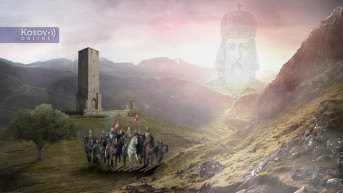
As Serbs in Kosovo gather again this year around their greatest holiday, faced with continuous pressures and attempts at revision and appropriation of cultural heritage, historians and local residents say that Vidovdan is deeply woven into the collective consciousness of the Serbian people, and that no decree or arrest can erase historical memory and the idea of freedom.
Written by: Milena Miladinovic
The celebration of Vidovdan in Gracanica and at Gazimestan has for years been accompanied by arrests over the display of Serbian symbols and the performance of songs.
Although the countries of the Quint, the European Union and EULEX recently stressed, in a letter addressed to the Kosovo authorities, that the use of flags and symbols is a constitutional right of communities, the Kosovo authorities continue, ahead of Vidovdan, to ban certain symbols, as well as certain words.
Only three days before Vidovdan, the Kosovo Police did not allow the installation of a billboard in Gracanica bearing the words “Zavet Vidovdana” — “The Vidovdan Covenant.” The billboard was later put up, but the word “zavet” — “covenant” or “vow” — was removed from it.
On the other hand, delegations from Montenegro and Republika Srpska were banned from entering Kosovo, while in North Mitrovica one person was fined for wearing a T-shirt with “elements that could cause an incident.”
Aware of the risks and pressures, Serbs from Kosovo, central Serbia, and countries of the region come in large numbers on 28 June to Gracanica and Gazimestan to mark Vidovdan. For the residents of Gracanica, that date represents a special solemn celebration that speaks to the importance of the holiday and its power to unite Serbs.
And while attempts at the revision of history have been present for years, historians emphasize that it is up to Serbs to preserve Vidovdan in their collective memory, because that, as they state, is its safest place.
Residents of Gracanica emphasized that Vidovdan represents gathering for them, and that for that reason it must not be allowed for the holiday to be relativized.
Zoran Stankovic from Livađe said that Vidovdan is a unique opportunity for a large number of people to visit Gracanica.
“Vidovdan means, above all, gathering. That is what I first associate it with, because this is a unique opportunity when a large number of people flock to Gracanica from other regions as well, when many of our fellow townspeople who were displaced long ago and left Kosovo come to pay their respects to Gracanica or to go to Gazimestan. So, above all, it is a gathering of the Serbian people. Secondly, it is one of the greatest solemn celebrations we have during the year, and one to which we are all in some way devoted. Therefore, in my opinion, the month of June is the most solemn month of the year,” Stankovic said.
Asked whether attempts to rewrite history can be noticed, Stankovic says that this has been a major problem for quite a long period of time.
“This has been happening for decades. I do not know how that problem will be solved, considering that it is very large and that we all know how the masses react. It is enough for one lie to be repeated several times for it to become the truth. That is why it will be very difficult,” he said.
He added that local residents preserve Vidovdan in their collective memory, but that they should do so even more.
“I think that we already do that to a great extent, but perhaps we could do more, especially our fellow citizens from central Serbia, who should come more often. What especially makes me happy is that I notice people coming from Republika Srpska, North Macedonia and other regions as well. Above all, we must achieve that through work with young people, pointing out to them our values, our holy places and our history,” he said.
For Miljan Slavkovic, Vidovdan represents Serbdom and something most beautiful that is marked in Gracanica.
“Vidovdan represents Serbdom. For me, it is the most beautiful and most important thing that we mark here in Kosovo. This year I am going to Gazimestan. I have not been for five years, because I was abroad for work, but this year I am definitely going, and I am very happy about that,” said this resident of Gracanica.
His fellow townswoman emphasized that it is shameful that Albanians are trying to present Serbian holy sites as their own, and said that Serbs who live in Kosovo must preserve them.
“Vidovdan is a great holiday for Serbs. And as for the fact that there are godless people among us as well, I can do nothing about that. They present all the holy sites as theirs, so where is our history? I know what I learned at school. What is being done is truly shameful. They are trying to do that, but if we allow them, they can succeed in it. We must preserve them,” she said.
The acting director of the Museum of Genocide Victims in Belgrade, Bojan Arbutina, emphasized that 28 June is the date on which Serbs essentially chose, as a people, how they would endure in the future, and that the best protection of Vidovdan from the revision of history, which has been present for years, is to preserve it within oneself, where, he adds, it is safest.
Arbutina told Kosovo Online that Vidovdan is the day on which the Serbian people unite.
“Vidovdan represents an important date in our history, in our collective past, and it is important both for Serbs in Kosovo and Metohija and for the entire Serbian people, because Vidovdan is the date around which we formed a covenant. It is the date on which we essentially chose, as a people, what we would be and how we would survive in the future, and it is certainly a date that continues to define us. Vidovdan is present throughout the entire Serbian people. It is an important identity-forming date, an important symbol of our people. It represents precisely one of those rare days in our history that unites the entire Serbian people, and one that needs to be celebrated and remembered for the sake of our future,” he said.
Arbutina emphasized that we are witnessing continuous attempts to rewrite history, but that everyone’s task is to preserve the importance of Vidovdan.
“We are continuously witnessing that. Not only when it comes to Vidovdan, but when it comes to our entire history. As someone who deals with the 20th century, I notice that tendency especially in the last few years. But through memory, conversations and various forms of the culture of remembrance, our task is precisely to preserve the importance of Vidovdan. When you look through history, from the Battle of Kosovo up to the present day, important turning points in our history have taken place on that date. Of course, various people and various experts, scholars — not only those who belong to the peoples surrounding us, but unfortunately also people from our own people — have tried to diminish the significance of Vidovdan. But we, as historians, lawyers, sociologists, and all of us who deal with social issues, have the responsibility to prevent that revision and to preserve Vidovdan in collective memory,” Arbutina said.
He believes that Serbs will best protect Vidovdan from appropriation in their own consciousness, because that is where it is safest.
“We can adopt various declarations, we can proclaim by various decrees that certain dates are important or unimportant, but until we plant Vidovdan deeply within ourselves, nothing will prevent either ourselves or others from completely erasing it. First of all, we should work on ourselves, on our own people, above all on our children, to pass on to them that covenant which has preserved us throughout the centuries of our existence in these lands. That is the strongest protection against any erasure of Vidovdan from our collective consciousness,” Arbutina said.
Historian and long-standing member of the Serbian Academy of Sciences and Arts Ljubodrag Dimic emphasized that we live in a time of attempts at a major revision of the past, in which other people’s cultural, scholarly and historical arguments and dates are being seized upon and subjected to unacceptable abuse. Because of this, he says, all significant dates from national history should be protected, and Vidovdan is one of them.
“As for the initiative to protect cultural heritage, it should certainly be supported. That is because we live in a time of a great revision of everything, especially the past, and in that revision of the past, other people’s cultural, scholarly and historical arguments and dates are being reached for, and a great, impermissible abuse is taking place, especially when the past is concerned. Therefore, all dates from national history should be protected. As for Vidovdan, of course, we always connect it with the Middle Ages, with the Battle of Kosovo, and with something that was at the same time both victory and defeat when it comes to the Serbian people, and which enabled the Serbian people to spiritually remember their magnificent medieval period. In a way, Vidovdan was the date when the Serbian people turned toward themselves and toward that memory,” Dimic told Kosovo Online.
He emphasized that almost all important historical events connected with Serbs took place on Vidovdan.
As he added, for that reason Vidovdan carries special weight for every generation, and it should not be viewed only as the past.
“It should be viewed as a moment in which we live today and as a cultural heritage that we must leave to the generations coming after us. But when history is concerned, everything connected with that date must be studied rationally and communicated rationally, without any mystifications, without any glorifications or mythologization. Everything else is disastrous, because it creates the possibility for us to lose ourselves in the time in which we live,” he said.
According to him, there are peoples — and their elites say this openly — who, if they had Vidovdan, would create a national revival and a firm foundation on the basis of which they would build their national culture, memory and identity.
“Vidovdan is one of those fundamental dates that Serbs possess, one that reminds them of what they were and compels them to be in the future what they ought to be. Vidovdan is something that enables everyone to look at themselves and face themselves, and to tell the truth to themselves, if not to others. We Serbs should ask ourselves how we treat our own past and in what way we trivialize what we have, and what we have is an unquestionable sign of our existence, our endurance, and our cultural contribution to what European culture is today,” Dimic stated.
Historian Momcilo Pavlovic said that Vidovdan evokes Kosovo, but also suffering, birth and the idea of freedom, and that while the regime in Priština arrests Serbs over various symbols during the marking of that holiday, an idea and consciousness cannot be arrested and mistreated; instead, such actions create natural resistance.
“Vidovdan is the most famous day in Serbian history. There is no such day where armies were defeated, where two emperors died, where heroism was demonstrated, where the Serbian empire and nobility were defeated, and yet, to this very day, in the consciousness of the Serbian people, wherever they may live, Vidovdan and Kosovo are intertwined into one event and one experience,” Pavlovic told Kosovo Online, pointing out that from the Battle of Kosovo, the erected marble pillars, and the monument to Prince Lazar on which, among other things, it says “fell for the Serbian land,” up to the present day, when Vidovdan is mentioned, one thinks of Kosovo.
But, as he adds, not only of Kosovo, but also of suffering, birth, the idea of freedom, and liberation.
According to him, the extent to which Serbs were devoted to Kosovo was shown in 1999.
“From 1999, with the entry of international forces, which entered by force and not by goodwill, the Serbian army withdrew, and with it more than 200,000 civilians, unarmed people, and with them history, remembrance and memory as well. To this day, a large part of that population has not returned. A form of occupying regime was created that supports Albanian separatism and nationalism in such a way that there is no place there for Serbs,” said our interlocutor.
As he stated, things have not changed significantly since 1999.
“Neither has a large number of people returned to Kosovo, nor has property that was usurped in one way or another been returned. At the same time, it should be said that the Albanian population also suffered, and their property was also usurped. So if all that is known, and if those relations are as they are, Vidovdan is a suitable day and holiday to consider not only the past, which cannot be changed, but also the future. Is it not better, more worthwhile and more logical to invest in peace, and not in conflicts and divisions? In other words, for 28 June at Gazimestan to be marked freely and with dignity, by whoever wishes — Serbs, Albanians, or anyone else — in the way in which that holiday was marked for centuries in the past, especially since 1912, when Kosovo was reoccupied from the Ottoman Empire,” the historian said.
Pavlovic said that Vidovdan has nothing to do with Albanians, but that the regime in Kosovo seeks to exert pressure on Serbs who wish to mark that holiday in a particular way and with particular symbols.
“The Battle of Kosovo and everything connected with Vidovdan has no essential connection with Albanians. They neither participated significantly, nor was it a battle between Serbs and Albanians, nor is national feeling in the 14th century the same as it is today. Nations are the product of the 19th century, and above all, a nation is not in the blood; a nation is in the head. Now you have this supported, young Albanian nationalism, which is turning into chauvinism, so that in Kosovo and Metohija there is simply no place for another people that inherits Kosovo and the entire past. Be that as it may, the current regime in Kosovo and Metohija, supported by international factors, is carrying out pressure against Serbs who would like to mark Vidovdan with a certain mural, billboard, poster, T-shirt or flag,” Pavlovic stated.
Although arrests of Serbs during the marking of Vidovdan have become frequent, Pavlovic says that consciousness and ideas cannot be arrested and mistreated.
“Those people have been arrested, detained, mistreated, and some convicted because of that. Some have been forbidden to display a flag or an ordinary slogan, ‘Zavet Vidovdana’ — ‘The Vidovdan Covenant.’ At the same time, it is forgotten that an idea and consciousness — and Vidovdan is in the consciousness of the Serbian people wherever they may live, as is Kosovo — cannot be arrested, cannot be mistreated, cannot be bombed; they remain and endure. Detention and mistreatment because of those ideas and because of that consciousness only provoke natural resistance and instability. In that sense, my opinion is that it is better to invest in peace, in some kind of togetherness, parallel life, and not in conflicts, mistreatment, or showing Serbs that they do not belong there and that they cannot mark any holiday or display their symbols,” Pavlovic said.
Regarding the initiative to have Vidovdan protected by UNESCO, the historian says that this is a complex issue.
“Vidovdan is a complex, multi-layered concept. So would we, for example, protect only the monument at Gazimestan, and both memorial complexes? But it would turn out that it is located in the territory of Kosovo, regardless of the fact that those monuments were built earlier. As for the spiritual sphere of heritage, Vidovdan is both a church and a folk holiday, and at certain moments also a state holiday. Therefore, how would that be formulated? How UNESCO bodies could put that issue on the agenda and make a decision is a topic for serious discussion,” Pavlovic added.



0 comments