
Who and where one will go from Kosovo after visa liberalization
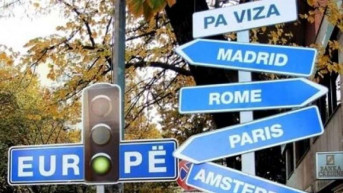
From January 1, 2024, it will be possible to travel to the EU without a visa with a Kosovar passport, and according to the estimates of Kosovo Online’s interlocutors, visa liberalization could turn out to be disastrous for Kosovo, because a large number of people will go to Germany, Austria, and Scandinavian countries, primarily from the medical and construction sectors.
In December 2021 and January 2022 alone, more than 105,000 citizens applied for a work visa at the German Embassy in Pristina, and thousands more applied at other embassies as well. We should not forget the statement of the head of the Union of Medical Technicians, Perparim Berisha, who believes that visa liberalization will contribute to the departure of health workers from Kosovo, which is why, he warns, there is a possibility that the quality of patient care will decrease.
Senior researcher at the NGO Aktiv Igor Markovic told for Kosovo Online that obtaining visa liberalization would only increase the departure of young people from Kosovo, but now through legal means.
"As the Kosovo migrant crisis of 2014 showed, when young people tried to leave Kosovo en masse in the absence of visa liberalization and a difficult economic situation, the search of young people for a place that will provide better living conditions is a constant, which in the later period will switch from illegal ways of going to Western Europe to legal ones, i.e. by applying for a visa. The promises that have been made by the European Union for years about possible visa liberalization have further frustrated the youth, which as a result has accelerated the process of the wave of young people leaving Kosovo," Markovic pointed out.
According to him, visa liberalization will be used by citizens of Kosovo whose relatives have been living and working in one of the EU countries for many years, higher education, medical and construction workers, as well as those employed in the IT sector.
"The first group of young people who will leave Kosovo is certainly the one who has a family base in the countries of the European Union and for whom the initial orientation will be made easier precisely because of the fact that their relatives will help them adapt to the conditions there and eventually find employment. The second group, which can contribute significantly weakening the quality of the Kosovo labor market, are young people who are highly educated and who can offer their abilities, skills and knowledge to employers in the most developed countries of Europe for much higher wages than those in Kosovo. As for the most sought-after occupations, medical workers will certainly be among the first to leave Kosovo , which are in demand in different parts of Europe. In addition to them, experienced construction workers will also have the opportunity to find work on construction sites across Europe. It should also be noted that young people who are employed in the IT sector, regardless of the post-pandemic culture of the so-called work from home, try to move and find new ones, or continue with existing business engagements," added Markovic.
As he stated, the Kosovo-Albanian diaspora is predominantly present in Germany and Switzerland, but we should not forget potential destinations such as Austria, the Netherlands and Sweden.
"I assume that the majority of young people who decide to leave Kosovo will head to these destinations. As I previously emphasized, the key factor in deciding on a destination will be family ties in those countries," Markovic concluded.
According to him, visa liberalization will be used by citizens of Kosovo whose relatives have been living and working in one of the EU countries for many years, higher education, medical and construction workers, as well as those employed in the IT sector.
"The first group of young people who will leave Kosovo is certainly the one who has a family base in the countries of the European Union and for whom the initial orientation will be made easier precisely because of the fact that their relatives will help them adapt to the conditions there and eventually find employment. The second group, which can contribute significantly weakening the quality of the Kosovo labor market, are young people who are highly educated and who can offer their abilities, skills and knowledge to employers in the most developed countries of Europe for much higher wages than those in Kosovo. As for the most sought-after occupations, medical workers will certainly be among the first to leave Kosovo , which are in demand in different parts of Europe. In addition to them, experienced construction workers will also have the opportunity to find work on construction sites across Europe. It should also be noted that young people who are employed in the IT sector, regardless of the post-pandemic culture of the so-called work from home, try to move and find new ones, or continue with existing business engagements," added Markovic.
As he stated, the Kosovo-Albanian diaspora is predominantly present in Germany and Switzerland, but we should not forget potential destinations such as Austria, the Netherlands and Sweden.
"I assume that the majority of young people who decide to leave Kosovo will head to these destinations. As I previously emphasized, the key factor in deciding on a destination will be family ties in those countries," concluded Markovic.
Analyst Nexhmedin Spahiu believes that young people from Kosovo could go to Germany, Switzerland, Austria and Scandinavian countries in the largest number after receiving visa liberalization.
"In this process, the Balkan countries, and especially Kosovo, which is the most underdeveloped country in the Balkans, is exposed in the process of the outflow of young people to the West, because there have already been introduced mechanisms for a better life, for human rights, higher salaries, safety and security. So young people from Kosovo will mostly go to those western countries and they will fill the "holes" in their societies. Such "holes" will appear here in the Balkans as well, due to the lack of personnel," said Spahiu.
According to him, young people from the West are opting for "easy" professions, such as economics and politics, so all professions where it is necessary to invest effort remain without workers.
"Western civilization is dying in a way, because for young Westerners, for example, it becomes a shame to be doctors, engineers, or to perform all those functions that require effort, and then those functions are taken over by others. For a while, the Balkans will do it, and then Indians and Chinese, because no one will deal with it, it means that in the period of 50 to 100 years the world will be under the rule of Indians and Chinese. Even the political power in which the west dominates the world will disappear. This is a sign that the western civilization is on sunset," Spahiu pointed out.
According to him, the departure of young people from Kosovo is also influenced by the social environment.
"A society like Kosovo, where there is a lot of injustice, there is no security, health insurance, where the courts and institutions do not function, is the reason why people are looking for a better life. Also, many people who graduate from universities with plagiarism find employment, while those who those who graduate with knowledge cannot get a job and work in the profession, so they go to Germany and other countries, because there those who are the best have an advantage," Spahiu said.
He pointed out that the normalization of relations between Kosovo and Serbia would give hope for a short time that things would get better, but that in any case the departure of young people would be a big problem for Kosovo in the future.
"The fear is justified, perhaps the departure will decrease a little if in the meantime an agreement is reached with Serbia, that would instill hope for a better future. If stabilization does not occur, visa liberalization will be disastrous for Kosovo. A million people means nothing to the West, anyway they need manpower, that would be a problem for Kosovo," Spahiu concluded.



0 comments