
Who is better prepared for a new showdown – Self-Determination or the opposition?
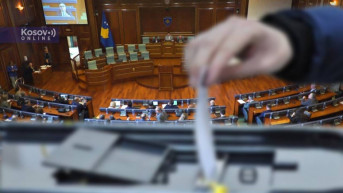
Extraordinary elections are now the most likely option following Albin Kurti’s failure to secure the necessary number of votes in parliament to form his third government. Which party is most prepared for a new election round is a matter of differing opinions among Kosovo Online’s interlocutors. Some argue that local elections will give momentum to the opposition, while others believe that Kurti’s party is in a better position for another parliamentary contest since being in a caretaker mandate has continuously given it an advantage over the opposition.
Written by: Dusica Radeka Djordjevic
After yesterday’s debacle of Self-Determination leader Albin Kurti, who fell five votes short in the Assembly of becoming prime minister for the third time, both analysts and politicians predict that forming a new government is now merely a theoretical possibility and that early elections are inevitable.
Researcher at the Kosovo Democratic Institute, Vulnet Bugaçku, said that although early elections are the best way to overcome the political deadlock, procedurally there is still room to form a government.
“According to the Constitutional Court’s ruling, the president is required to make maximum efforts within ten days to call consultations with the parties and determine whether there is a possibility of reaching a political compromise, either for an inclusive or a technical government, since there are important laws that need to be adopted by the Assembly, such as the Budget Law and international agreements. However, considering the political statements, there is nothing left to do but call early elections,” Bugaçku stated.
These elections are expected in December, though they would not necessarily guarantee faster government formation than after those on February 9, since results are expected to be similar.
Political analyst Astrit Gaši believes that the new showdown at the polls will not produce a significantly different outcome, as no party will win more than one percent more than last time.
Political analyst Shkëlzen Maliqi says it is hard to say which party is most ready for elections, but notes that in the local elections the Democratic Party of Kosovo (PDK) managed to preserve its electorate, making it likely to again be the second-largest party.
“I think the Democratic Party of Kosovo fared best in the local elections, keeping its voters. They have about 120,000 consistent supporters, which guarantees that in the general elections they will likely again be at least the second party. As for other parties, I don’t know. Kurti’s party and Kurti himself are in decline—how large that decline will be, I can’t tell. Their approach has been demagogic and populist,” Maliqi told Kosovo Online.
He does not rule out the possibility that Self-Determination and PDK might form a coalition in the future, if, as he says, Kurti tones down and agrees to negotiate with that party.
“Perhaps we should wait for the second round of local elections to see what the results will be. There are about 12 municipalities where Self-Determination is first or second, and it has small chances to win two or three more municipalities. The main battles will be for Pristina and Mitrovica. Kurti has heavily invested in Mitrovica, and if he loses it—and he might also lose Pristina—then he’ll be left with very little local power,” Maliqi noted, adding that judging by the current situation, Kosovo will most likely go to parliamentary elections in December.
Historian Stefan Radojkovic said that in the next two weeks it will be clear whether a new government headed by the Democratic Party of Kosovo, which came second on February 9, will be formed. If that does not happen, he too expects elections in December.
According to him, party rankings will depend on the results of the second round of local elections on November 9, where the strength of all Albanian parties, both opposition and ruling, will be measured.
“Self-Determination will remain the strongest Albanian political party, but with an insufficient number of votes to form a government alone or even with minority support. The same applies to the Albanian opposition parties, which have strongholds and voting bases in certain parts of Kosovo and Metohija but also cannot form a government even through coalition agreements,” Radojkovic told Kosovo Online.
He pointed out the irony that in both scenarios the votes of the Serb List could help either the opposition or Self-Determination form a government at the central level, but since interethnic relations are so strained, it is unlikely that Albanian parties will consider that option.
In Radojkovic’s assessment, despite everything, Self-Determination is currently the most prepared for elections.
“As a party, they reach into the voter bases of all other parties. They are not limited to urban or rural areas but penetrate all segments of Albanian-Kosovar society. Moreover, the fact that they are in power, albeit in a technical mandate, gives them an advantage over the opposition parties, which may be strong locally but lack control of ministries and therefore the same access to resources and infrastructure. Self-Determination’s voters will not easily withdraw their support, which remains stable—unless there is a major shift, especially in the relationship between the U.S. administration and Albin Kurti’s government,” he emphasized.
He concluded that after the second round of local elections it will be clearer what the coalition potential of Kosovo’s political parties is.
“The focus should be on Pristina, southern Mitrovica, and Prizren. These will largely indicate the coalition potential of Self-Determination. It seems to me that it is close to zero, while the coalition potential of other Albanian parties is likely greater, though still insufficient to form even a simple majority, let alone a two-thirds one,” Radojkovic assessed.
ournalist from North Mitrovica Lazar Stevic believes that Kosovo’s caretaker Prime Minister Albin Kurti will receive less support in the new elections than in the previous ones.
According to him, opposition parties are better prepared for elections, while international actors—especially the Quint countries—are hoping for change.
He said the international community, particularly the United States, is dissatisfied with cooperation with the current Kurti government and desires political change in Pristina.
“Serbs also wish for a new government with which dialogue and resolution of issues—both in the north and the rest of Kosovo—would be possible,” Stevic told Kosovo Online.
He believes that despite social measures and wage increases, Kurti has lost part of the citizens’ trust due to the poor economic situation and mass emigration.
“All actions that Kurti undertook in the north against Serbs caused us great harm. It is noticeable that even in the south, he has not opened any new factories or created new jobs. He tried social programs, raised wages, but the economic situation remains difficult despite the government’s claims to the contrary. Thousands of discontented Albanians have left Kosovo in the last three to four years for Europe,” Stevic stressed.
He added that Self-Determination’s popularity has significantly declined, both at parliamentary and local levels.
“Since the last parliamentary elections, Albin Kurti and his Self-Determination have seen a considerable drop in support and popularity. They failed to achieve notable results in the local elections already held, and now face a tough battle in the second round against the strongest opposition parties, PDK and LDK, which have strengthened and taken power in many municipalities,” Stevic said.
According to him, the biggest winner in the past year has been the opposition.
“The Democratic Party of Kosovo and the Democratic League of Kosovo achieved significant results in both the previous parliamentary and local elections, so we expect them to benefit the most this time. Whether a coalition will form remains to be seen. They cannot form a government on their own—they will need support from the third-placed party, the Alliance for the Future of Kosovo (AAK) of Ramush Haradinaj, which is in coalition with NISMA, while the Serb List, with its nine MPs, will also play an important role in the Assembly,” Stevic stated.
He believes that the Serb List is currently the best-prepared political force for the upcoming elections.
“The Serb List demonstrated in the previous elections that it is the most organized. Wherever they ran, they won an absolute majority. I expect them to reaffirm their dominance in Serb communities in the next elections as well. As for the Albanian parties, we have seen Self-Determination’s weaknesses, while the leaders of LDK and PDK have already expressed readiness to go to elections,” Stevic concluded.
In yesterday’s Assembly vote for the new cabinet proposed by nominee Albin Kurti, 56 MPs voted in favor out of the required 61. Fifty-two were against, and four abstained.
The Constitution of Kosovo stipulates that if the government proposed by the nominee fails to receive a majority, the president, within ten days, must appoint another nominee who then has 15 days to propose a cabinet. If the government again fails to be elected, the president must call elections to be held within 40 days.


comments