
Who is imagining a fundamental agreement between the SOC and Pristina?
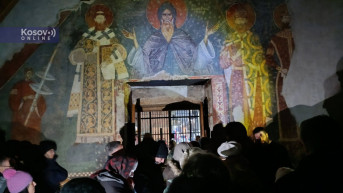
The Serbian Orthodox Church (SOC) has strongly denied claims that negotiations are underway to conclude a Fundamental Agreement with Pristina. Whether spin or “fake news,” interlocutors of Kosovo Online say these are “monstrous, historical lies” and yet another blow to the Serbian Church where it hurts most – Kosovo.
Written by: Djordje Barovic:
Certain media outlets reported claims that negotiations were taking place involving Serbian Patriarch Porfirije and Backa Bishop Irinej to conclude a Fundamental Agreement between the SOC and Kosovo. This information quickly went viral, and even a purported draft of such a document was published, stating that “the contracting parties confirm that the SOC and Kosovo, each within its own field of activity, are independent and autonomous, and undertake to respect this principle in their relations.”
In its response, the SOC called this slander in the service of “Kurti’s cabal.”
“Those who conceived and circulated such slanders against the Church wish, in the service of Kurti’s cabal, to further destabilize the Serbian people in Kosovo and Metohija,” the SOC statement said.
The Raska-Prizren Diocese, in an additional denial, stated that there is no “text, draft, or proposal” concerning the SOC’s status in Kosovo.
“No text, draft, or proposal dealing with the status of the Serbian Orthodox Church as a ‘contracting party’ in relation to the Government of Kosovo has ever existed, nor does it exist in any process of consideration within any SOC body—be it the Holy Assembly or the Holy Synod—nor has it ever been submitted to His Holiness the Patriarch or to the Raska-Prizren Diocese,” the Diocese stated.
Clear Position of the SOC
Former coordinator of the Legal Council of the Metropolitanate of Montenegro and the Littoral, who took part in negotiations on the Fundamental Agreement between the SOC and Montenegro, Archpriest-Stavrophore Dr. Velibor Dzomic, told Kosovo Online that although the SOC has agreements regulating its position with several regional countries, that “model” is in no way applicable to Pristina due to the Church’s clear stance on Kosovo.
“Even the birds on the branches know this is not a topic in the SOC. There are no negotiations on an alleged Fundamental Agreement, nor could the model applied in Montenegro—in which I personally took part—or in Croatia, Slovenia, Bosnia and Herzegovina, or Hungary, be applied here. The SOC has concluded several Fundamental Agreements with states, and you know what its position is on Kosovo and Metohija. Anyone with even minimal knowledge of the Church and its stance on Kosovo and Metohija knows that this is blasphemy, fabricated to alarm our people in Kosovo and Metohija—those wonderful heroes who remain there, preserving their faith,” Dzomic said.
He called the allegations a “monstrous historical lie” aimed against the Patriarch, the Synod, and the Assembly of the SOC, as well as against the Serbian people in Kosovo.
“This entire construction—this monstrous, historical lie—about an alleged Fundamental Agreement between the SOC and the so-called Republic of Kosovo serves the purpose of fighting against the SOC, worsening the position of Serbs in Kosovo and Metohija, the clergy, monastics, and SOC institutions in Kosovo and Metohija,” Dzomic stated, calling on all that “if you cannot help the Serbs and the SOC in Kosovo, at least do not harm them.”
For Dzomic, the key issue for Serbs in Kosovo is “the question of survival and continued existence.”
“What can we talk about if our Serbian woman from Djakovica cannot move about freely? The right to life, existence, education, and work—these are the key issues at this moment. Of course, the SOC has existed for centuries in Kosovo and Metohija—with or without the state, sometimes under occupation in the past and today. It stands firm, founded on the living faith in the Risen Lord Jesus Christ, in the Gospel, in our all-encompassing tradition,” he emphasized.
A Matter of Logic
A good connoisseur of Kosovo’s (dis)realities, journalist and writer from Gracanica, Zivojin Rakocevic, told Kosovo Online that “on the ground” there are not even “signals” of alleged negotiations between the Serbian Orthodox Church (SOC) and Pristina on a Fundamental Agreement.
He stressed that “you cannot talk about rights when all your rights have been taken away.”
“As far as we here on the ground know, there is not the slightest indication that such negotiations or ‘signals,’ diplomatic activities, are taking place in this field so that one could talk about agreements, documents, papers… On the other hand, the key issue is a matter of logic. Why would this need to be done, and why would the SOC need it? That is the first question with which both the SOC and the Serbian people in Kosovo and Metohija logically collide,” Rakocevic emphasized.
He reminded that Kosovo is the central point for the SOC, which makes it “absolutely impossible” to consider a Fundamental Agreement with Pristina.
“When we say SOC, we mean a thousand years of continuity and life, of uninterrupted presence, with Kosovo and Metohija as the central point. These are not dead numbers, but a living experience from which the SOC has never emerged as a loser. That is why it is absolutely impossible to think about any kind of Fundamental Agreement,” Rakocevic stressed.
He recalled that under the Ahtisaari Plan, later incorporated into the Constitution of Kosovo, the SOC was granted certain “expanded rights,” but the main problem is that they are, for the most part, not implemented, and the same model applies to the rights of Serbs in Kosovo.
“You cannot talk about rights when all your rights have been taken away or when they are threatened in various ways. What kind of discussion could that be if a liturgy is served among the ruins of the Church of the Holy Virgin of Hvosno, or if the hermitage of Saint Peter of Korisa near Prizren is demolished, or if your very existence is questioned? From that perspective, it is rather meaningless to speak even about drafts and ideas, and the information we have shows that such a thing, in fact, does not exist,” Rakocevic emphasized.
He explained that the SOC and Serbs in Kosovo face “three levels of ongoing problems.”
“The first is the disappearance of the state of Serbia in every possible form, as the goal of Pristina. The second level is the scope of attacks on the SOC, which is so broad and deep that it ranges from the hermitage of Saint Peter of Korisa somewhere in the Sar Mountains, to the violation of property rights of the largest monasteries and the prevention of the Patriarch from coming to Kosovo and Metohija,” Rakocevic said.
As the “third level” of endangerment of the Serbian community in Kosovo, he pointed to “innocent people in prisons.”
“This third level is particularly dangerous because it essentially undermines life itself in Kosovo and Metohija. And that life says to itself: ‘Am I next?’ If we know that someone from our immediate surroundings is innocent, yet has been in prison for three years, then we say: ‘God, am I next? And what about me?’ You come to a situation where, when you have these three levels, all these rumors, pseudo-rumors, and bits of information circulating from various sides actually hit the weakest the hardest and affect their sense of security,” Rakocevic stressed.
He said that Serbs in Kosovo have therefore developed “a particular form of resistance.”
“In the ghetto-like environments in which Serbs in Kosovo and Metohija live, a type of resistance has developed that simply says: ‘It is their time, and I do not have to listen to everything coming from all sides. I will somehow manage to filter the information that endangers me and that, at some point, makes me wonder whether our survival is possible,’” Rakocevic explained.
An Attack on Church Unity
For Belgrade University Faculty of Philosophy professor and sociologist Vladimir Vuletic, the claims about alleged preparations for signing a Fundamental Agreement between the SOC and the authorities in Pristina represent an attempt to break the unity of the Serbian Church and its stance on Kosovo.
He stressed that the Fundamental Agreement is essentially not a church matter, but a political one.
“When you see who is named as the alleged SOC negotiator, you realize this is a continuation of what I would call a special war not only against the Patriarch but against the unity of the Church. In every way, there is an attempt, both among the clergy and especially among the faithful, to create the impression that the Church is divided, split, and acting against the interests of Serbs and Serbia. This is just another way to continue that special war,” Vuletic said.
He noted that the SOC pays special attention to everything happening in Kosovo, and destabilizing it on that issue would be most damaging.
Commenting on the potential signing of such an agreement, Vuletic said it “has little to do with the Church.”
“The Church has its own goals, its own independent policy. Many governments have changed, many state frameworks have come and gone, but the Church has always had its own stance and position toward Kosovo and Metohija and toward its own organization. Therefore, this is not essentially a church matter,” he stressed.
According to him, only after a “political settlement” could the Church enter into talks on resolving certain issues.
Vatican or Mount Athos Models
Historian Aleksandar Gudzic believes that due to the increasingly difficult circumstances, it is necessary to secure guarantees for the normal functioning of the SOC in Kosovo, modeled on the Vatican or Mount Athos.
“This is not about a document like the Fundamental Agreement, but about trying to safeguard the very survival of both the Serbian Church and the Serbian people in Kosovo and Metohija,” Gudzic said.
He stressed that the international community must play a key role, and that any agreement with the Pristina authorities is out of the question because “they are champions in failing to respect even their own laws and Constitution.”
“What is needed here is international assistance, not only from Western democracies that look favorably upon Pristina’s unilateral moves but also from states that do not look favorably on the self-proclaimed independence of Kosovo,” Gudzic added.
In his view, the SOC should be granted a permanent solution that has proven effective elsewhere: “The examples of the Vatican or Mount Athos have produced results,” he concluded.
0 comments